

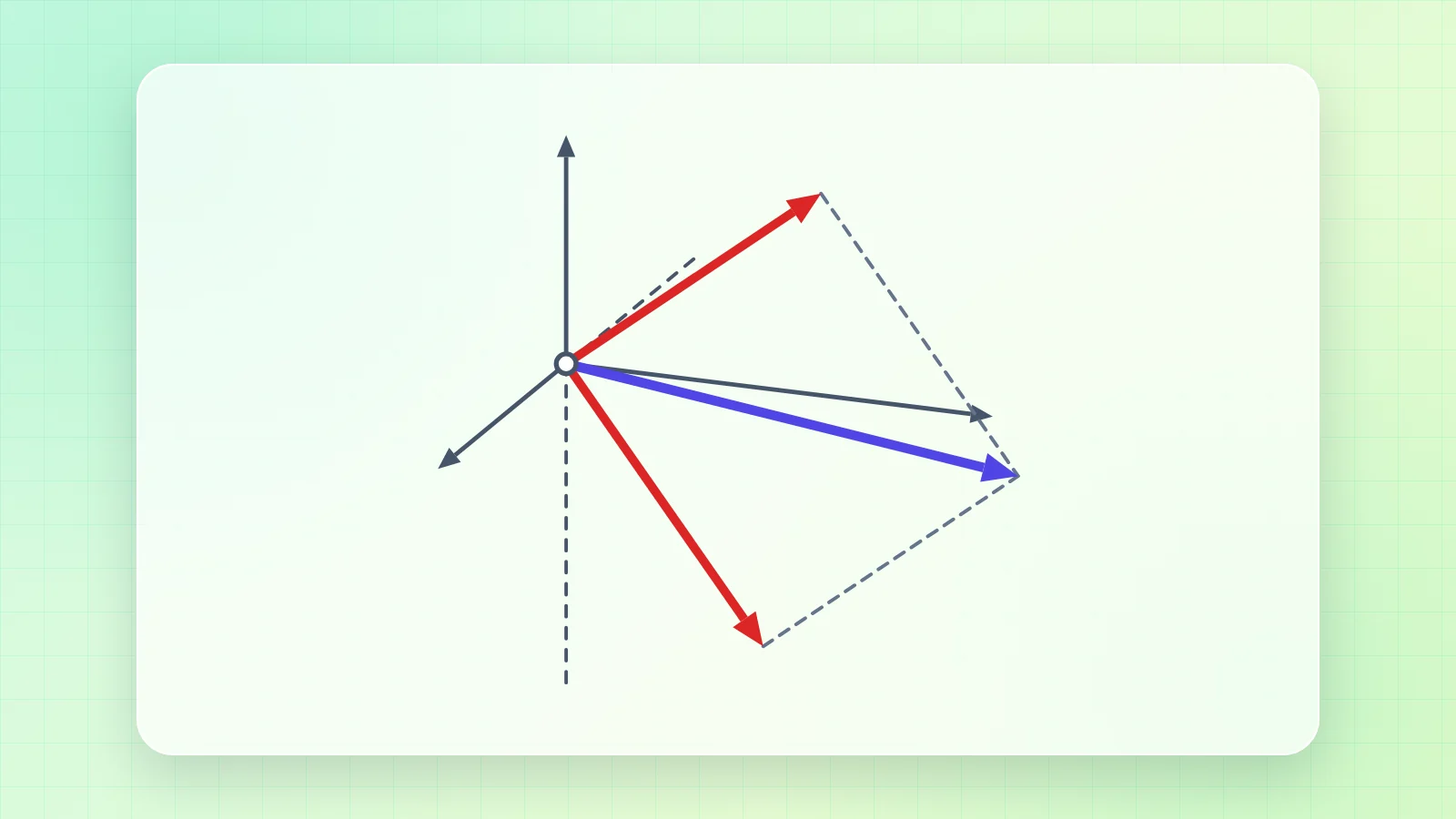

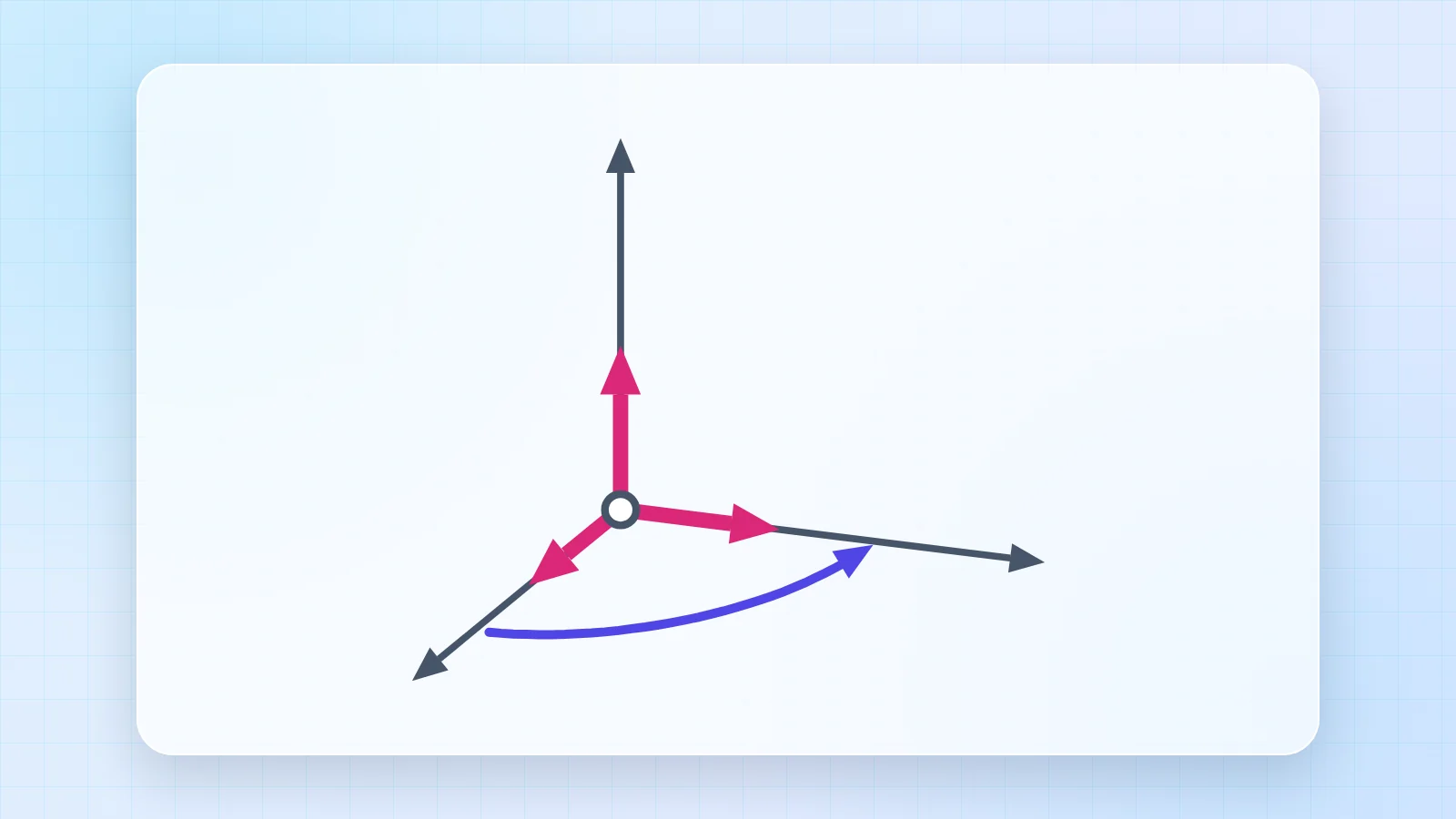
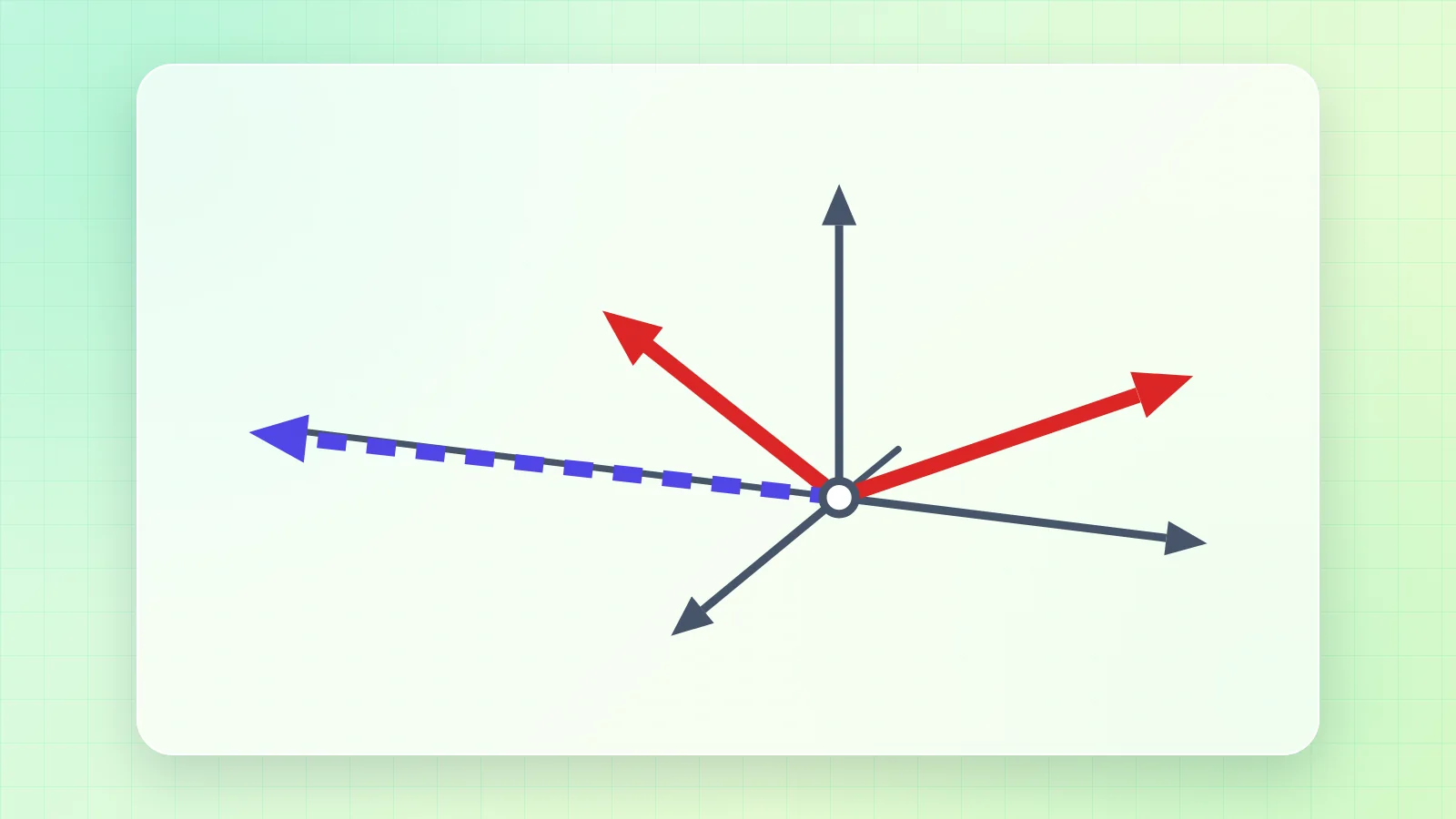
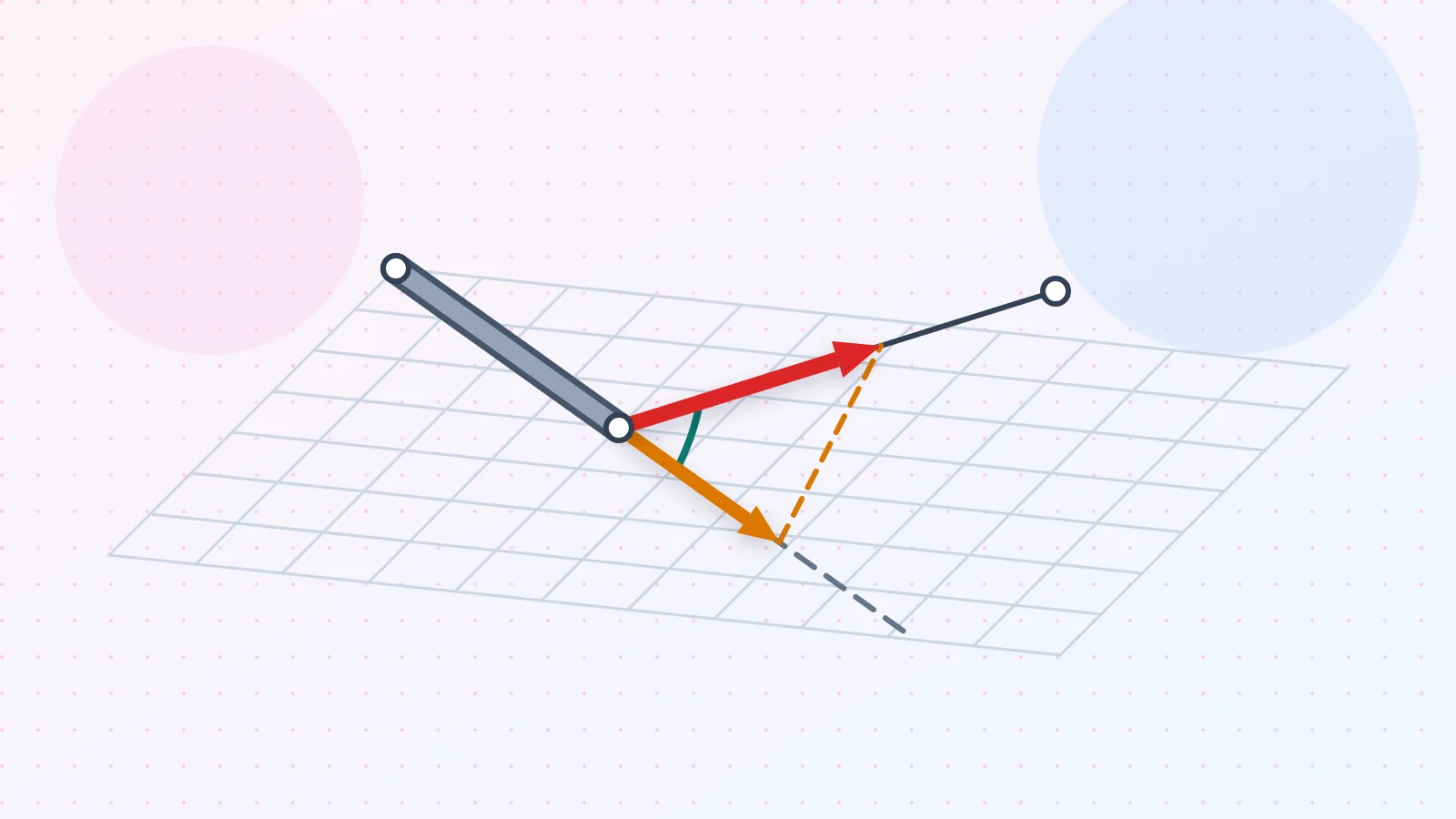
Concurrent forces in space are added exactly as in the plane: write each force as a Cartesian vector, add the components, then find the magnitude and direction of the sum. The only change is a third component.
1. Adding Cartesian vectors
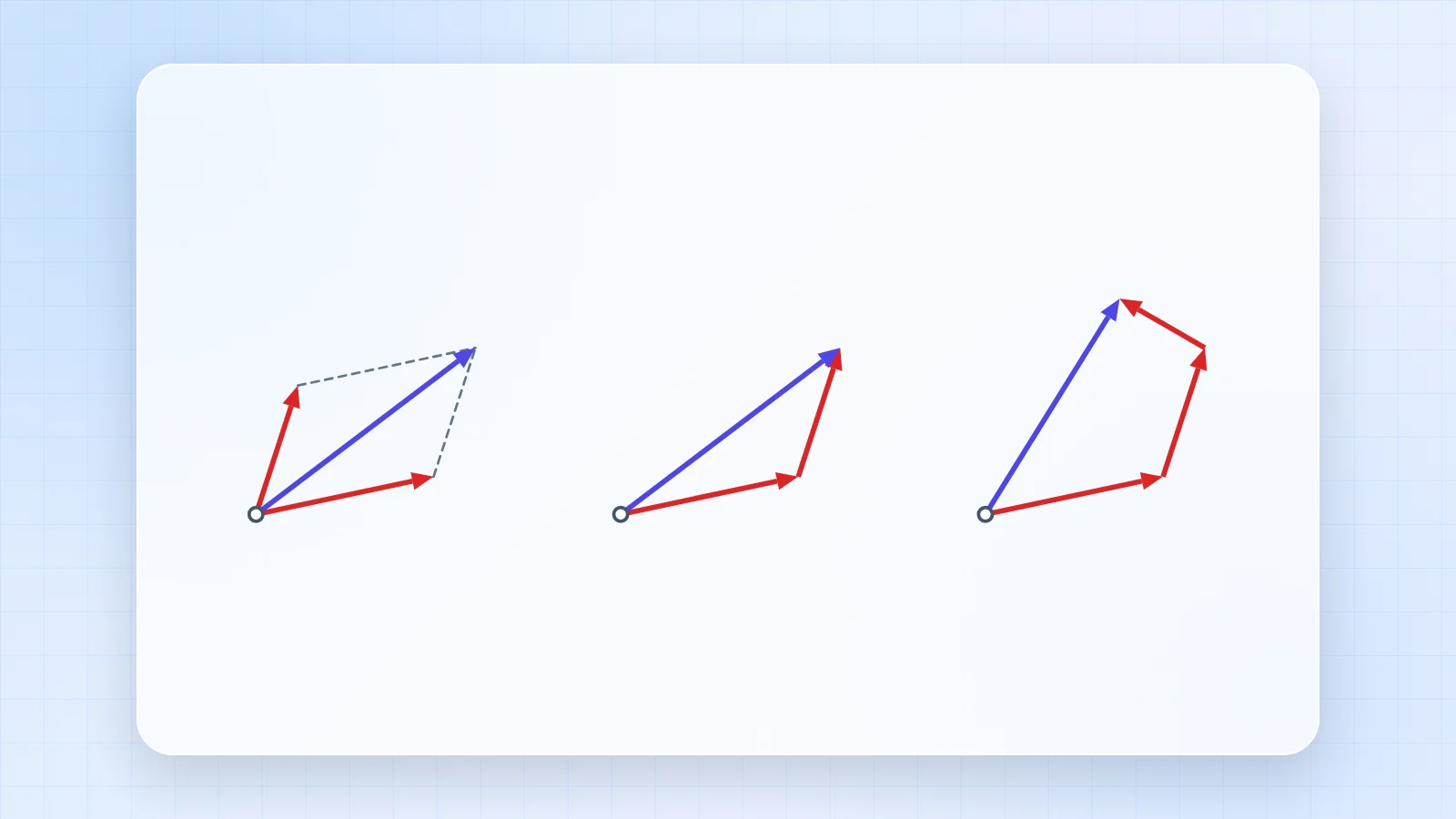
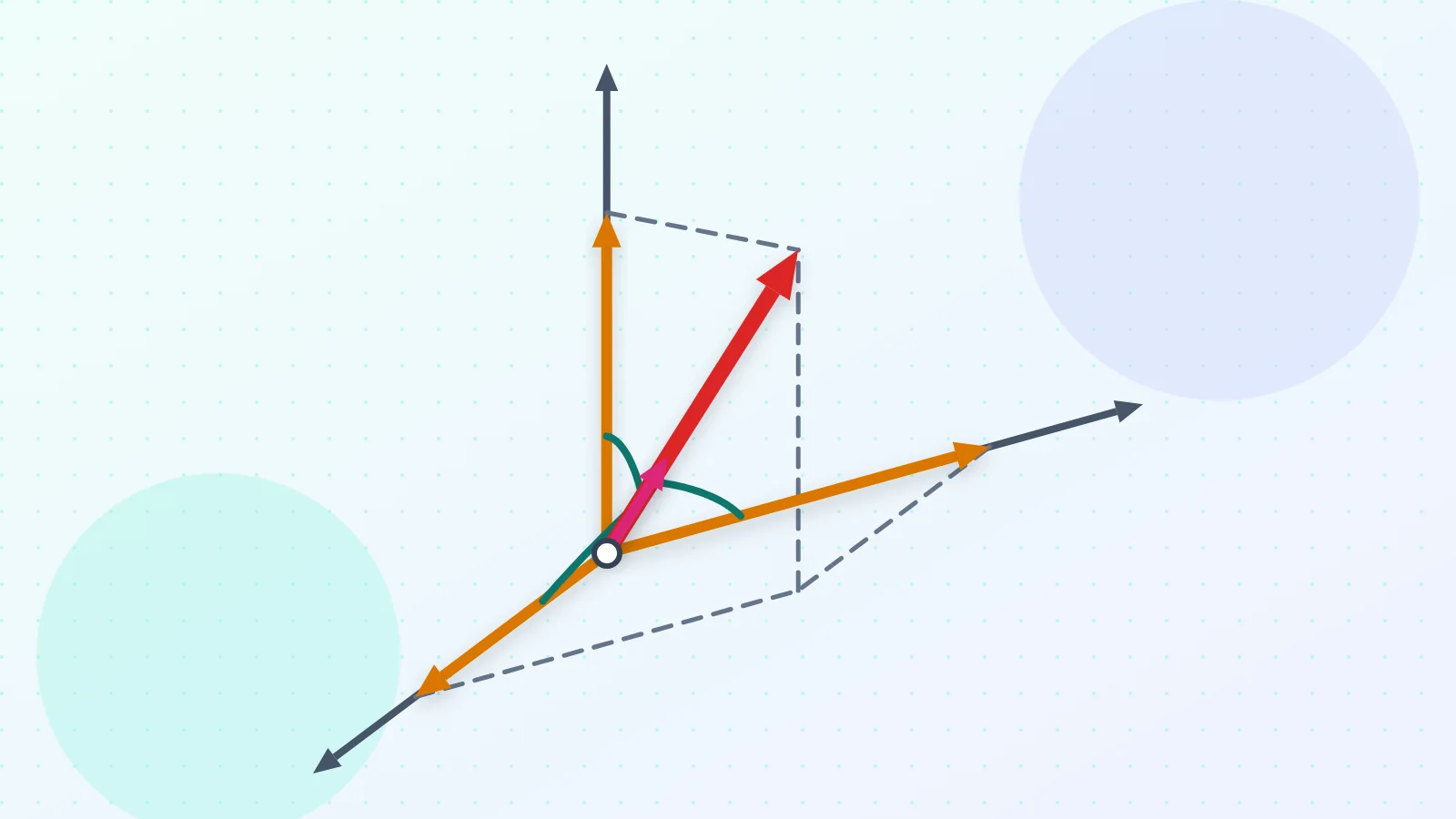
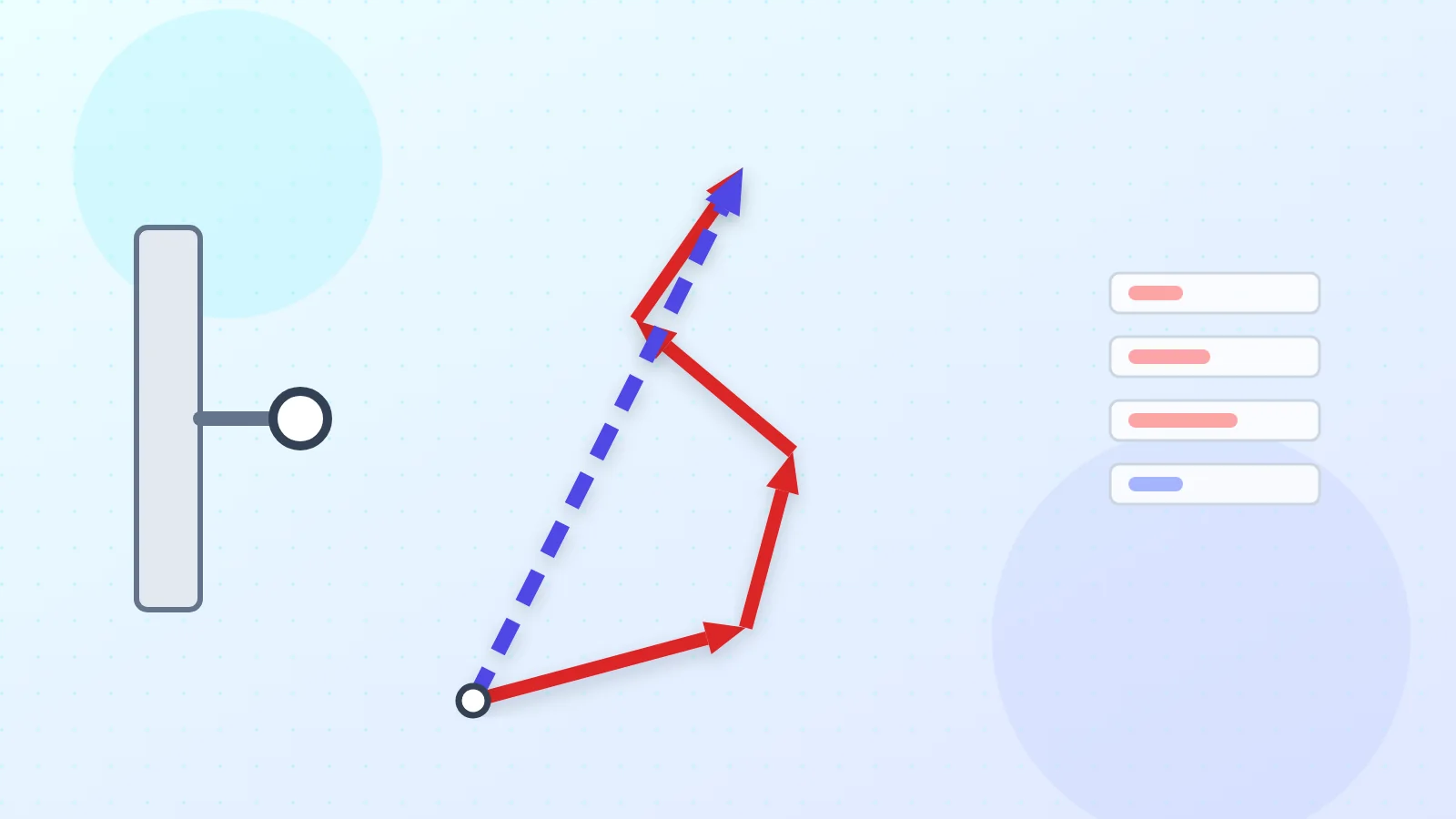
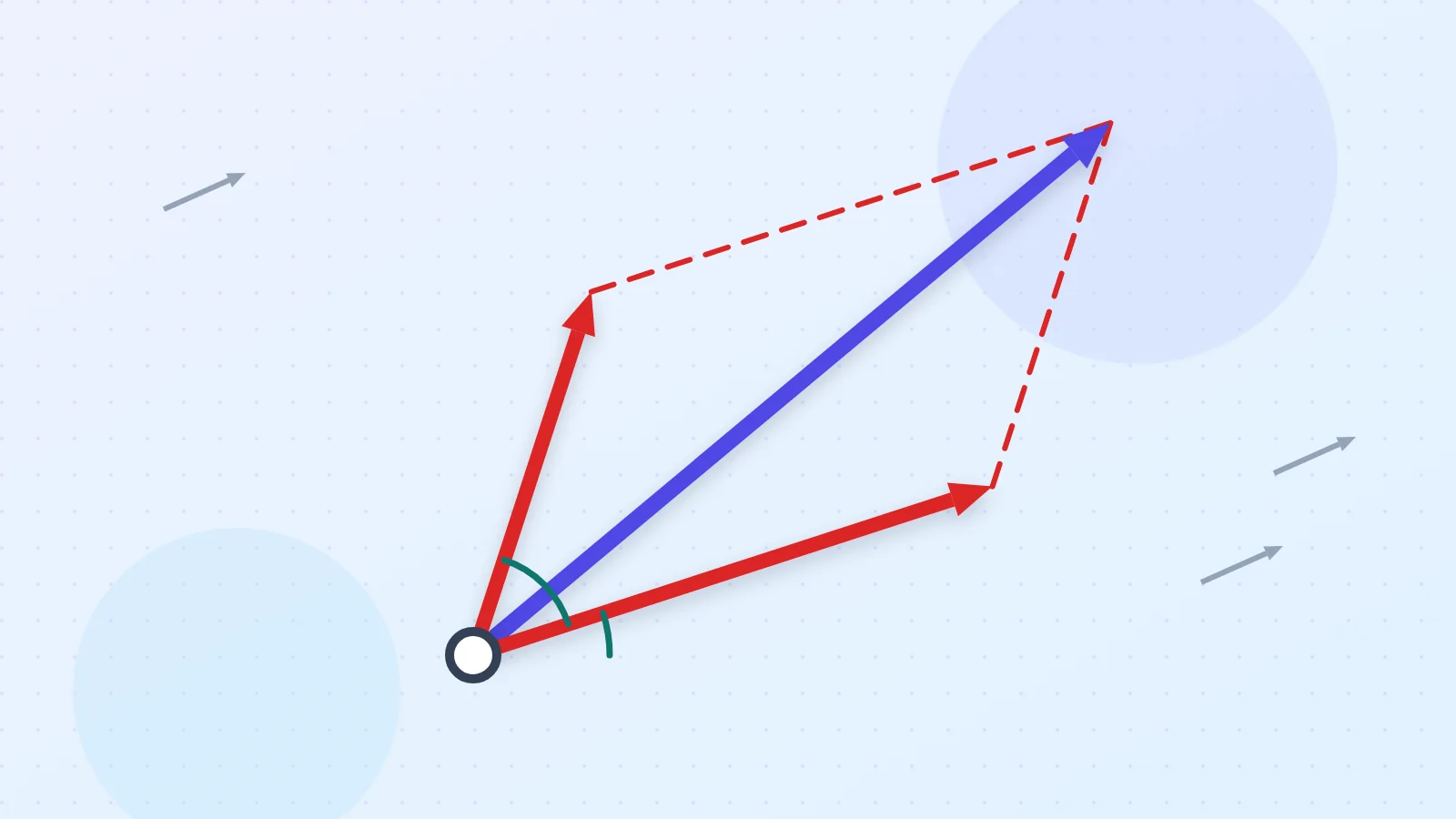
The resultant of concurrent forces is their vector sum. Since terms with the same unit vector add, each component of the resultant is the sum of the corresponding components:
Subtraction works the same way, component by component. The magnitude and the direction angles of \(\mathbf{F}_R\) follow from its components:
2. Procedure
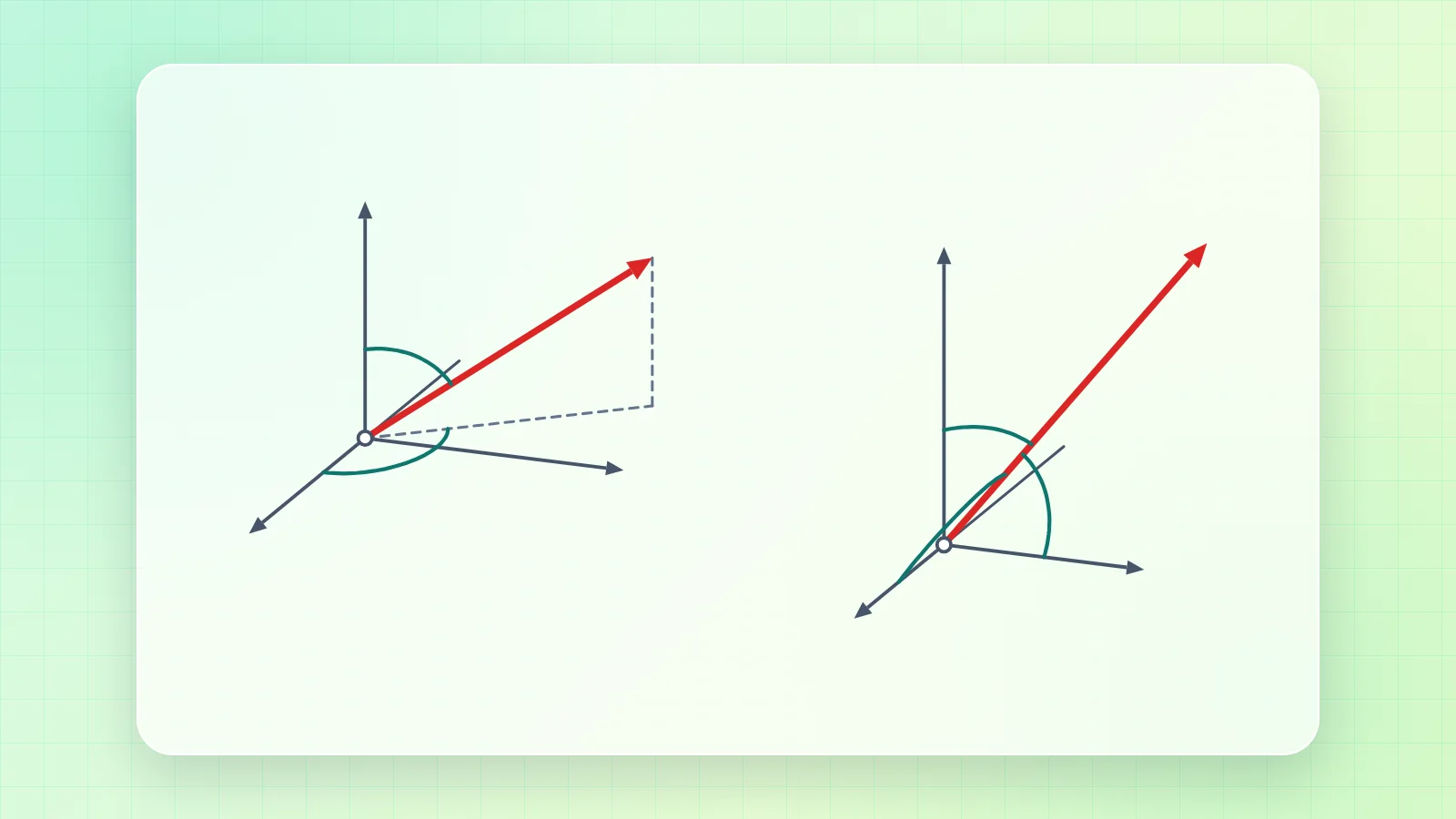
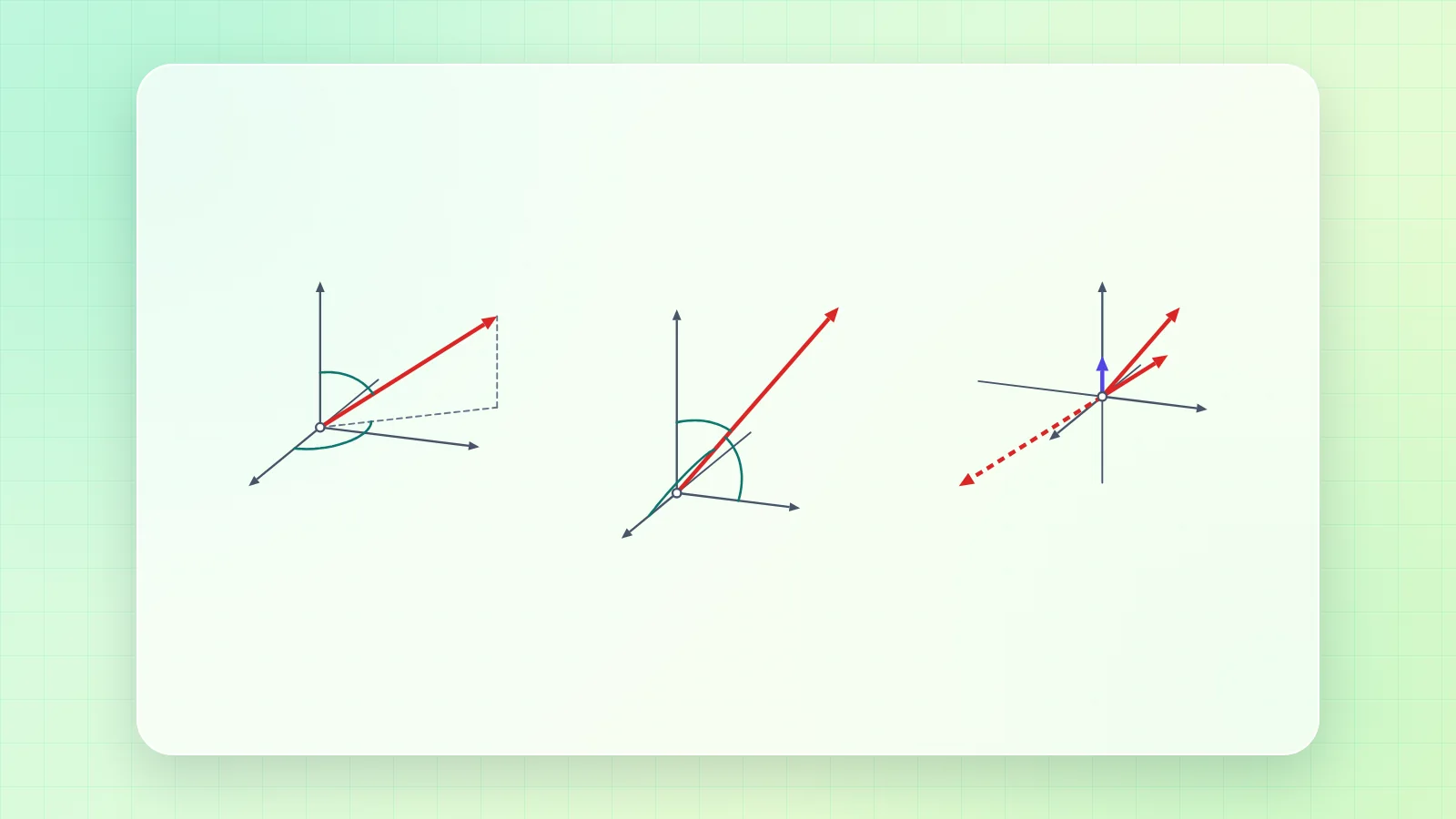
- Write each force as a Cartesian vector. Use its components directly, its direction angles (\(\mathbf{F} = F\,\mathbf{u}\)), its two angles \(\theta\) and \(\phi\), or two points on its line of action.
- Add the components in a table with one column each for \(x\), \(y\) and \(z\).
- Find the magnitude of the resultant with Equation 2.
- Find the direction angles and check that their cosines squared add up to 1.
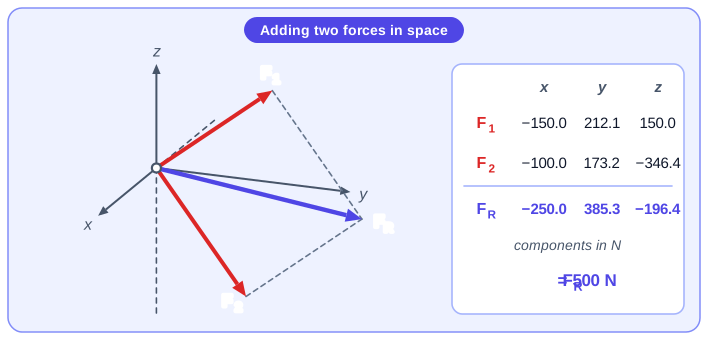
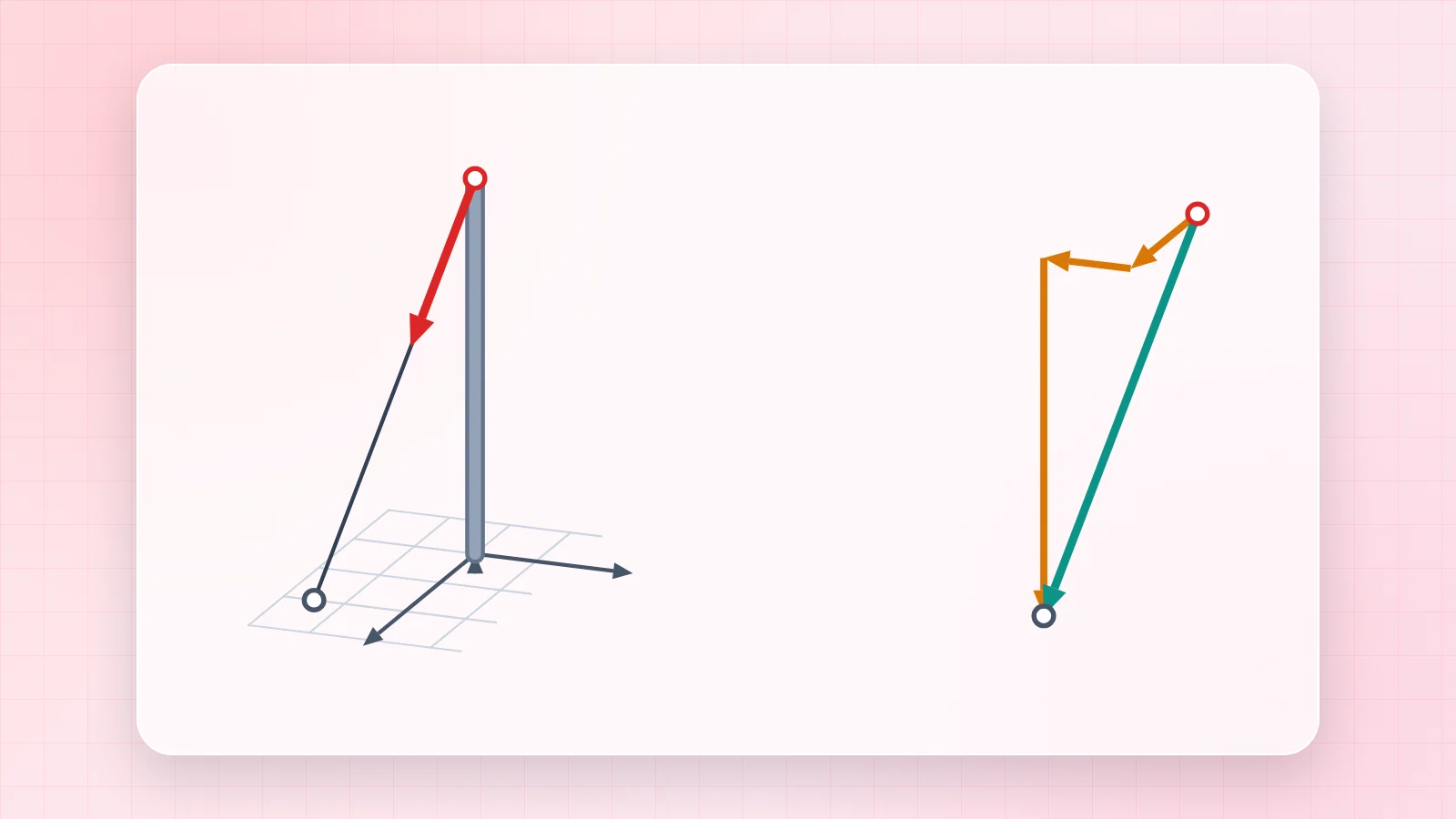
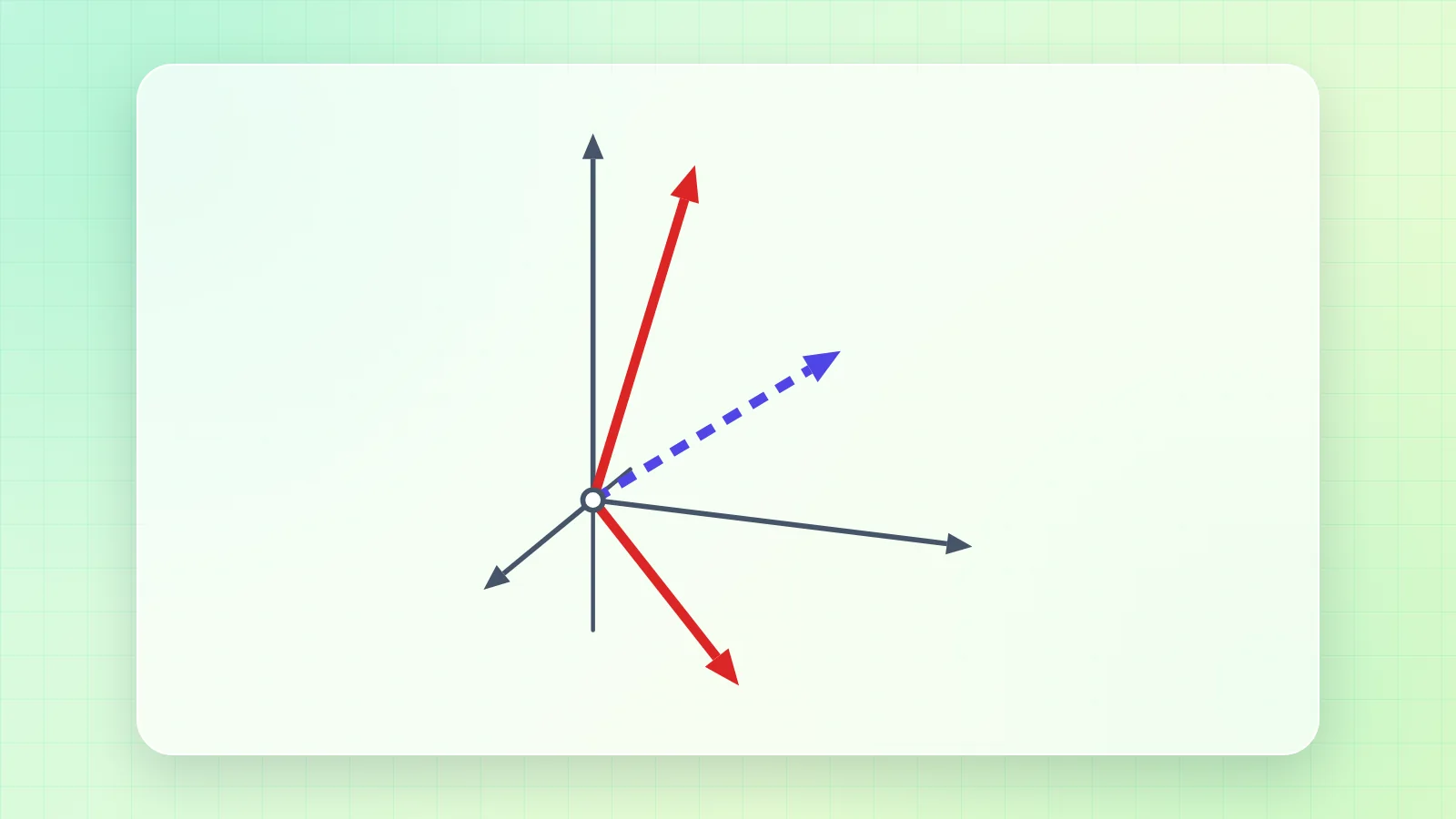
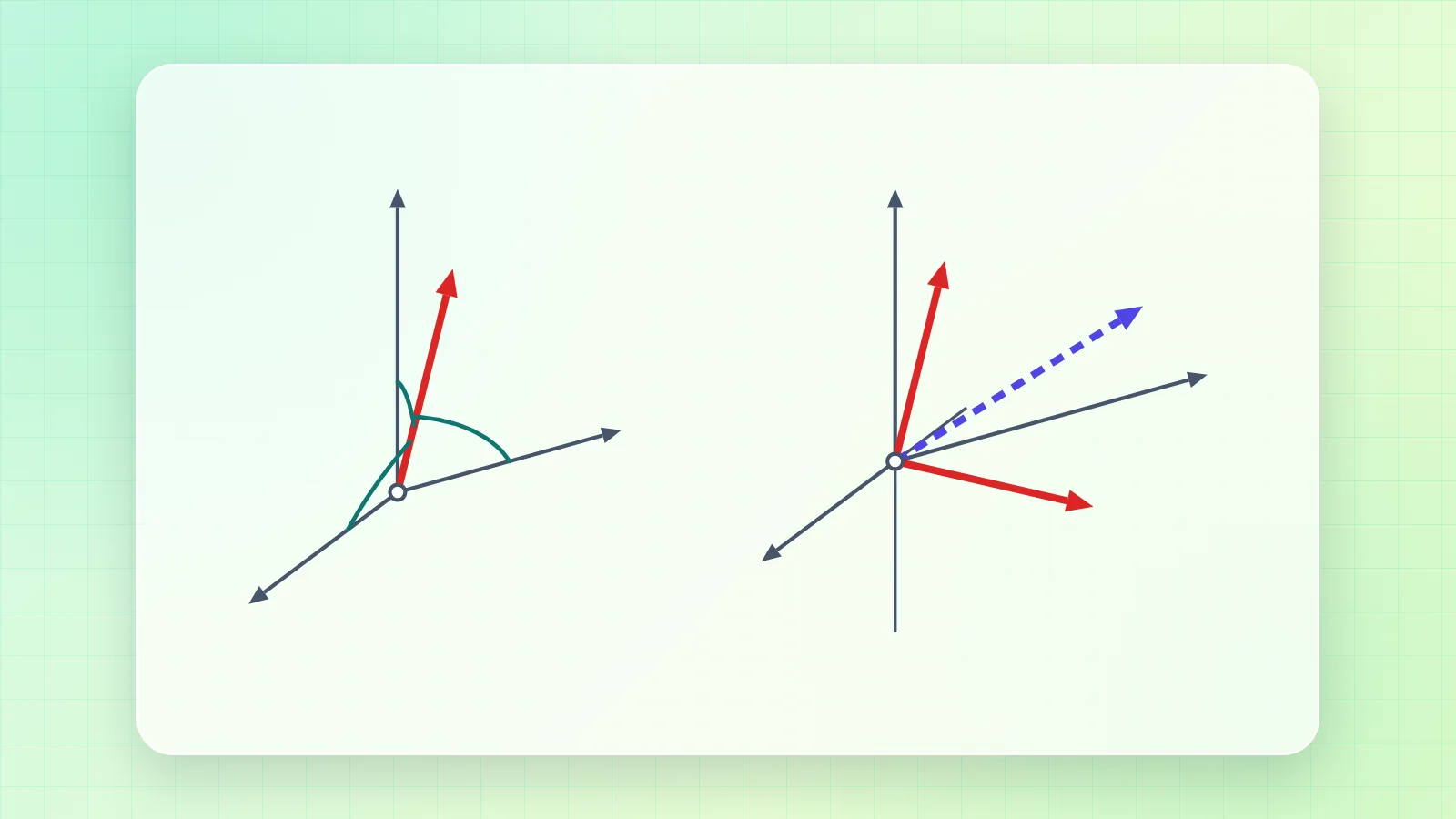
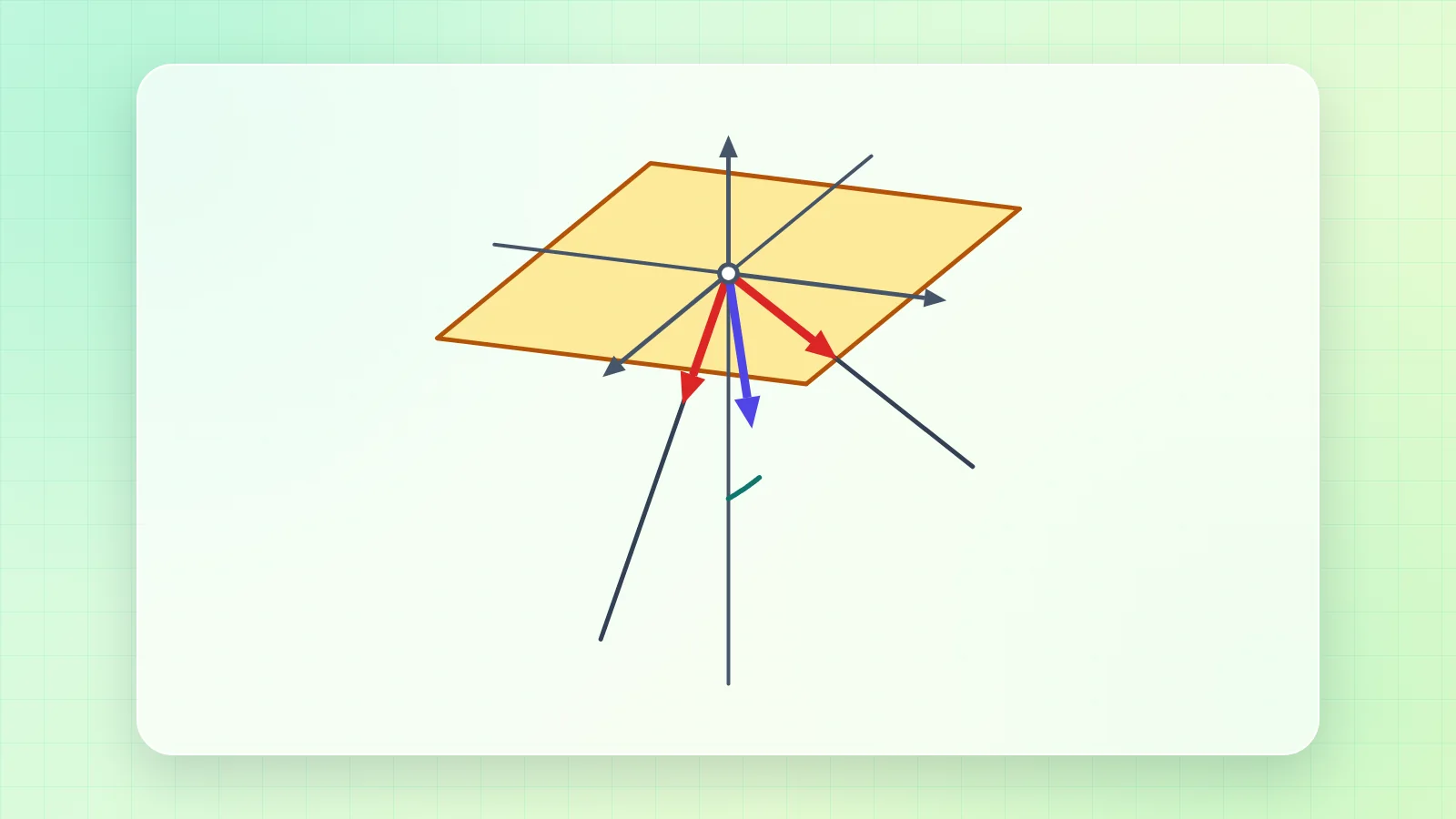
Two forces on a bracket. \(F_1 = 300\,\text{N}\) has direction angles \(\theta_x = 120^\circ\), \(\theta_y = 45^\circ\), \(\theta_z = 60^\circ\). \(F_2 = 400\,\text{N}\) has \(\theta = 120^\circ\) in the \(xy\) plane and \(\phi = 150^\circ\) from \(+z\). Find the resultant (Figure 1).
Force 1, from its direction angles:
$$ \mathbf{F}_1 = 300(\cos 120^\circ\,\mathbf{i} + \cos 45^\circ\,\mathbf{j} + \cos 60^\circ\,\mathbf{k}) $$
so \(\mathbf{F}_1 = \{-150.0\,\mathbf{i} + 212.1\,\mathbf{j} + 150.0\,\mathbf{k}\}\,\text{N}\).
Force 2, from its two angles: vertically, \(F_{2z} = 400\cos 150^\circ = -346.4\,\text{N}\) and \(F_2' = 400\sin 150^\circ = 200.0\,\text{N}\); in the \(xy\) plane, \(F_{2x} = 200.0\cos 120^\circ = -100.0\,\text{N}\) and \(F_{2y} = 200.0\sin 120^\circ = 173.2\,\text{N}\). So \(\mathbf{F}_2 = \{-100.0\,\mathbf{i} + 173.2\,\mathbf{j} - 346.4\,\mathbf{k}\}\,\text{N}\).
Sum:
$$ \mathbf{F}_R = \{-250.0\,\mathbf{i} + 385.3\,\mathbf{j} - 196.4\,\mathbf{k}\}\,\text{N} $$
Magnitude and direction. \(F_R = \sqrt{250.0^2 + 385.3^2 + 196.4^2} = 499.6\,\text{N}\), so \(\theta_x = \cos^{-1}(-250.0/499.6) = 120.0^\circ\), \(\theta_y = \cos^{-1}(385.3/499.6) = 39.5^\circ\) and \(\theta_z = \cos^{-1}(-196.4/499.6) = 113.2^\circ\).
Answer. \(F_R = 500\,\text{N}\) with \(\theta_x = 120.0^\circ\), \(\theta_y = 39.5^\circ\), \(\theta_z = 113.2^\circ\).
3. Unknown forces from a known resultant
Equation 1 contains three scalar equations, one per axis. When the resultant is prescribed, they can be solved for up to three unknowns, such as the three components of one force, or a magnitude and two angles.
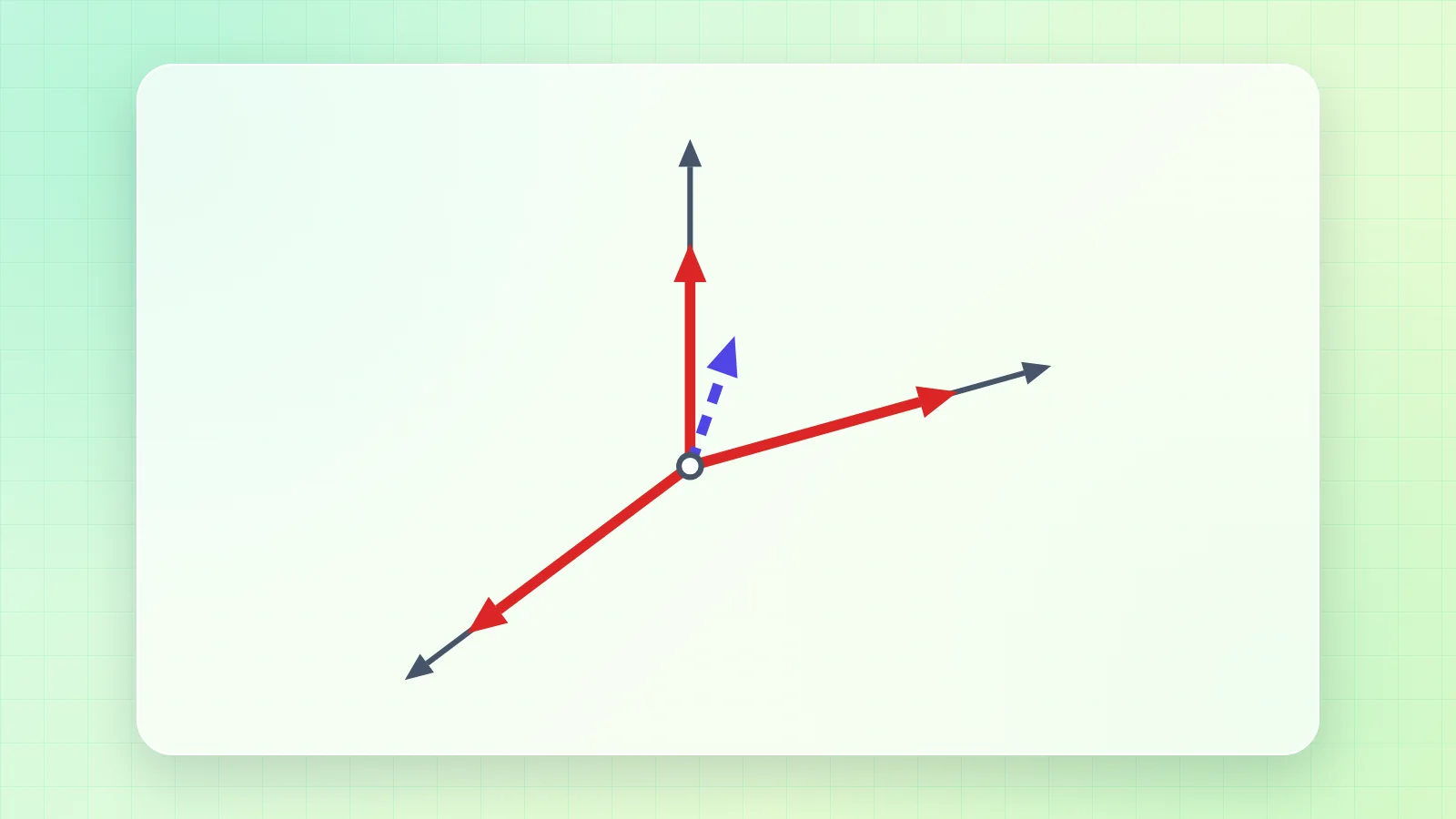
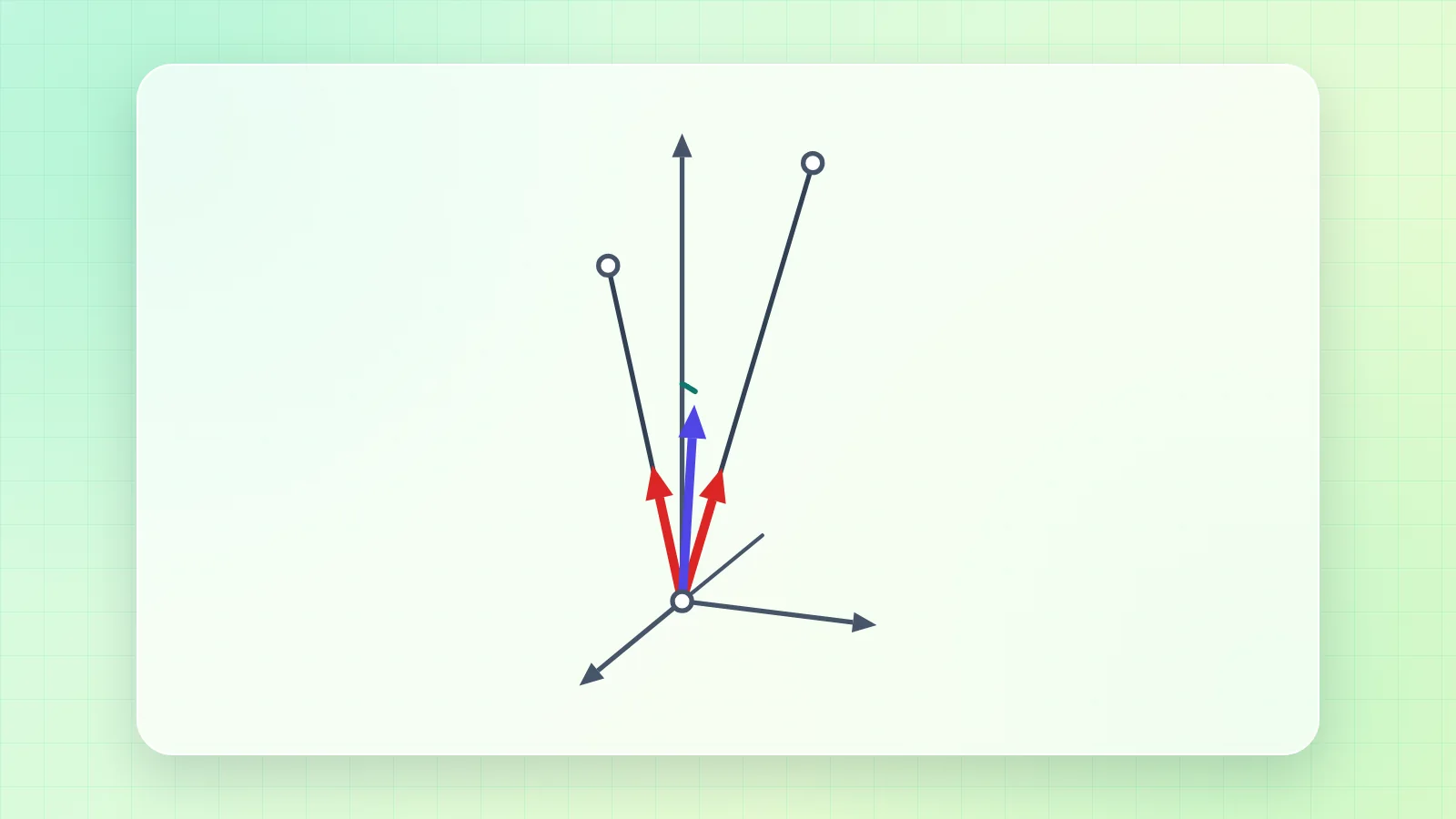
A third force. A third force \(\mathbf{F}_3\) is added to the bracket of Example 1 so that the resultant of all three becomes \(\{800\,\mathbf{j}\}\,\text{N}\). Find \(\mathbf{F}_3\).
Solution. Solve the vector sum for the unknown force and use the sum \(\mathbf{F}_1 + \mathbf{F}_2\) from Example 1:
$$ \mathbf{F}_3 = \mathbf{F}_R - (\mathbf{F}_1 + \mathbf{F}_2) = 800\,\mathbf{j} - (-250.0\,\mathbf{i} + 385.3\,\mathbf{j} - 196.4\,\mathbf{k}) $$
so \(\mathbf{F}_3 = \{250.0\,\mathbf{i} + 414.7\,\mathbf{j} + 196.4\,\mathbf{k}\}\,\text{N}\).
Answer. \(F_3 = \sqrt{250.0^2 + 414.7^2 + 196.4^2} = 523\,\text{N}\), with \(\theta_x = 61.4^\circ\), \(\theta_y = 37.5^\circ\), \(\theta_z = 67.9^\circ\).
4. Checks
- The direction cosines of every force and of the resultant satisfy \(\cos^2\theta_x + \cos^2\theta_y + \cos^2\theta_z = 1\); small rounding differences are fine.
- A negative component means a direction angle larger than \(90^\circ\).
- The resultant is never larger than the sum of the magnitudes of the forces.
Summary
- Add concurrent forces in space component by component: \(F_{Rx} = \sum F_x\), \(F_{Ry} = \sum F_y\), \(F_{Rz} = \sum F_z\).
- Get the magnitude from the three components and the direction angles from the direction cosines.
- Write every force as a Cartesian vector first, whatever form its direction is given in.
- The three component equations can be solved for up to three unknowns.








Comments 0
Ask questions, explain a step or share a tip about this note.
Join the discussion
Log in to comment, reply and vote. It is free.
No comments yet
Ask a question, share a tip or say thanks. Be the first!