


Resolving a force along two perpendicular axes, \(x\) and \(y\), gives its rectangular components. They turn vector addition into ordinary addition of numbers, which is why almost every statics problem uses them.
1. Rectangular components
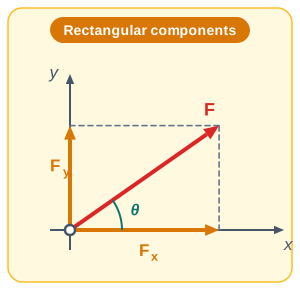
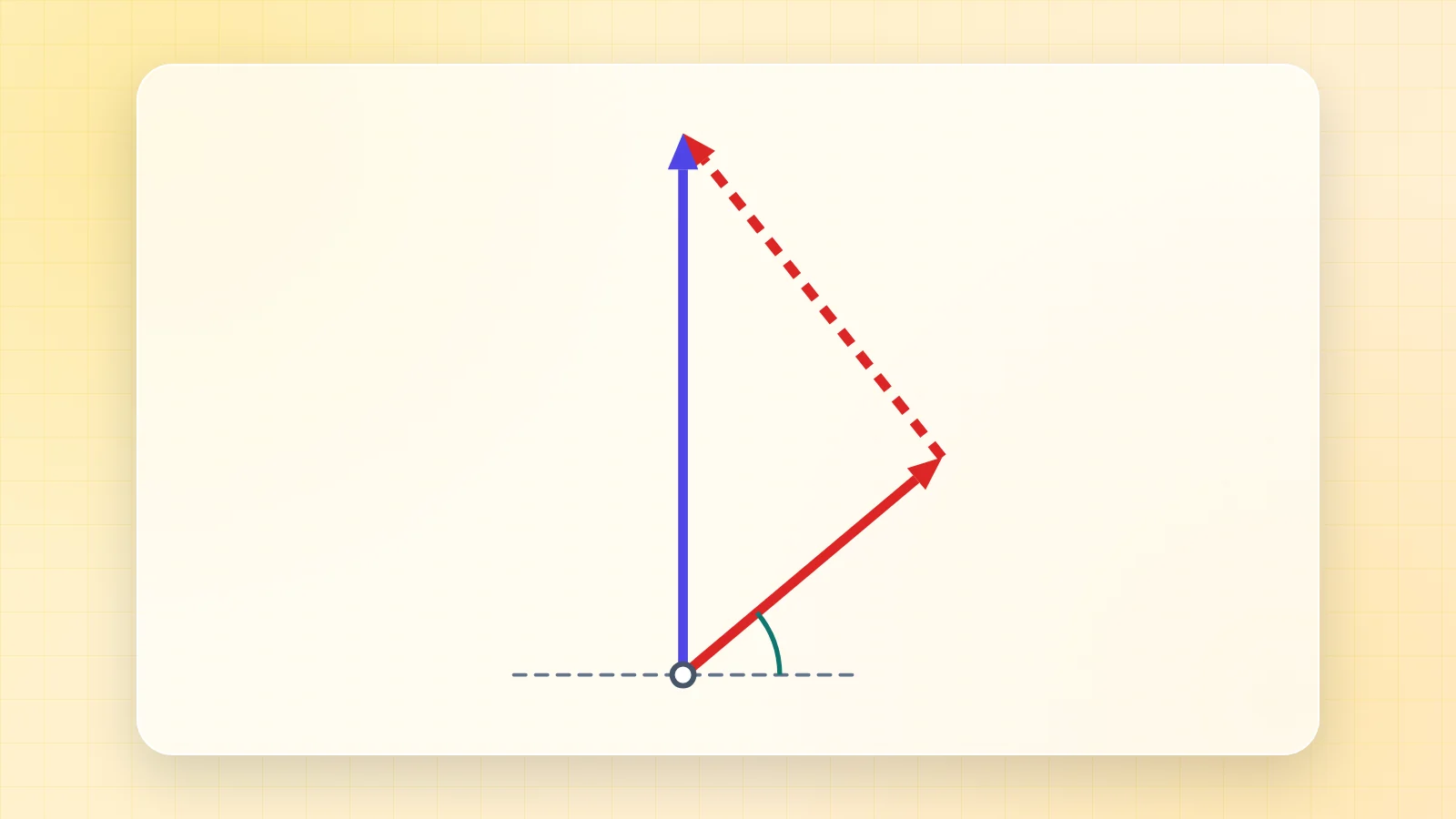
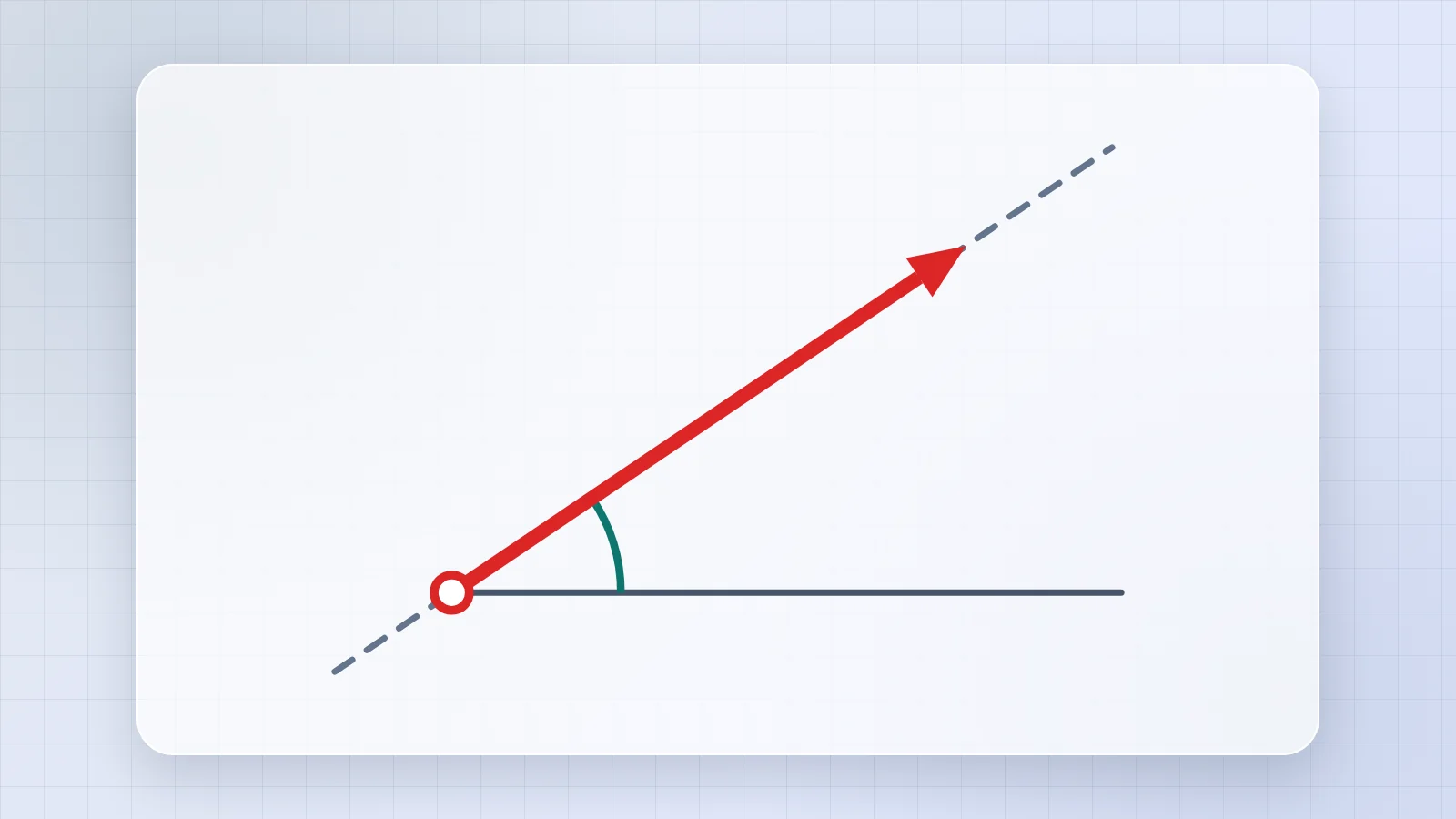
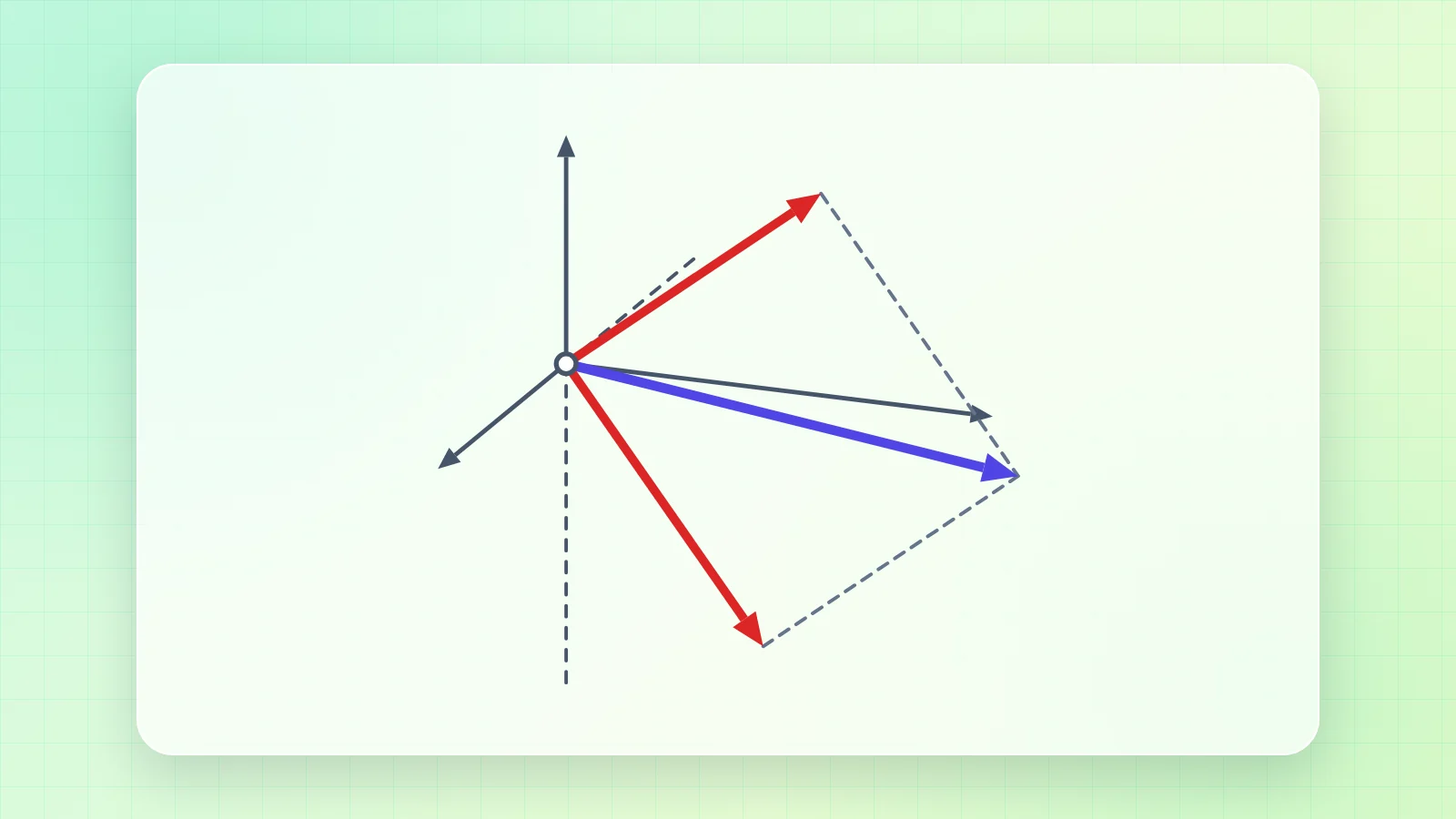
On perpendicular axes, the parallelogram of the components becomes a rectangle (Figure 1). If \(\theta\) is the angle between \(\mathbf{F}\) and the \(x\) axis, the components follow from the right triangle:
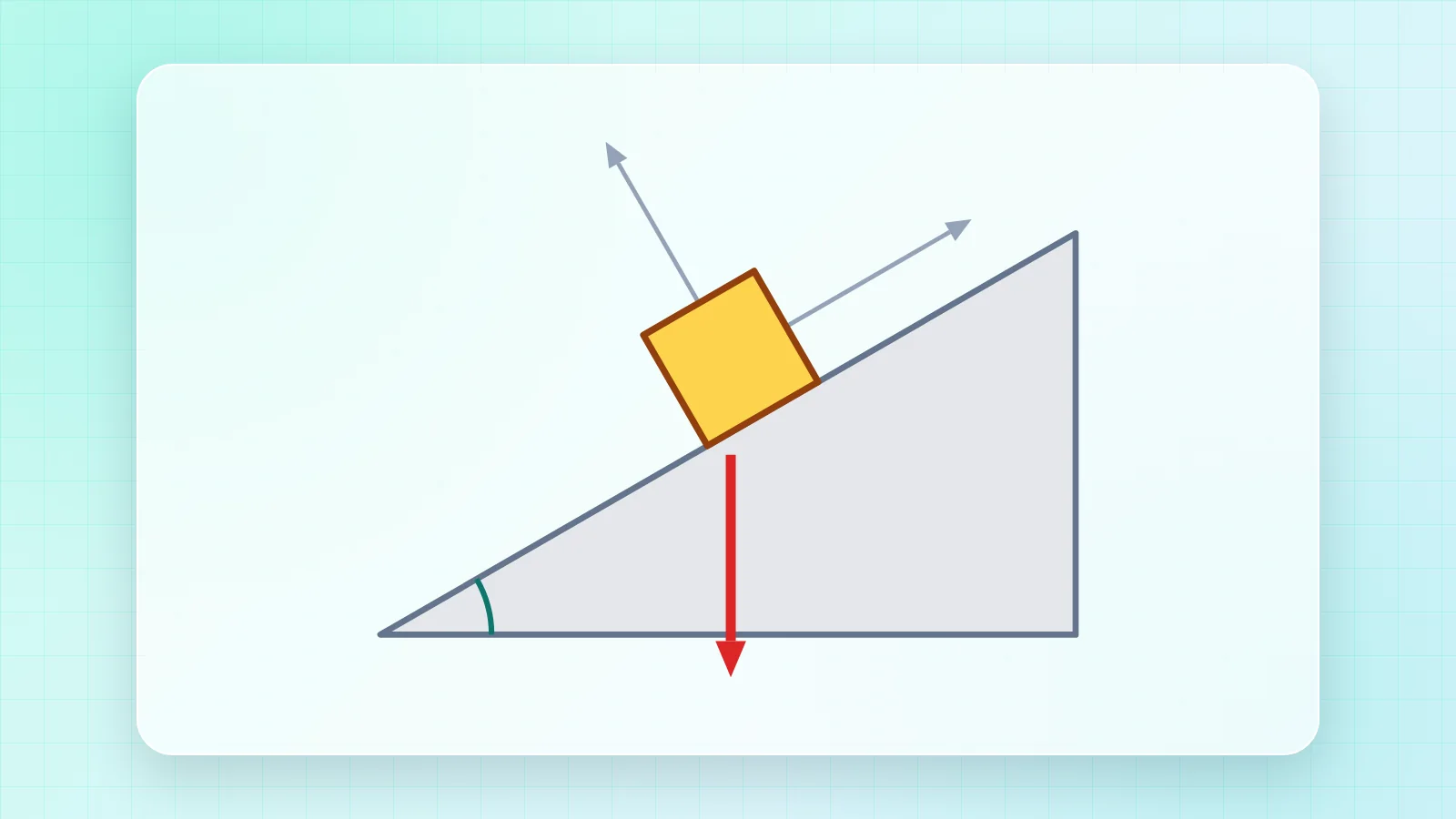
The axes do not have to be horizontal and vertical. On an incline, axes along and across the slope often make the components simpler; Equation 1 still holds with \(\theta\) measured from the new \(x\) axis.
2. Signs of the components
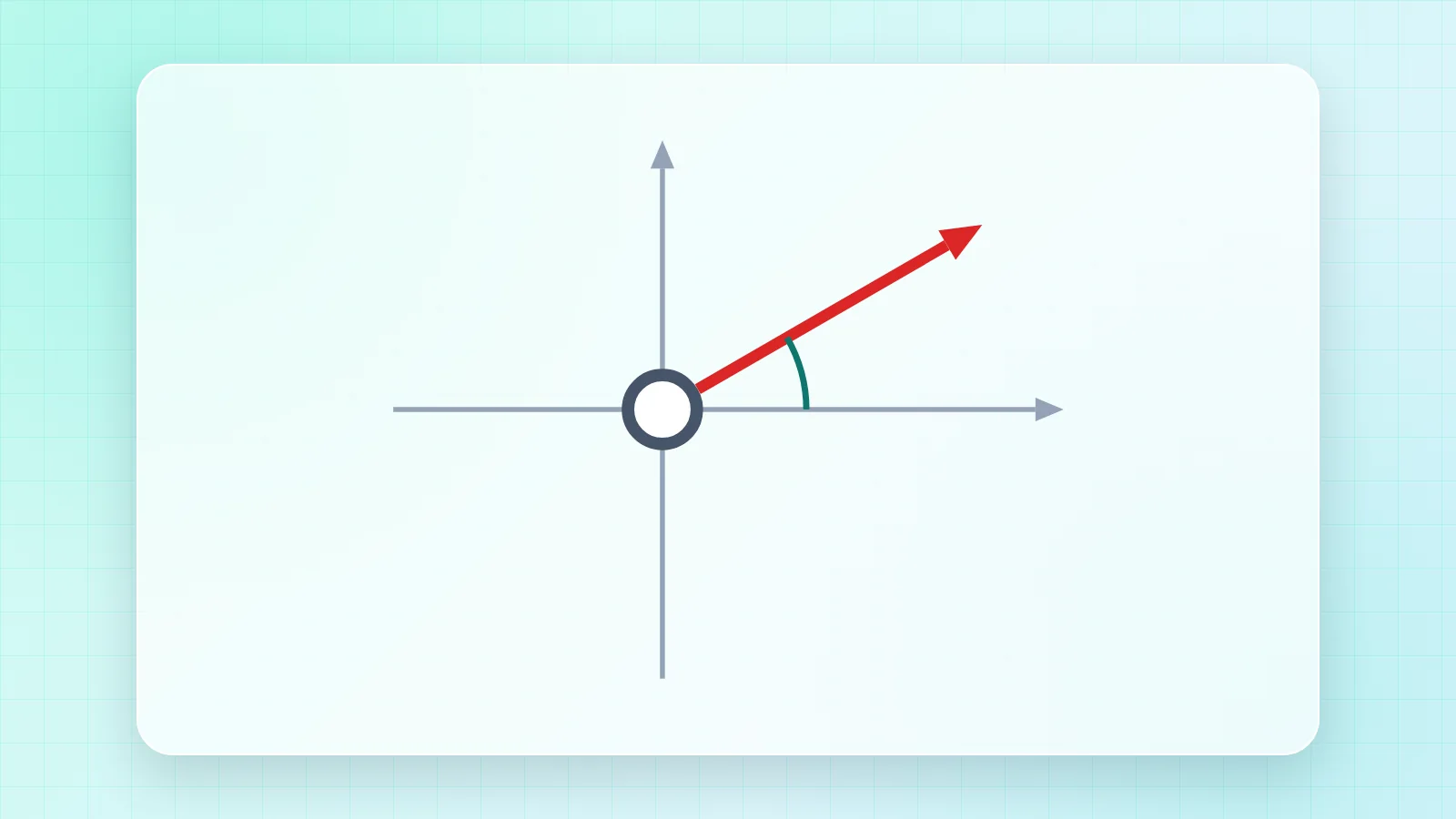
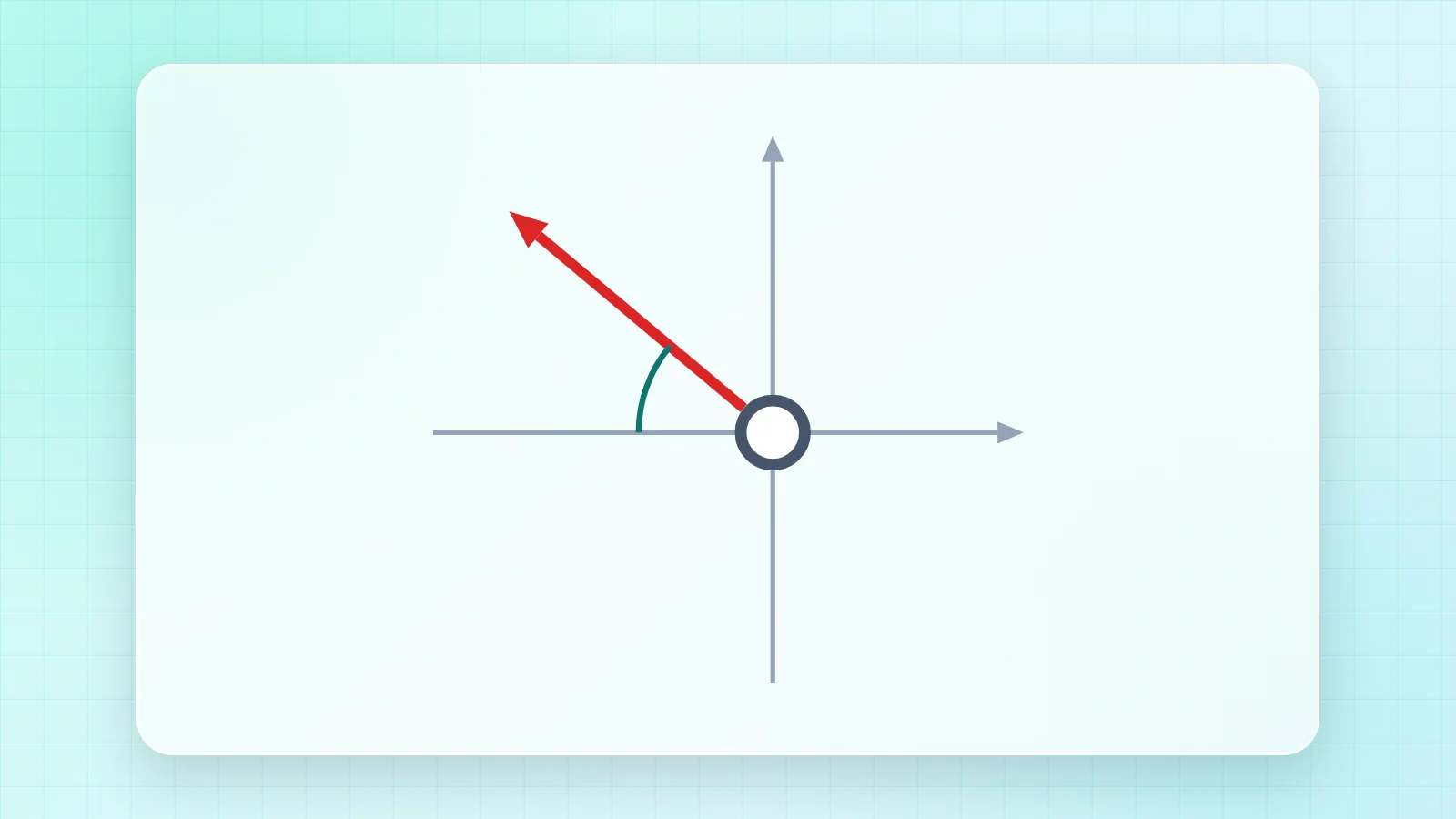
In scalar notation, \(F_x\) and \(F_y\) are numbers with signs: positive when the component points along \(+x\) or \(+y\), negative otherwise. The same force turned into each of the four quadrants gives four sign pairs (Figure 2).

Use the acute angle. Take the acute angle between the force and the nearest axis, compute the magnitudes of the components with sine and cosine, and give each one its sign from the sketch. This is safer than working with angles over 90°.
3. Cartesian vector notation
The unit vectors \(\mathbf{i}\) and \(\mathbf{j}\) have magnitude 1, no unit, and point along \(+x\) and \(+y\). Any force in the plane can be written with them:
The signs of the components go into the expression. A force of 200 N directed 30° below the \(-x\) axis is \(\mathbf{F} = \{-173\,\mathbf{i} - 100\,\mathbf{j}\}\,\text{N}\). Scalar and Cartesian notation carry the same information; the Cartesian form is the one that extends to three dimensions.
4. Components from a slope
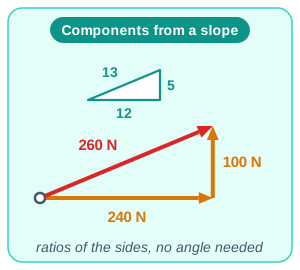
Drawings often give a direction as a small slope triangle, or as the coordinates of two points, instead of an angle. The components are then in the same ratio as the sides of the triangle:
For a 260 N force along a 5-12-13 slope (Figure 3), \(F_x = 260 \cdot 12/13 = 240\,\text{N}\) and \(F_y = 260 \cdot 5/13 = 100\,\text{N}\). No angle is needed.
5. Back from components to the force
When the components are known, the magnitude and the direction are:
Equation 4 gives the acute angle from the \(x\) axis; the signs of \(F_x\) and \(F_y\) tell the quadrant.
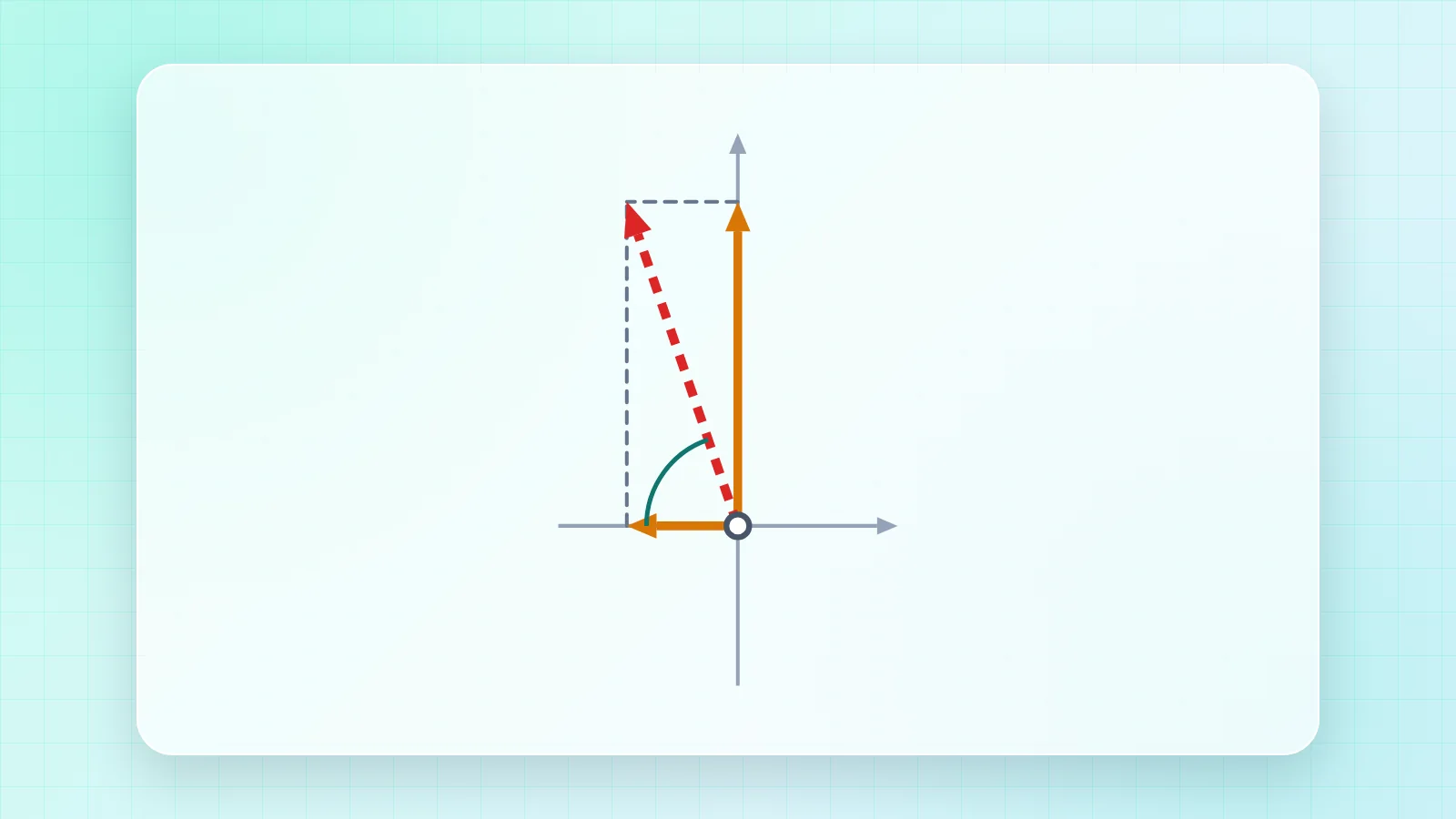
Check the quadrant. A calculator's \(\tan^{-1}\) returns angles between \(-90^\circ\) and \(90^\circ\) only. For \(F_x = -40\,\text{N}\) and \(F_y = 30\,\text{N}\), \(F = 50\,\text{N}\) and the acute angle is \(36.9^\circ\), but the force points up and to the left: \(36.9^\circ\) above the \(-x\) axis, or \(143.1^\circ\) from \(+x\).
Summary
- Rectangular components: \(F_x = F\cos\theta\), \(F_y = F\sin\theta\), with \(\theta\) from the \(x\) axis.
- Components carry signs; take magnitudes from the acute angle and signs from the sketch.
- Cartesian form: \(\mathbf{F} = F_x\mathbf{i} + F_y\mathbf{j}\).
- With a slope triangle, the components are in the ratio of its sides.
- \(F = \sqrt{F_x^2 + F_y^2}\); always check the quadrant of the angle.











Comments 0
Ask questions, explain a step or share a tip about this note.
Join the discussion
Log in to comment, reply and vote. It is free.
No comments yet
Ask a question, share a tip or say thanks. Be the first!