



Mechanics is the science of forces and their effects. Every statics course starts here: before you analyze a bridge or a crane, it helps to know what mechanics studies and where statics fits within it.
1. What mechanics studies
Mechanics is the branch of physics that describes and predicts how bodies behave under forces: whether they stay at rest, move, or change shape. It rests on only a few laws, Newton's laws of motion and his law of gravitation, yet these explain the behavior of everything from a door hinge to a suspension bridge.
Engineers use mechanics to predict how a structure or machine will respond to its loads before it is built. That is why it is part of almost every engineering curriculum.
2. The branches of mechanics
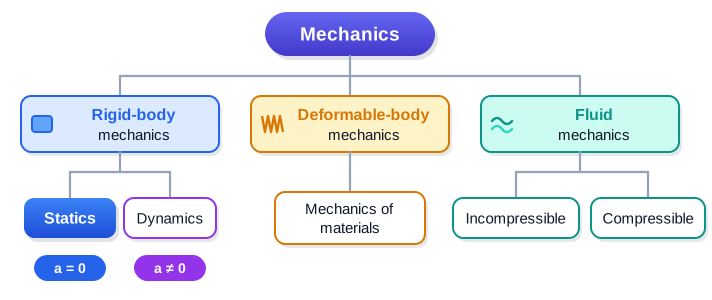
Mechanics is divided into three branches according to how the body responds to load (Figure 1):
- Rigid-body mechanics: bodies are assumed not to deform. It is split into statics and dynamics.
- Deformable-body mechanics: how bodies stretch, bend and fail; usually taught as mechanics of materials.
- Fluid mechanics: liquids and gases at rest and in motion.
Real bodies always deform a little, but in most structures the change in shape is so small that the forces can be found as if the body were rigid. Statics is built on this assumption.
3. Statics and dynamics
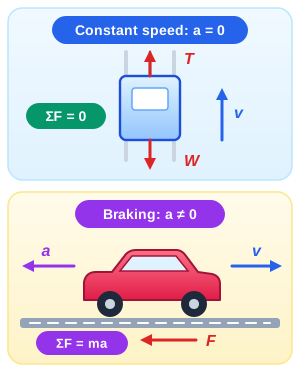
Statics studies bodies in equilibrium: bodies at rest or moving in a straight line at constant speed. Dynamics studies bodies that accelerate. Both follow from Newton's second law, and statics is the special case of zero acceleration (Figure 2):
A body in equilibrium does not have to be still. An elevator rising at a steady speed is in equilibrium; a braking car is not. What decides is the acceleration, not the motion.
4. A short history
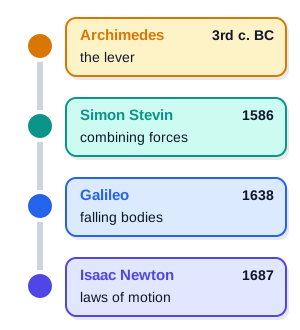
Statics is the oldest part of mechanics, because its laws need only measurements of length and force. Archimedes described the lever in the third century BC. Simon Stevin showed how forces combine (1586), Galileo published his work on falling bodies (1638), and Isaac Newton set out the laws of motion and gravitation in his Principia (1687) (Figure 3).
Dynamics developed later, because it also needs accurate measurement of time.
5. Why statics comes first
Most engineering structures, such as buildings, bridges, towers and machine frames, are designed to stay in equilibrium, so designing them is a statics problem. Statics also introduces the two tools used in every later mechanics course: the free-body diagram and the equilibrium equations.
Summary
- Mechanics studies how bodies respond to forces.
- It has three branches: rigid-body, deformable-body and fluid mechanics.
- Statics deals with bodies in equilibrium (zero acceleration); dynamics deals with accelerating bodies.
- Statics treats bodies as rigid and is the basis of structural and machine design.










Comments 0
Ask questions, explain a step or share a tip about this note.
Join the discussion
Log in to comment, reply and vote. It is free.
No comments yet
Ask a question, share a tip or say thanks. Be the first!