

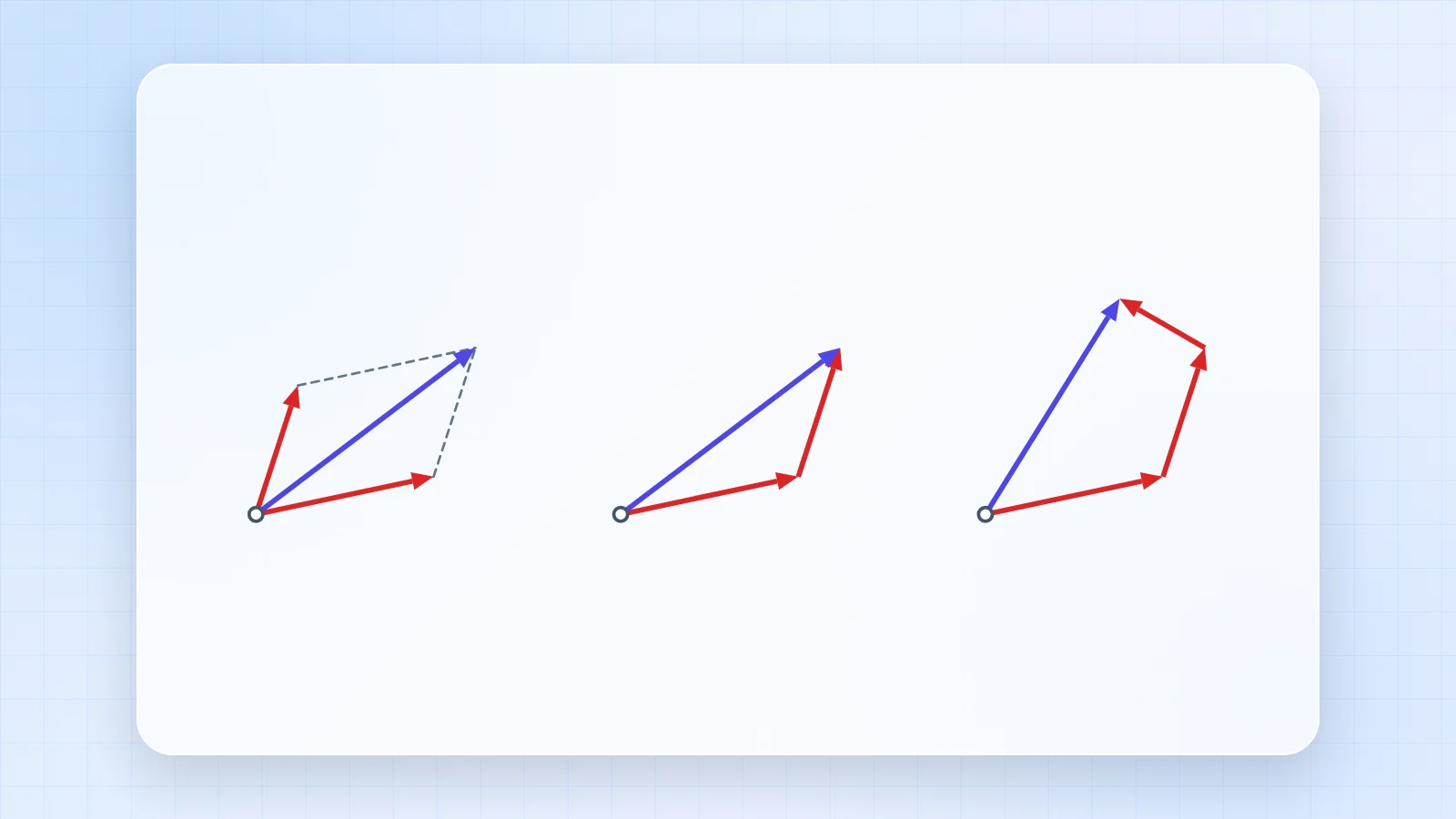

When two or more forces act at the same point, they can be replaced by a single force that has the same effect: their resultant. Graphical rules show how forces add, and trigonometry turns the drawing into numbers.
1. The resultant of two forces
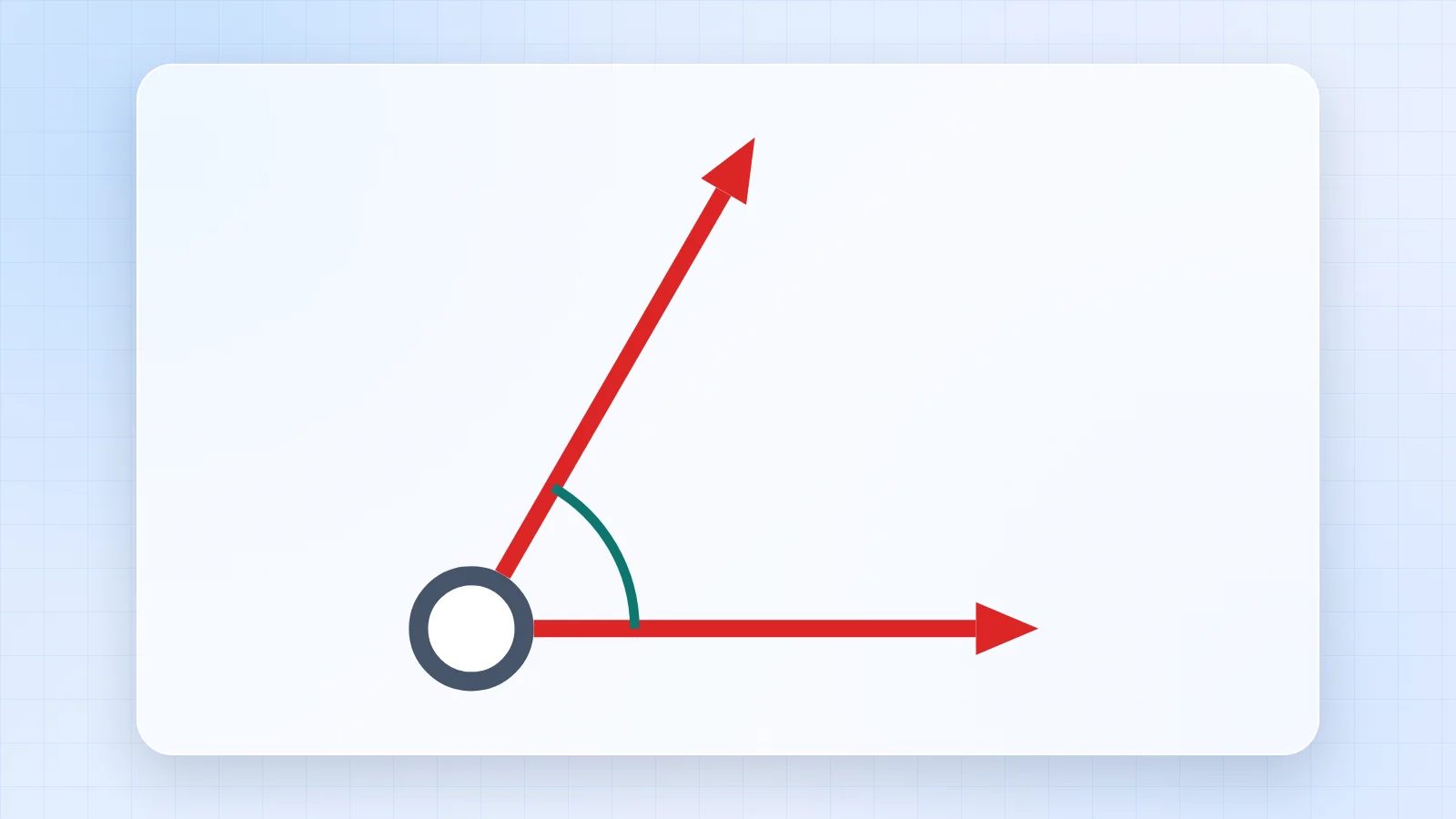
Forces whose lines of action meet at one point are called concurrent. Two concurrent forces \(\mathbf{F}_1\) and \(\mathbf{F}_2\) add as vectors:
This is a vector sum, not a sum of numbers. The magnitude \(F_R\) equals \(F_1 + F_2\) only when the two forces point the same way.
2. Parallelogram law and triangle rule
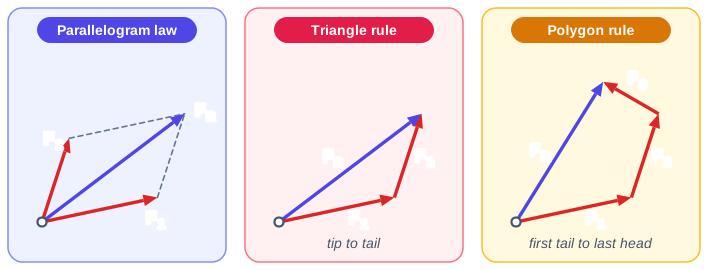
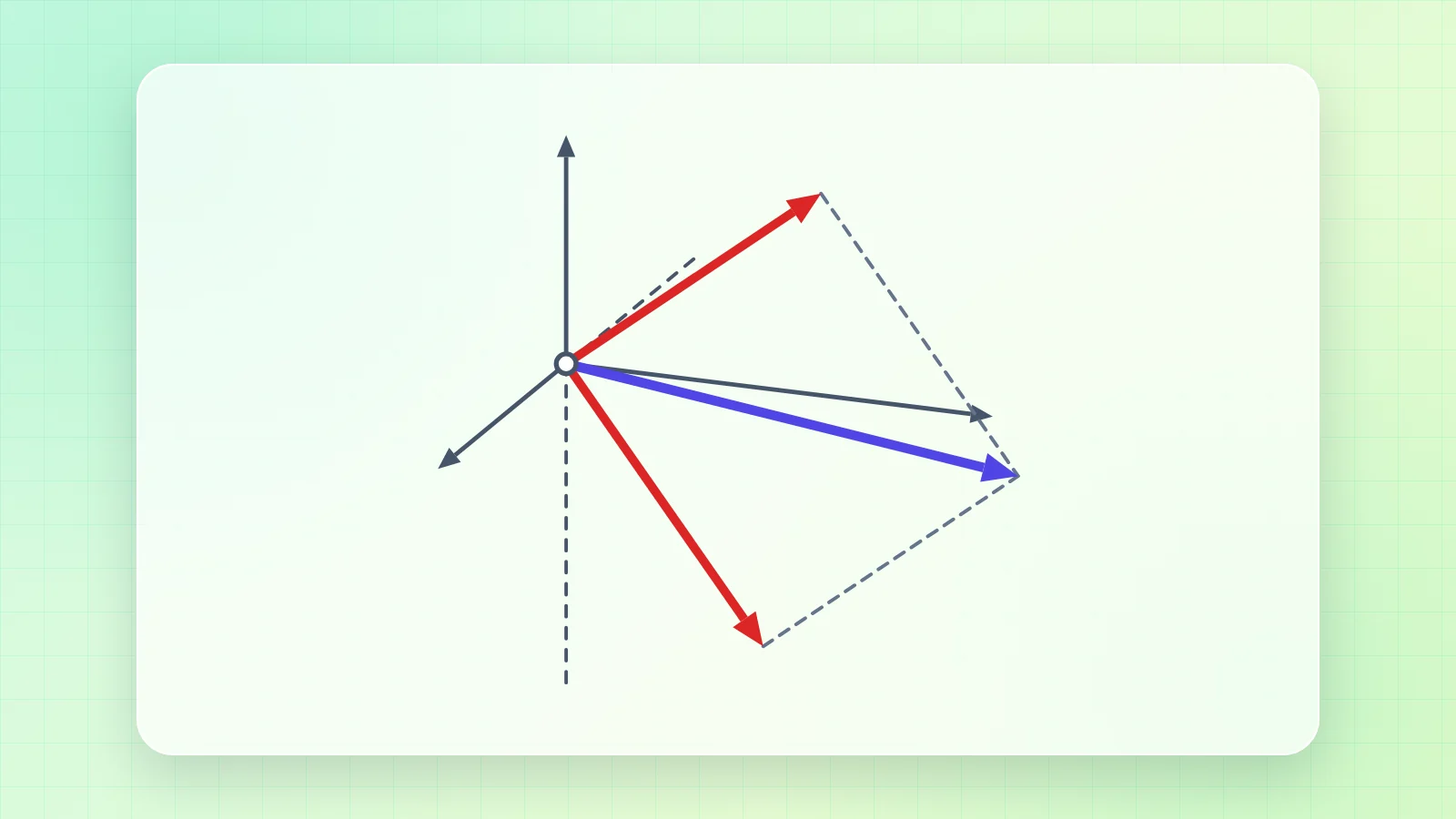
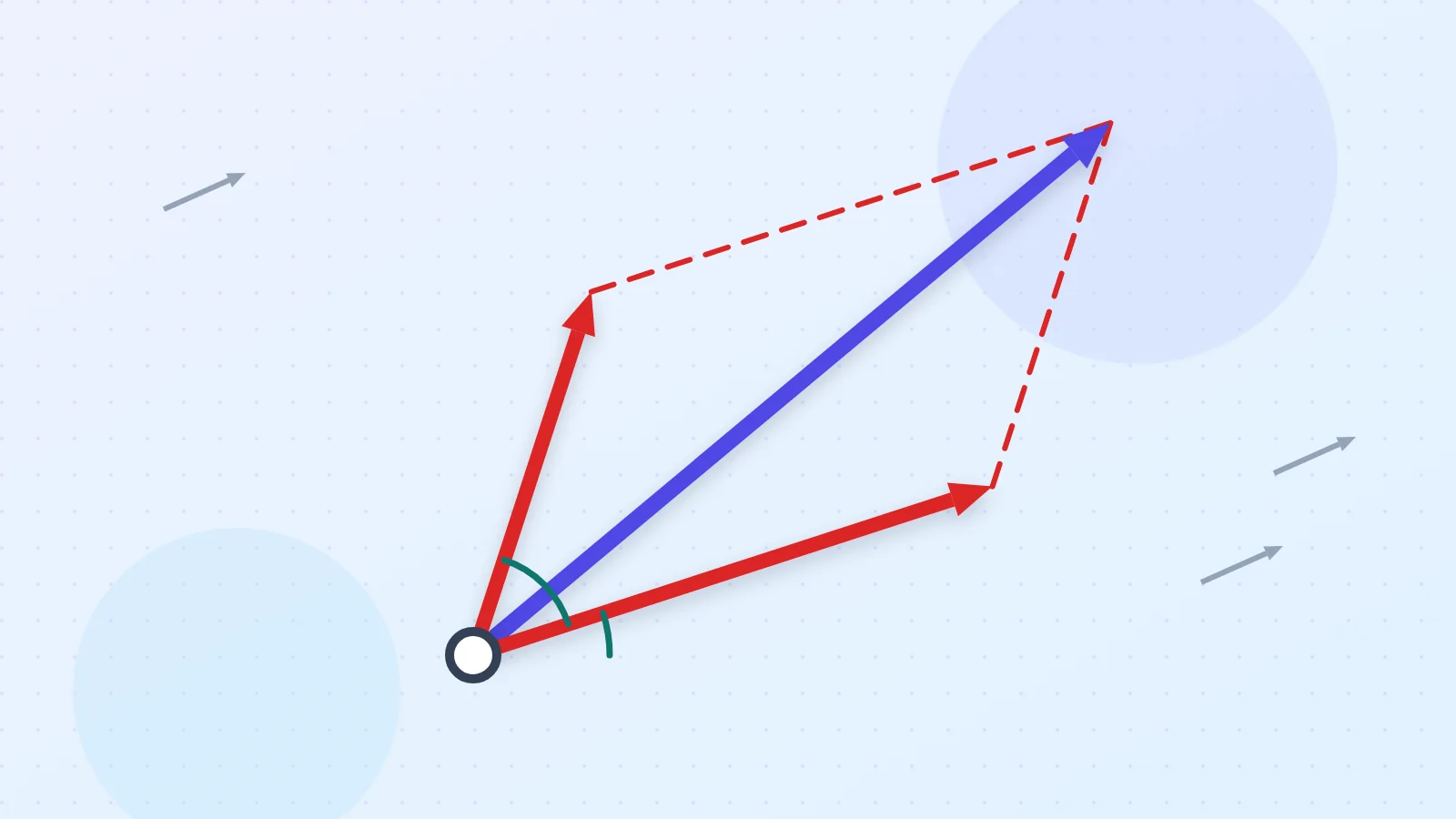
There are two equivalent ways to draw the sum (Figure 1):
- Parallelogram law. Draw both forces from their common point and complete the parallelogram. The diagonal from the common point is \(\mathbf{F}_R\).
- Triangle rule. Place the tail of \(\mathbf{F}_2\) at the head of \(\mathbf{F}_1\). The resultant runs from the tail of \(\mathbf{F}_1\) to the head of \(\mathbf{F}_2\). The triangle is one half of the parallelogram.
The order does not matter: \(\mathbf{F}_1 + \mathbf{F}_2 = \mathbf{F}_2 + \mathbf{F}_1\).
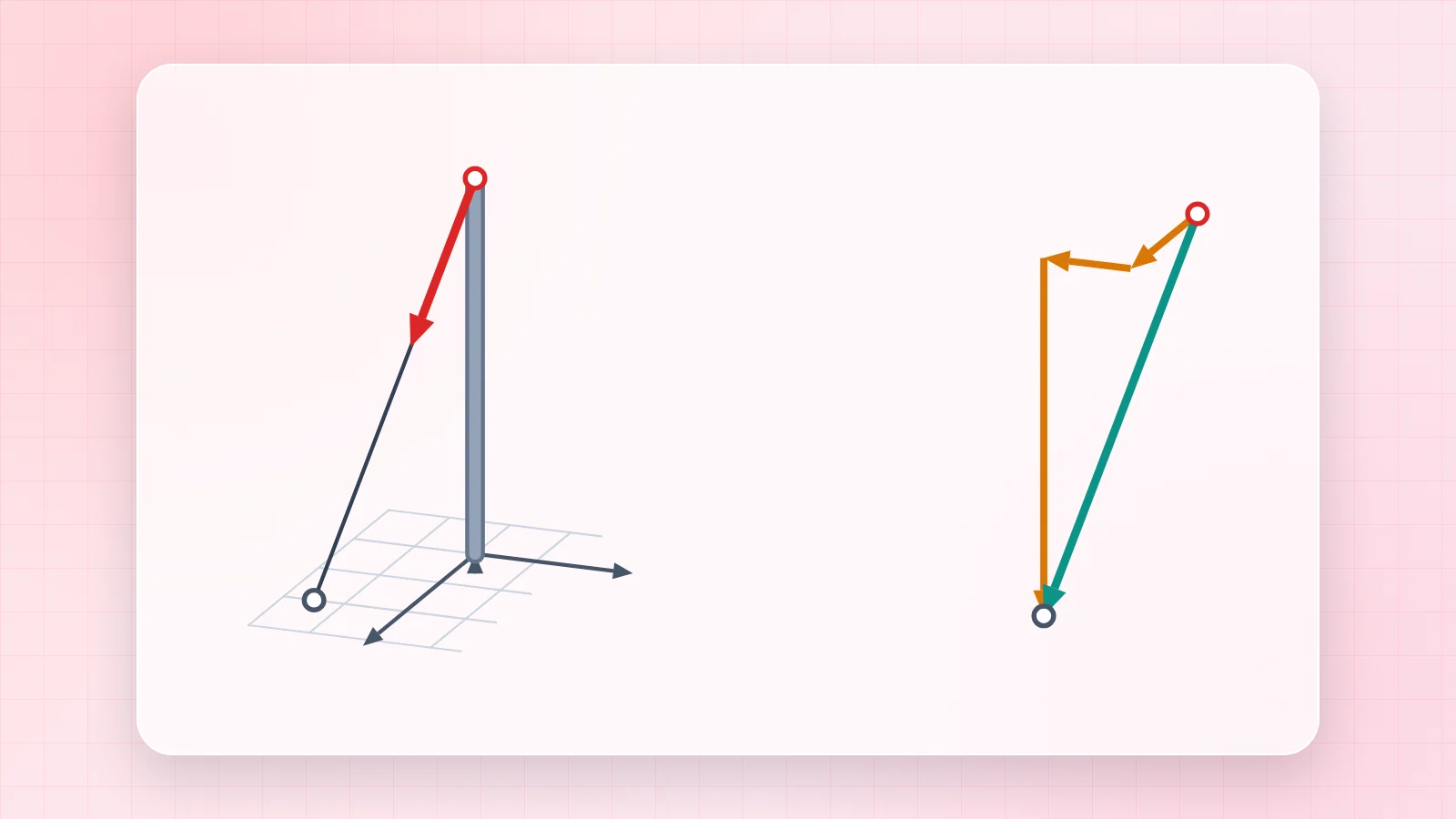
Where the resultant acts. The triangle gives the correct magnitude and direction of \(\mathbf{F}_R\), but the triangle itself is only a construction. On the body, the resultant acts through the point where the original forces meet.
3. More than two forces
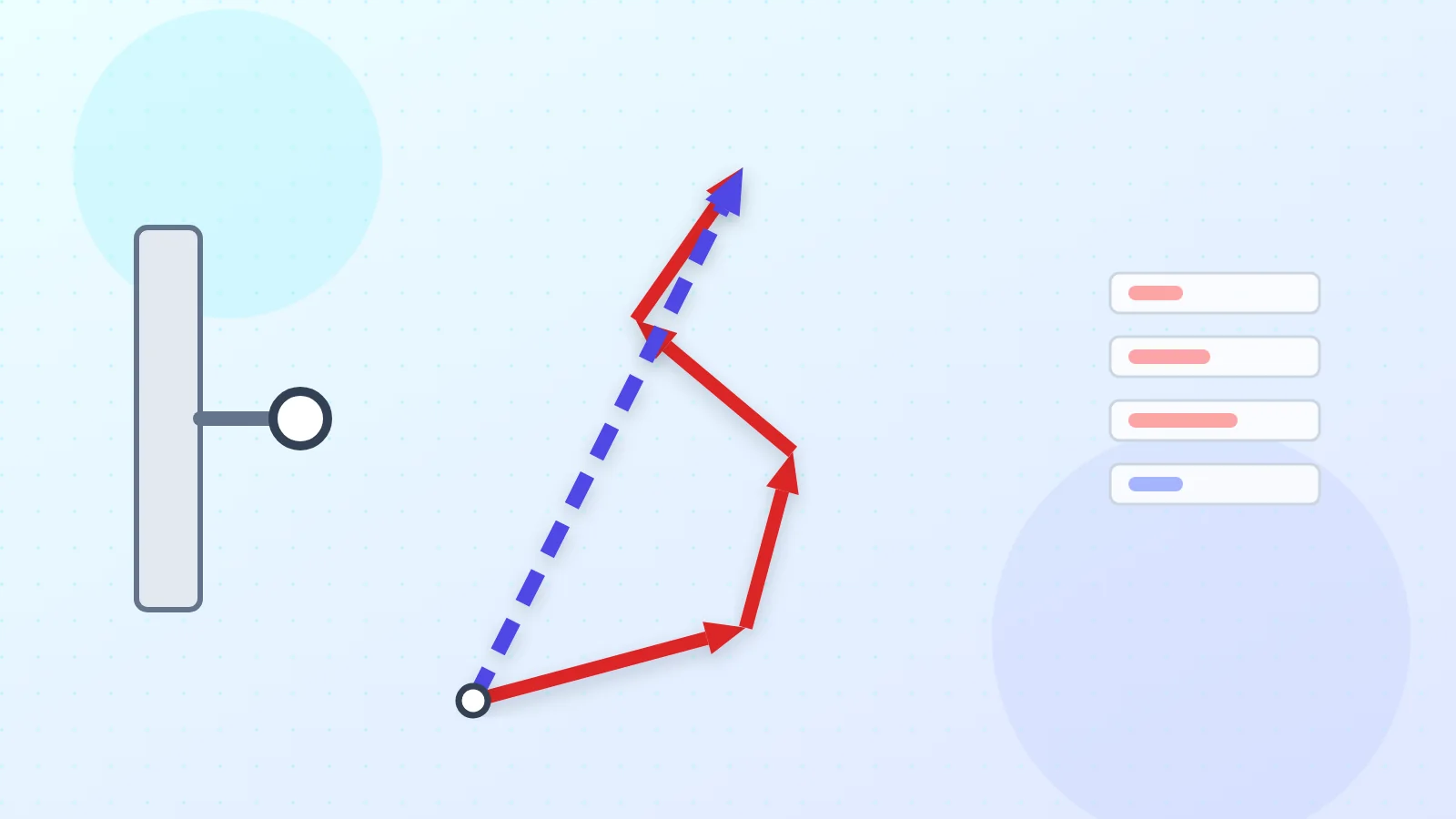
For three or more forces, keep adding tip to tail. The resultant runs from the tail of the first force to the head of the last one; this is the polygon rule. The grouping does not matter: \((\mathbf{F}_1 + \mathbf{F}_2) + \mathbf{F}_3 = \mathbf{F}_1 + (\mathbf{F}_2 + \mathbf{F}_3)\).
- Subtraction is addition of the negative: \(\mathbf{F}_1 - \mathbf{F}_2 = \mathbf{F}_1 + (-\mathbf{F}_2)\).
- Collinear forces, which act along the same line, add as signed numbers.
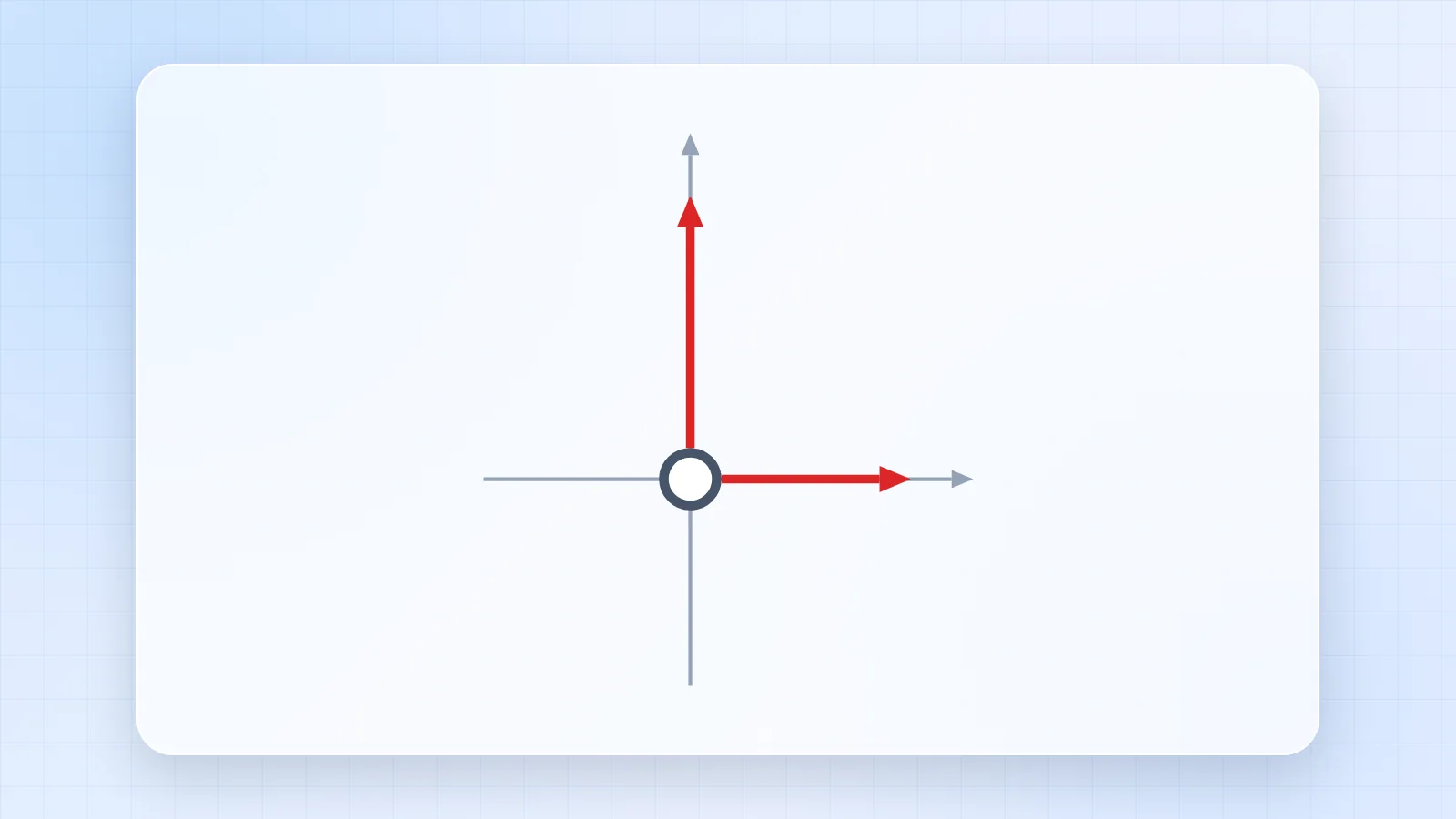
With many forces, the triangles become tedious; adding rectangular components is usually faster.
4. Solving the force triangle

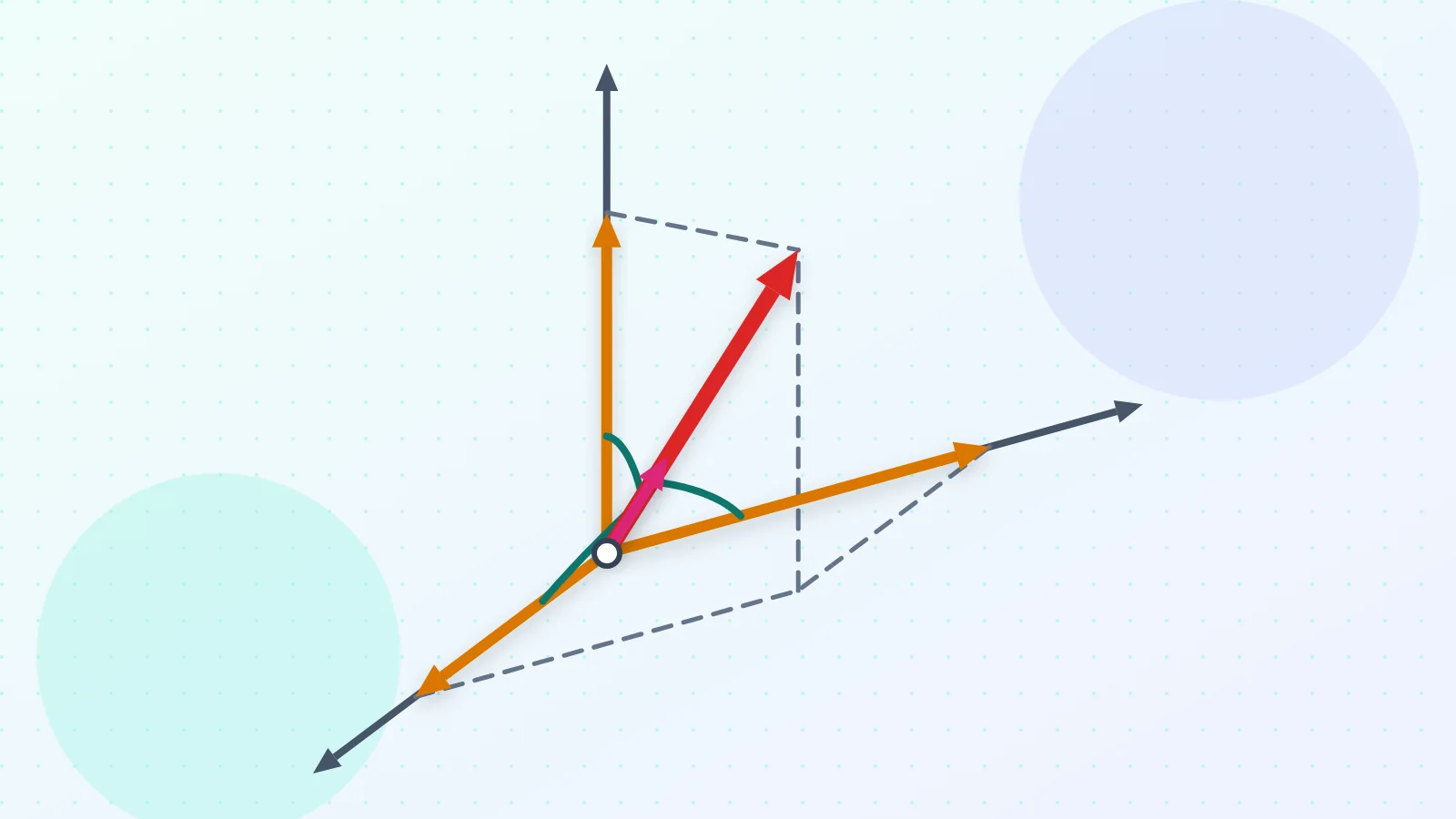
Sketch the triangle, not necessarily to scale, and mark the known sides and angles. Then use two results from trigonometry, written for a triangle with sides \(A\), \(B\), \(C\) and opposite angles \(a\), \(b\), \(c\) (Figure 2):
Equation 2 is the law of cosines; it gives the resultant when the angle between the two forces is known. Equation 3 is the law of sines; it then gives the direction.
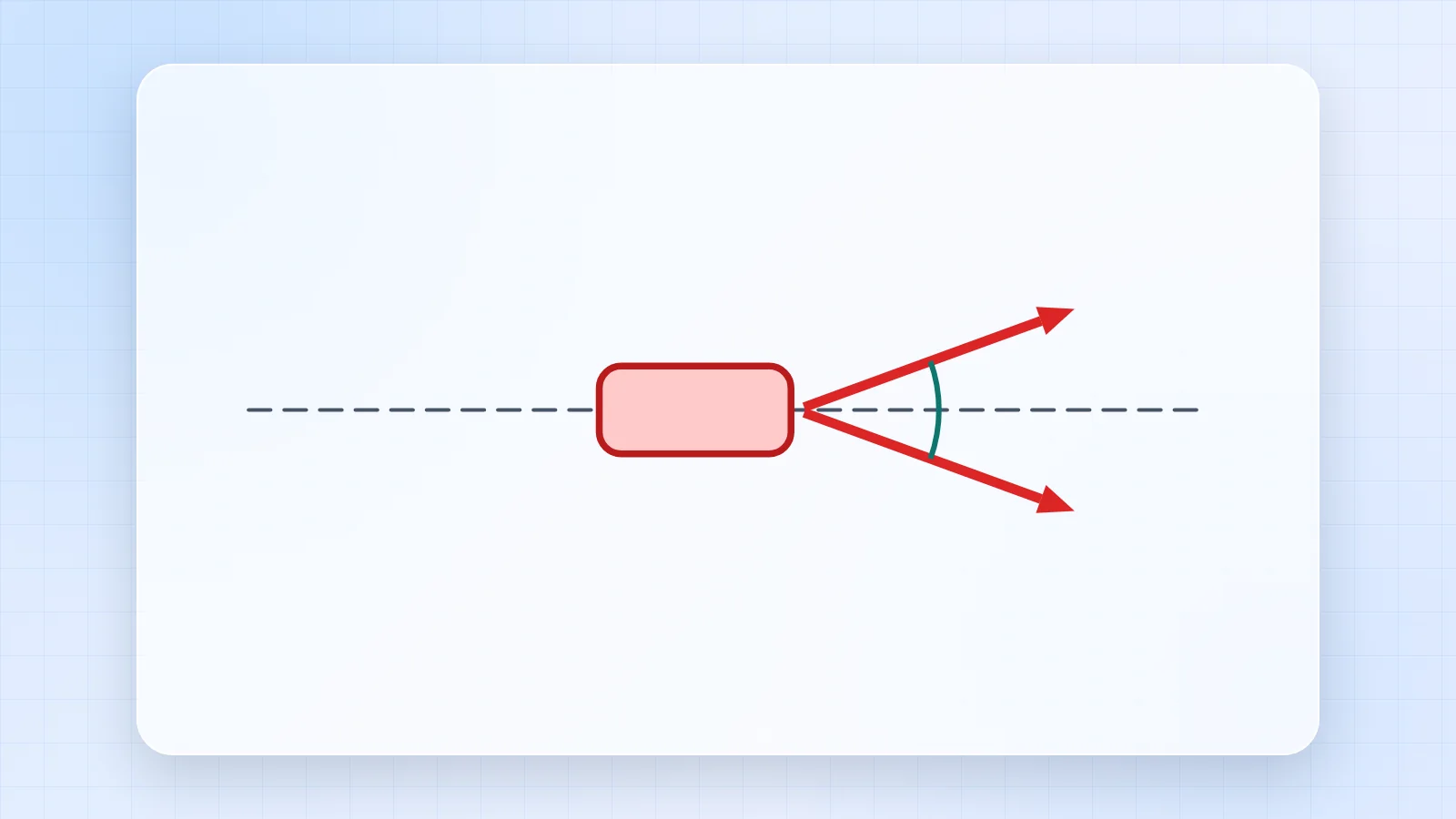
Find the triangle angle first. If two forces drawn tail to tail are \(\beta\) apart, the angle of the force triangle opposite \(\mathbf{F}_R\) is \(180^\circ - \beta\).
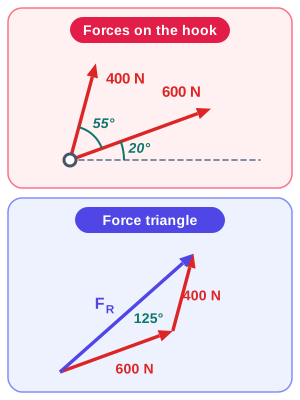
The example below applies both laws to a common case: two cables pulling on one hook.
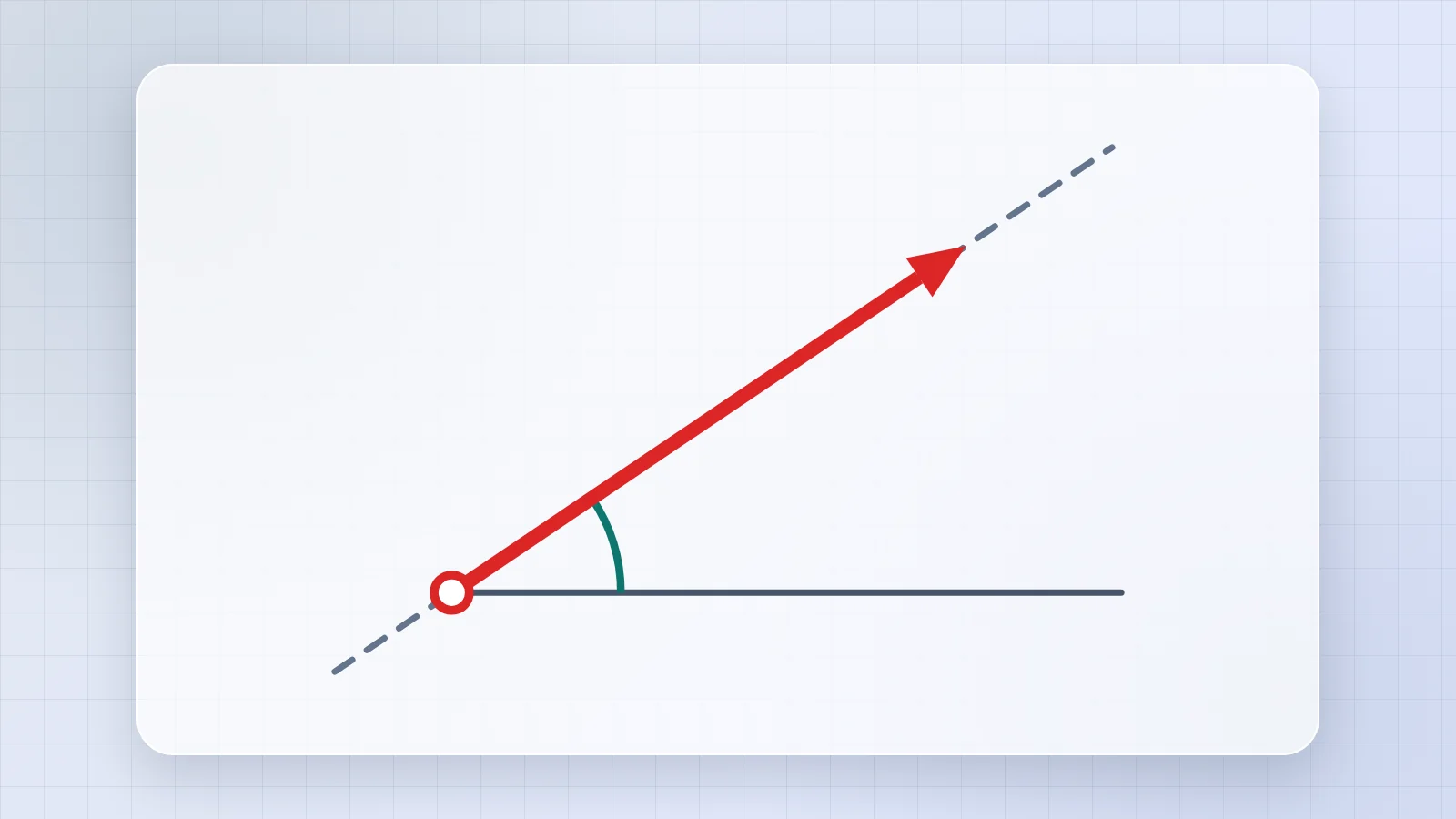
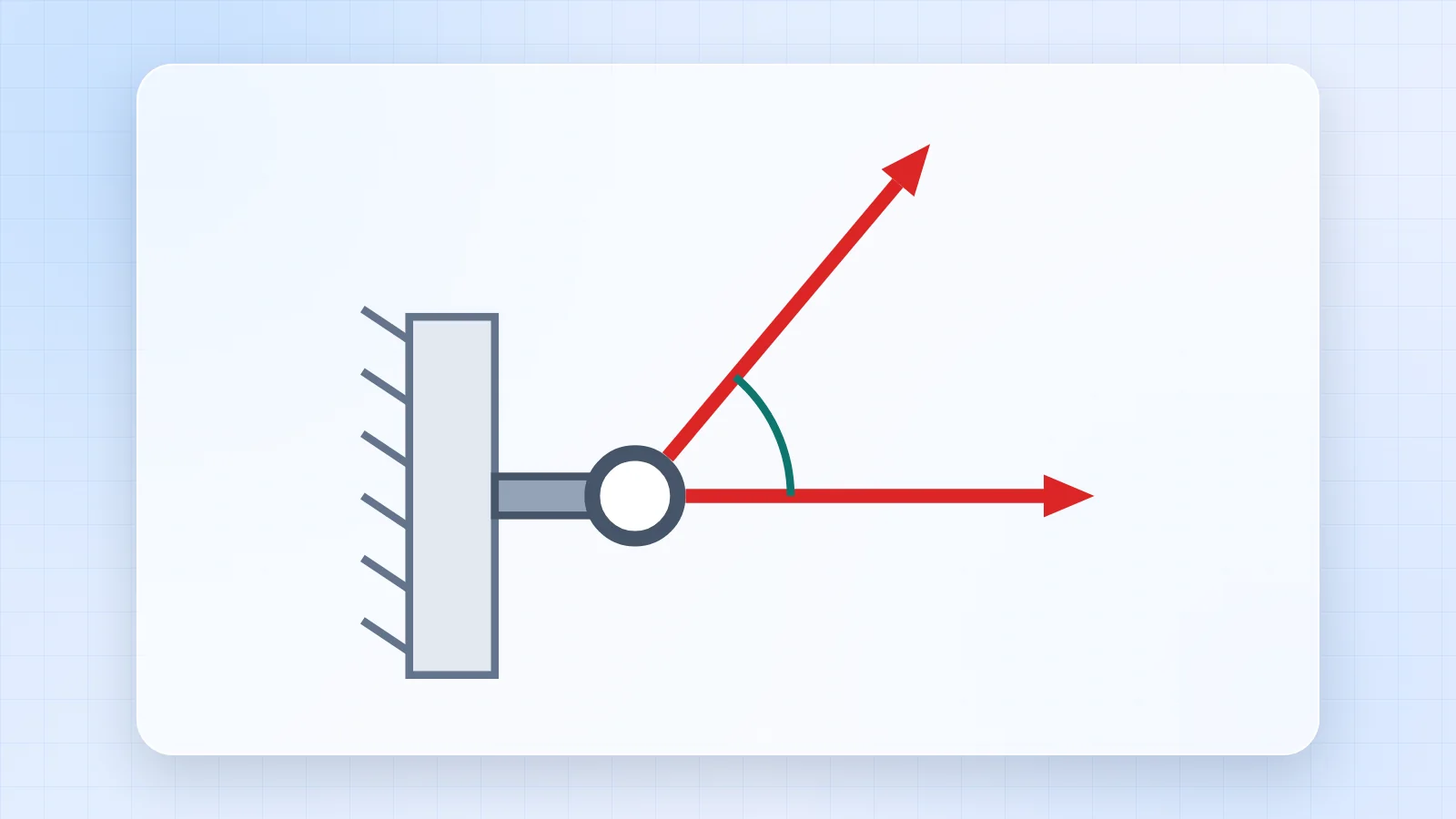
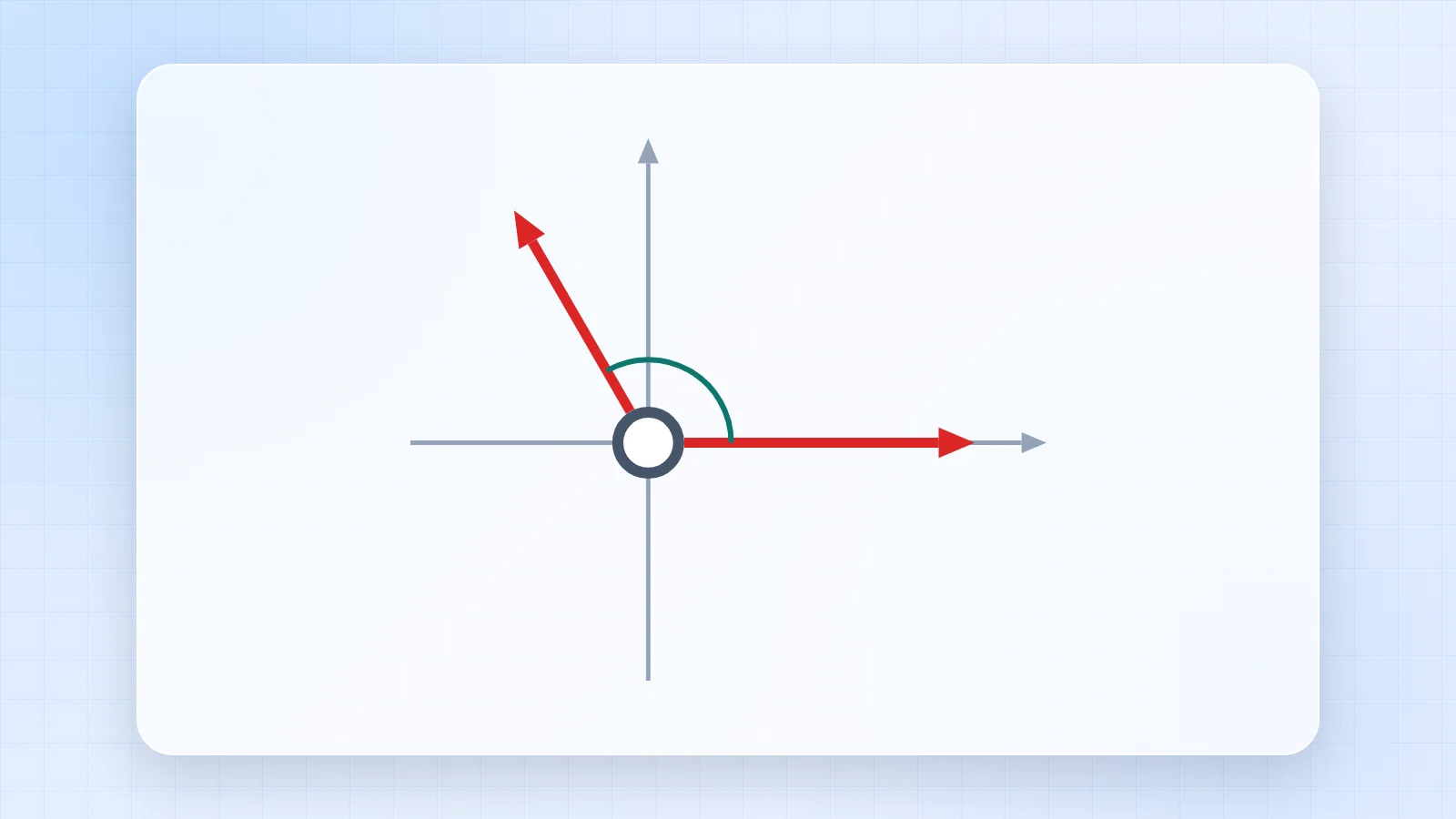
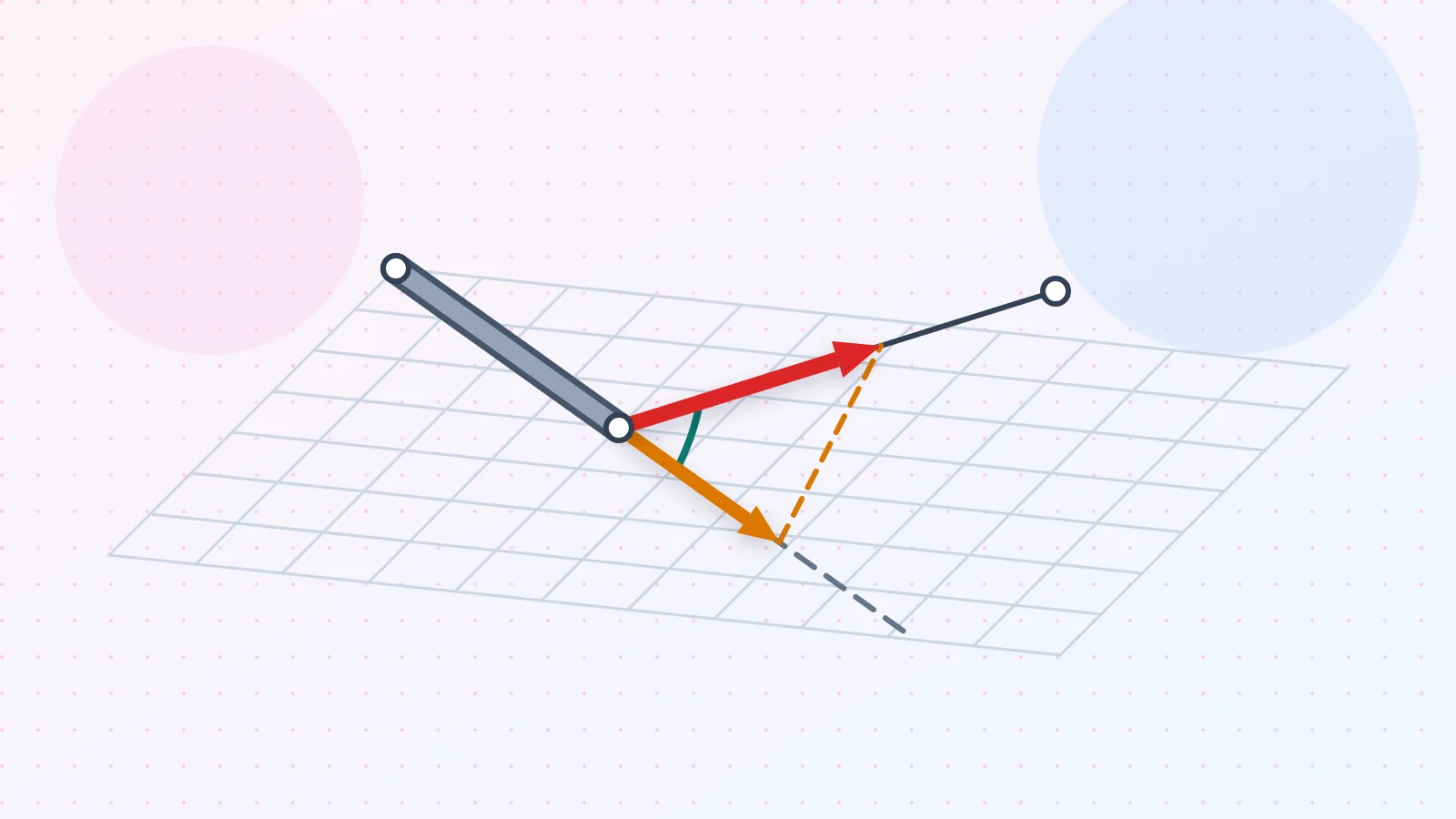
Two cables on a hook. A hook is pulled by \(F_1 = 600\,\text{N}\) at \(20^\circ\) above the horizontal and by \(F_2 = 400\,\text{N}\) at \(75^\circ\) above the horizontal (Figure 3). Find the magnitude and direction of the resultant.
Triangle angle. The forces are \(75^\circ - 20^\circ = 55^\circ\) apart, so the angle opposite \(\mathbf{F}_R\) is \(180^\circ - 55^\circ = 125^\circ\).
Magnitude (law of cosines):
$$ F_R = \sqrt{600^2 + 400^2 - 2(600)(400)\cos 125^\circ} = 892\,\text{N} $$
Direction (law of sines), with \(\alpha\) the angle between \(\mathbf{F}_R\) and \(\mathbf{F}_1\):
$$ \sin\alpha = \frac{400 \sin 125^\circ}{891.8} = 0.3674, \qquad \alpha = 21.6^\circ $$
Answer. \(F_R = 892\,\text{N}\) at \(20^\circ + 21.6^\circ = 41.6^\circ\) above the horizontal.
Summary
- The resultant of concurrent forces is their vector sum, \(\mathbf{F}_R = \mathbf{F}_1 + \mathbf{F}_2\).
- Add graphically with the parallelogram law or tip to tail with the triangle and polygon rules.
- The resultant acts through the common point of the forces.
- Solve the force triangle with the law of cosines for the magnitude and the law of sines for the direction.











Comments 0
Ask questions, explain a step or share a tip about this note.
Join the discussion
Log in to comment, reply and vote. It is free.
No comments yet
Ask a question, share a tip or say thanks. Be the first!