

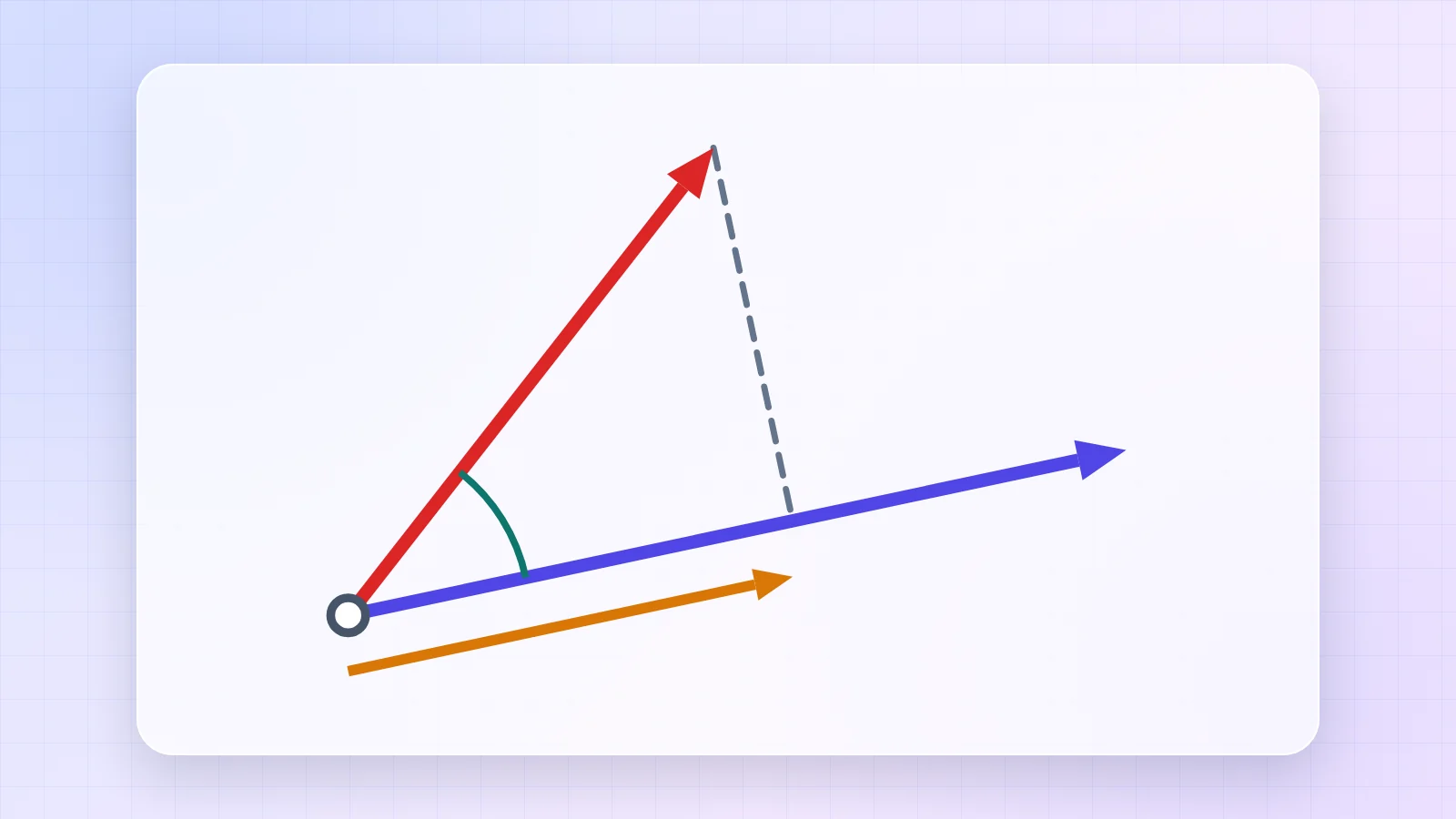

The dot product multiplies two vectors and gives a scalar. In statics it answers two everyday questions: what is the angle between two lines in space, and how much of a force acts along a given line?
1. Definition
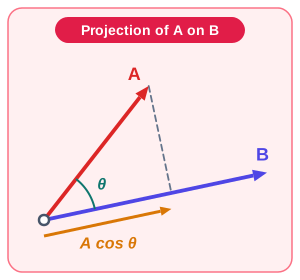
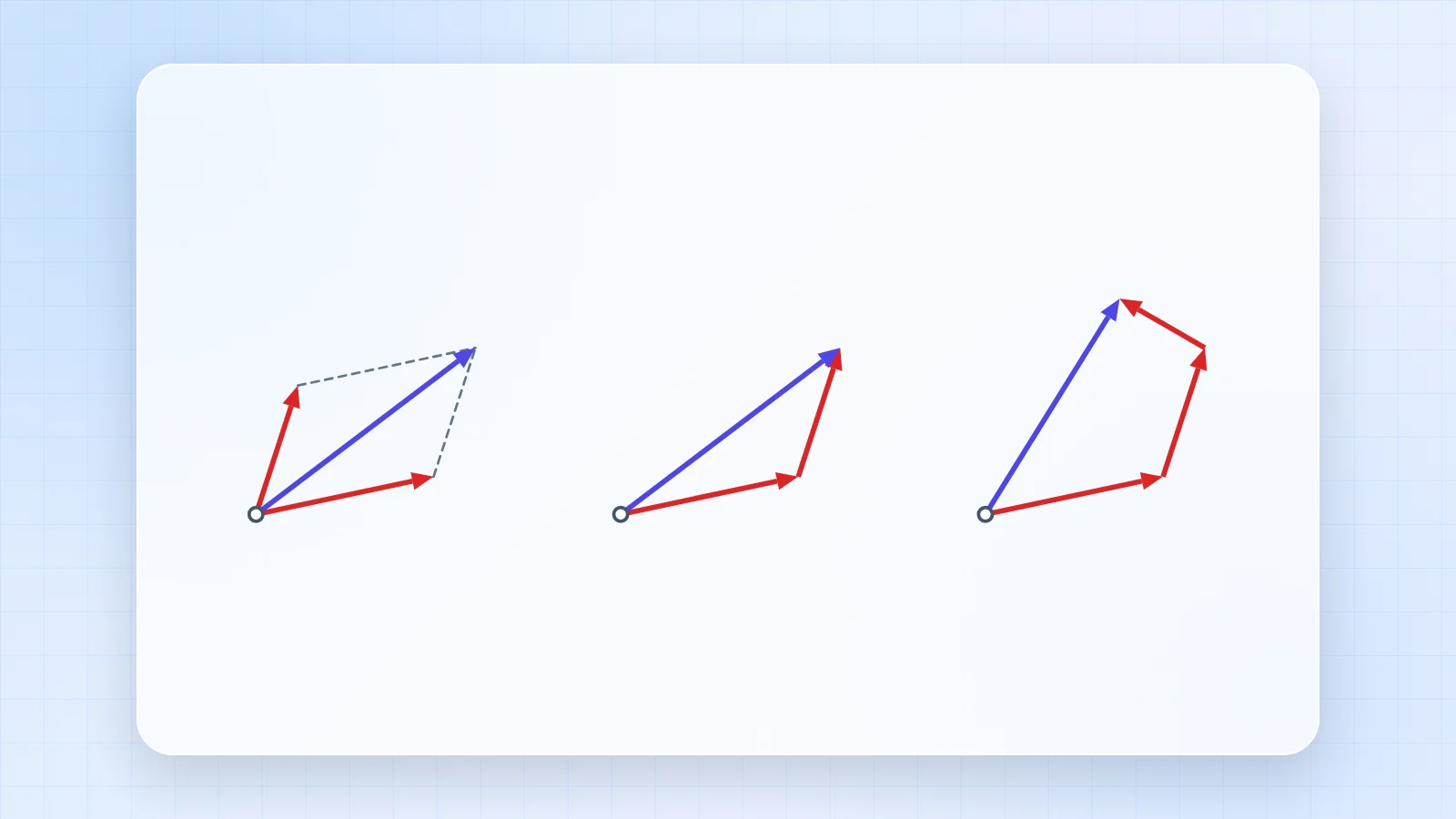
The dot product of \(\mathbf{A}\) and \(\mathbf{B}\) is the product of their magnitudes and the cosine of the angle \(\theta\) between them, with \(0^\circ \le \theta \le 180^\circ\):
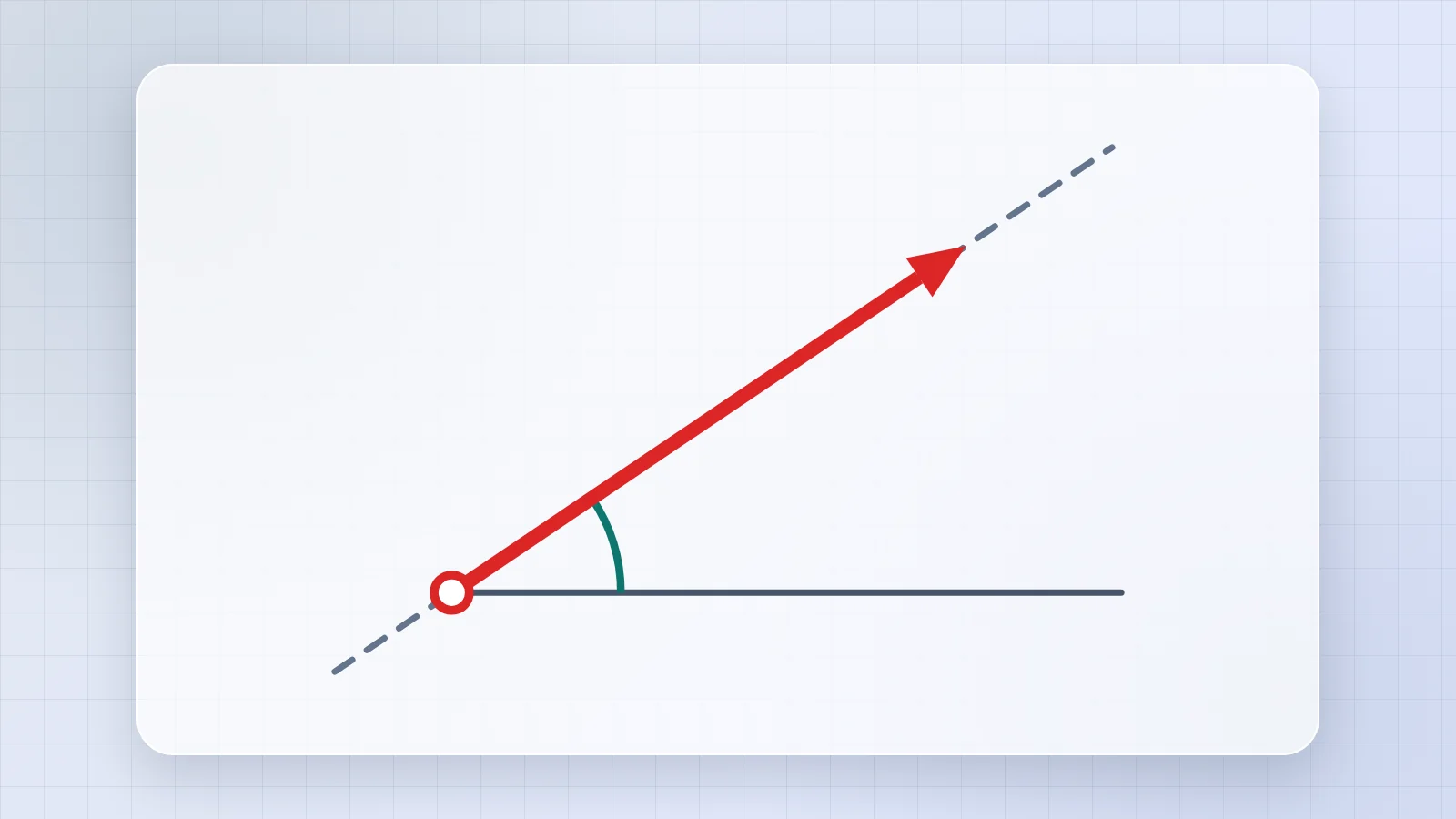
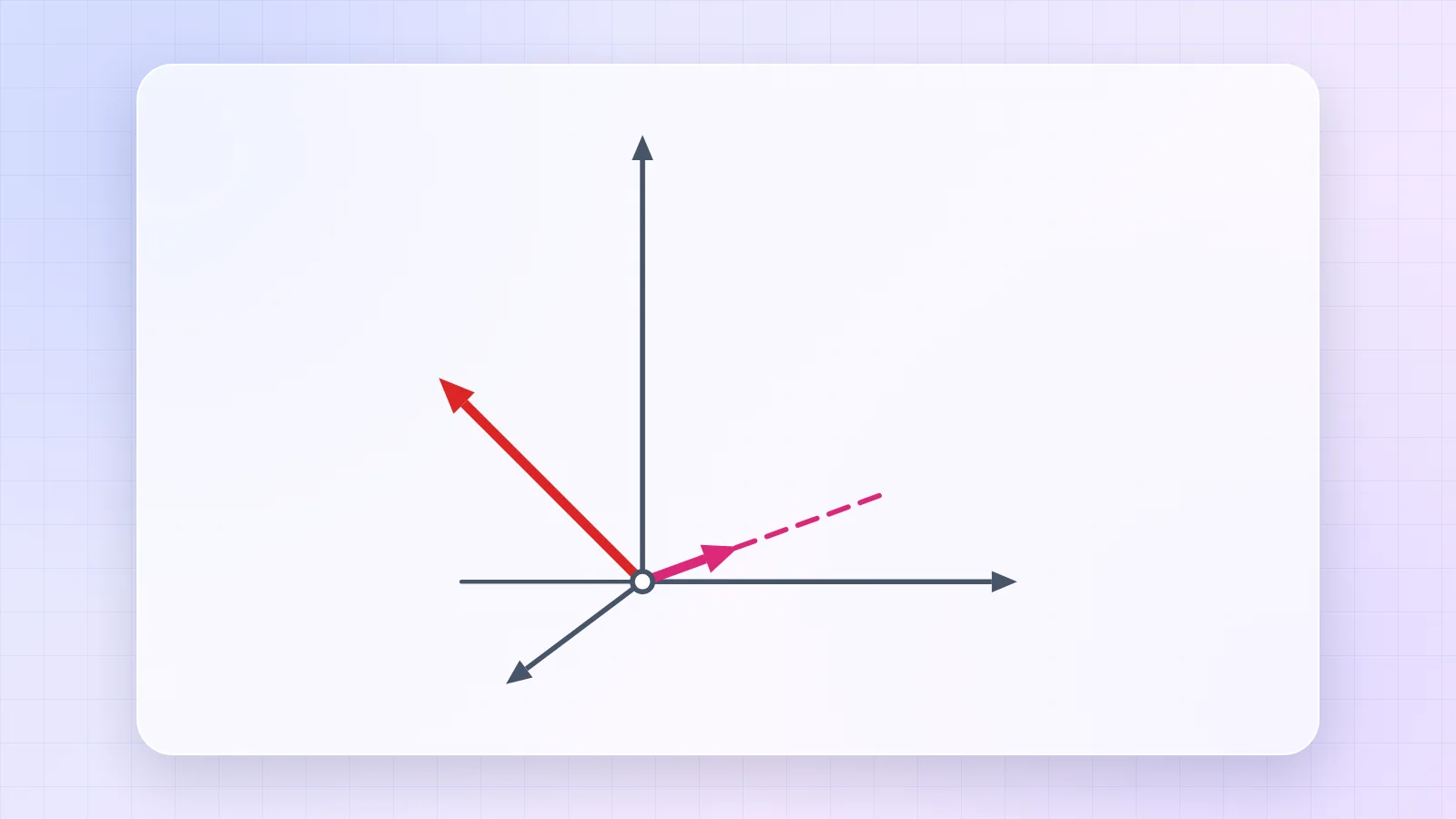
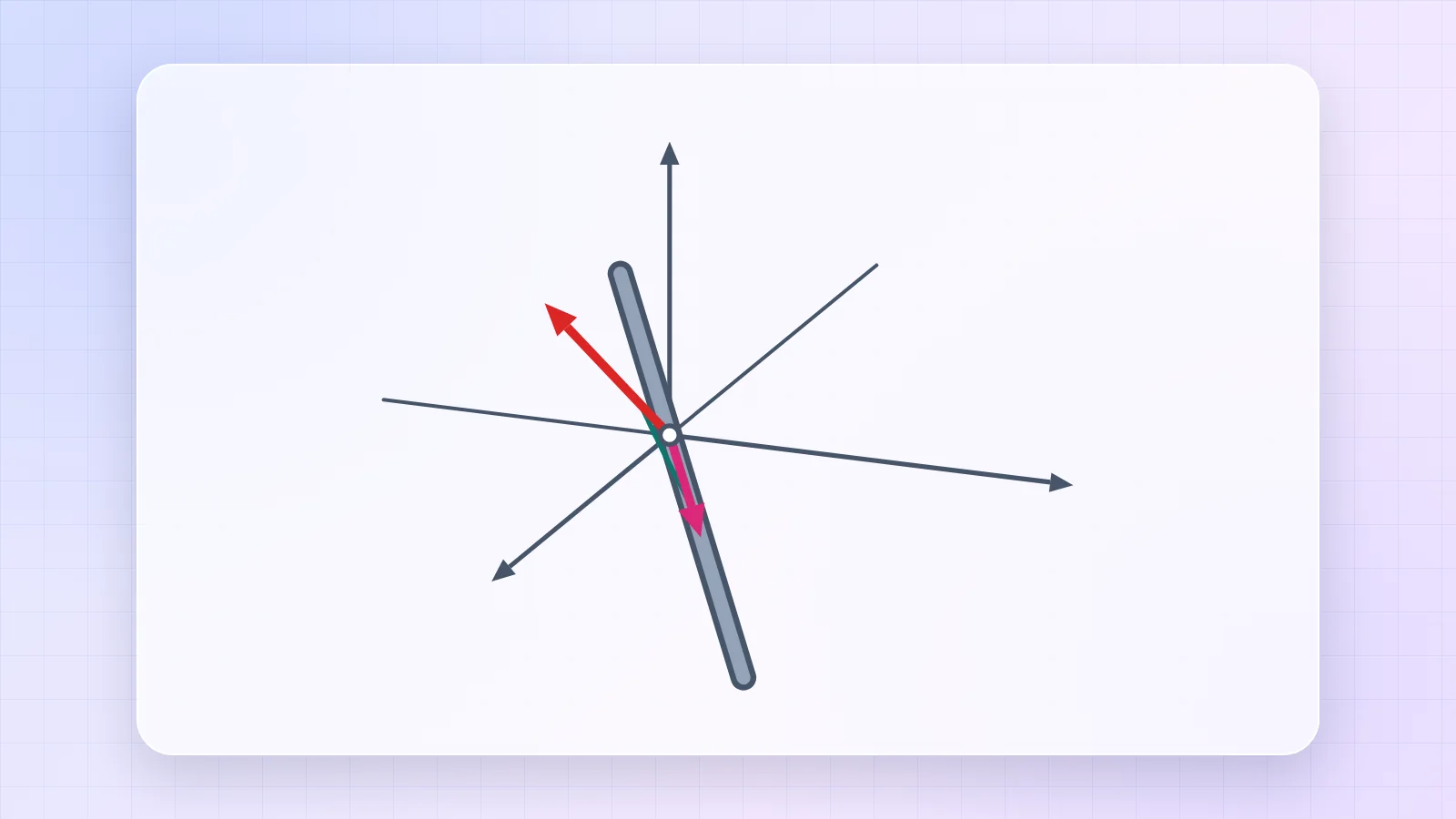
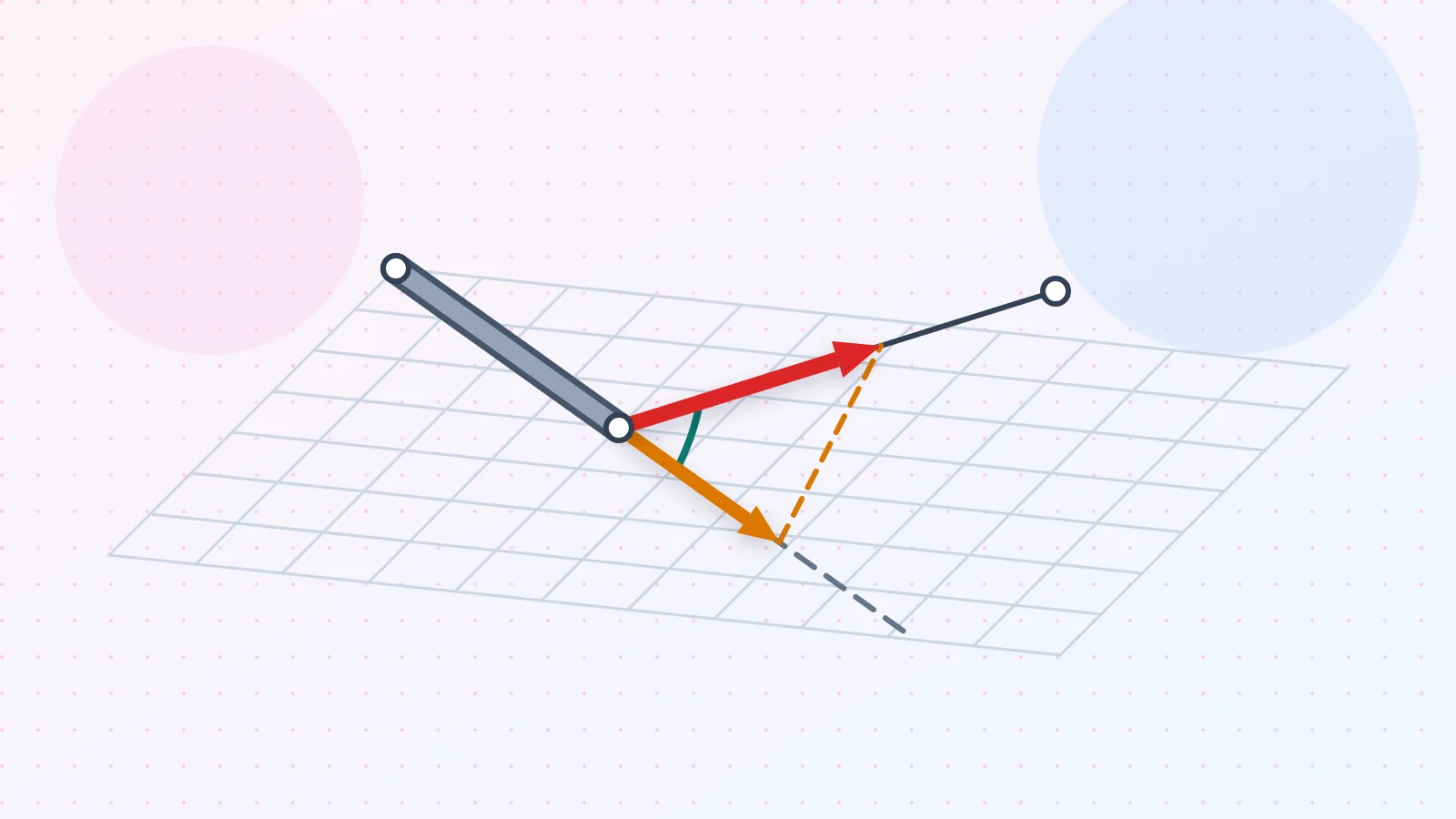
\(A\cos\theta\) is the perpendicular projection of \(\mathbf{A}\) on the line of \(\mathbf{B}\) (Figure 1), so the dot product is that projection times \(B\). It is positive for \(\theta < 90^\circ\), zero for perpendicular vectors and negative for \(\theta > 90^\circ\).
The dot product obeys three rules:
- commutative: \(\mathbf{A}\cdot\mathbf{B} = \mathbf{B}\cdot\mathbf{A}\);
- a scalar factor can be moved: \(a(\mathbf{A}\cdot\mathbf{B}) = (a\mathbf{A})\cdot\mathbf{B} = \mathbf{A}\cdot(a\mathbf{B})\);
- distributive: \(\mathbf{A}\cdot(\mathbf{B} + \mathbf{D}) = \mathbf{A}\cdot\mathbf{B} + \mathbf{A}\cdot\mathbf{D}\).
2. The dot product from components
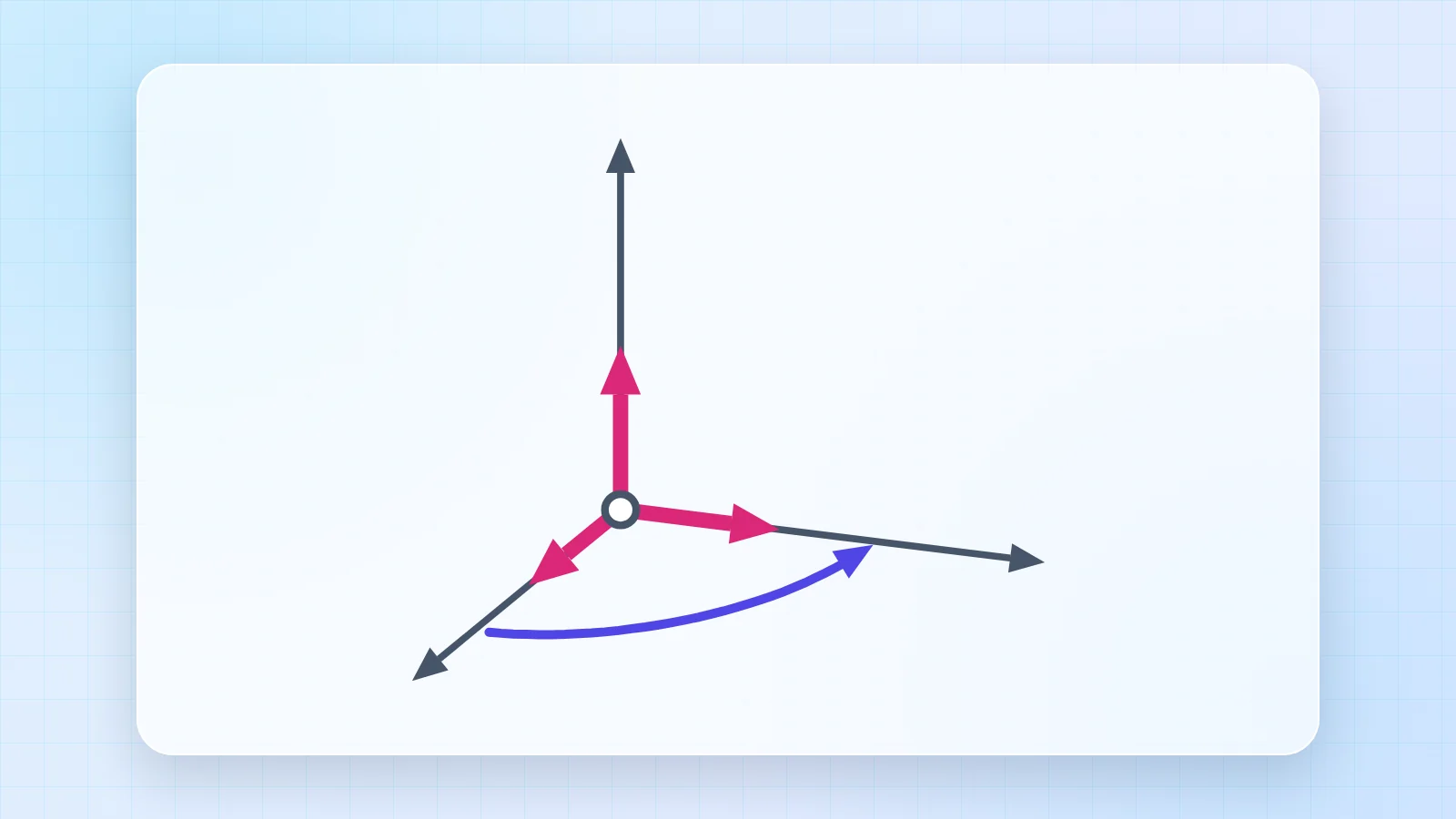
For the unit vectors, the angle between equal ones is \(0^\circ\) and between different ones \(90^\circ\): \(\mathbf{i}\cdot\mathbf{i} = \mathbf{j}\cdot\mathbf{j} = \mathbf{k}\cdot\mathbf{k} = 1\) and \(\mathbf{i}\cdot\mathbf{j} = \mathbf{j}\cdot\mathbf{k} = \mathbf{k}\cdot\mathbf{i} = 0\). Multiplying out two Cartesian vectors therefore leaves only three terms:
With \(\mathbf{B} = \mathbf{A}\), Equation 2 gives \(\mathbf{A}\cdot\mathbf{A} = A^2\), the square of the magnitude.
3. The angle between two lines
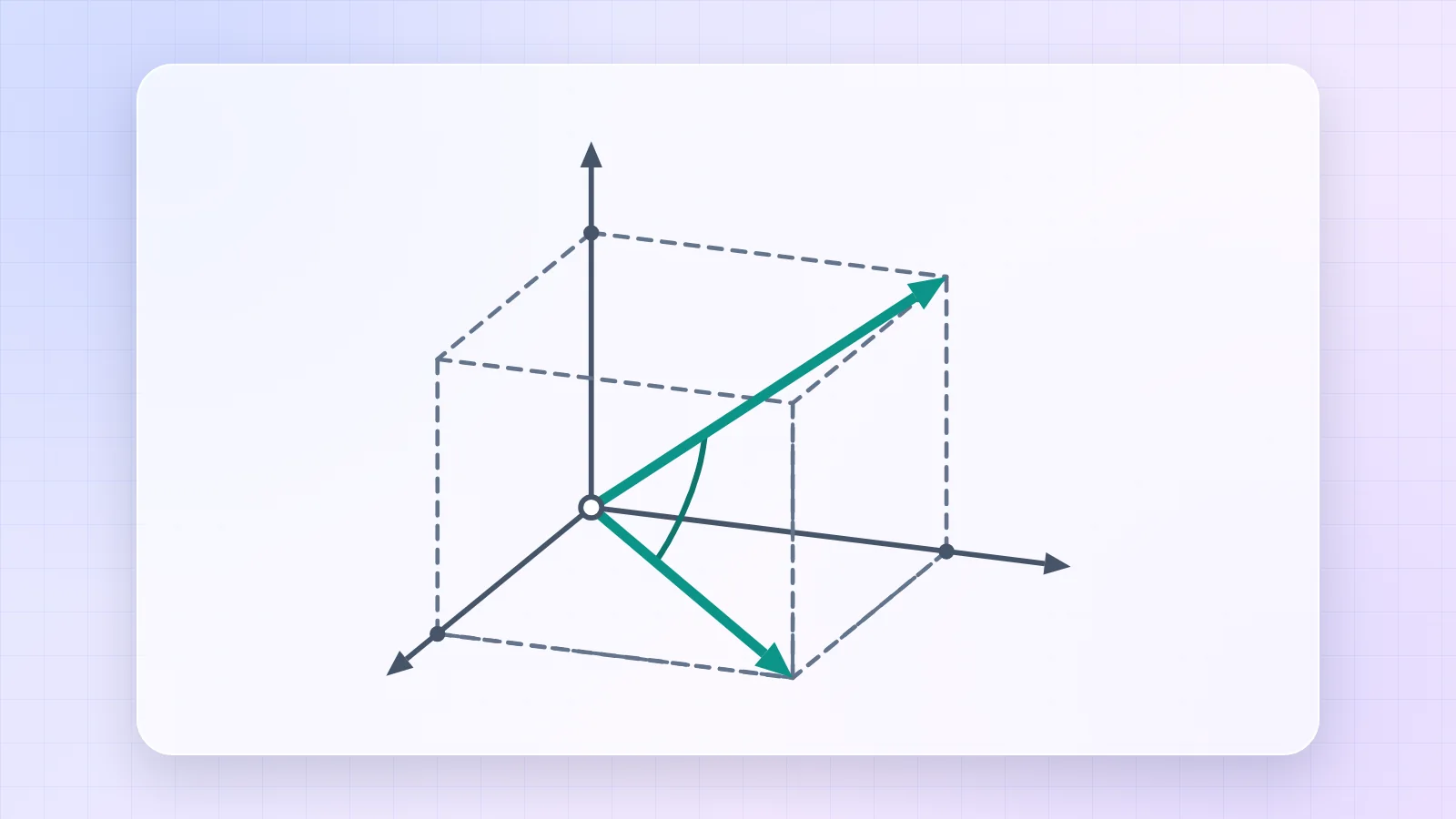
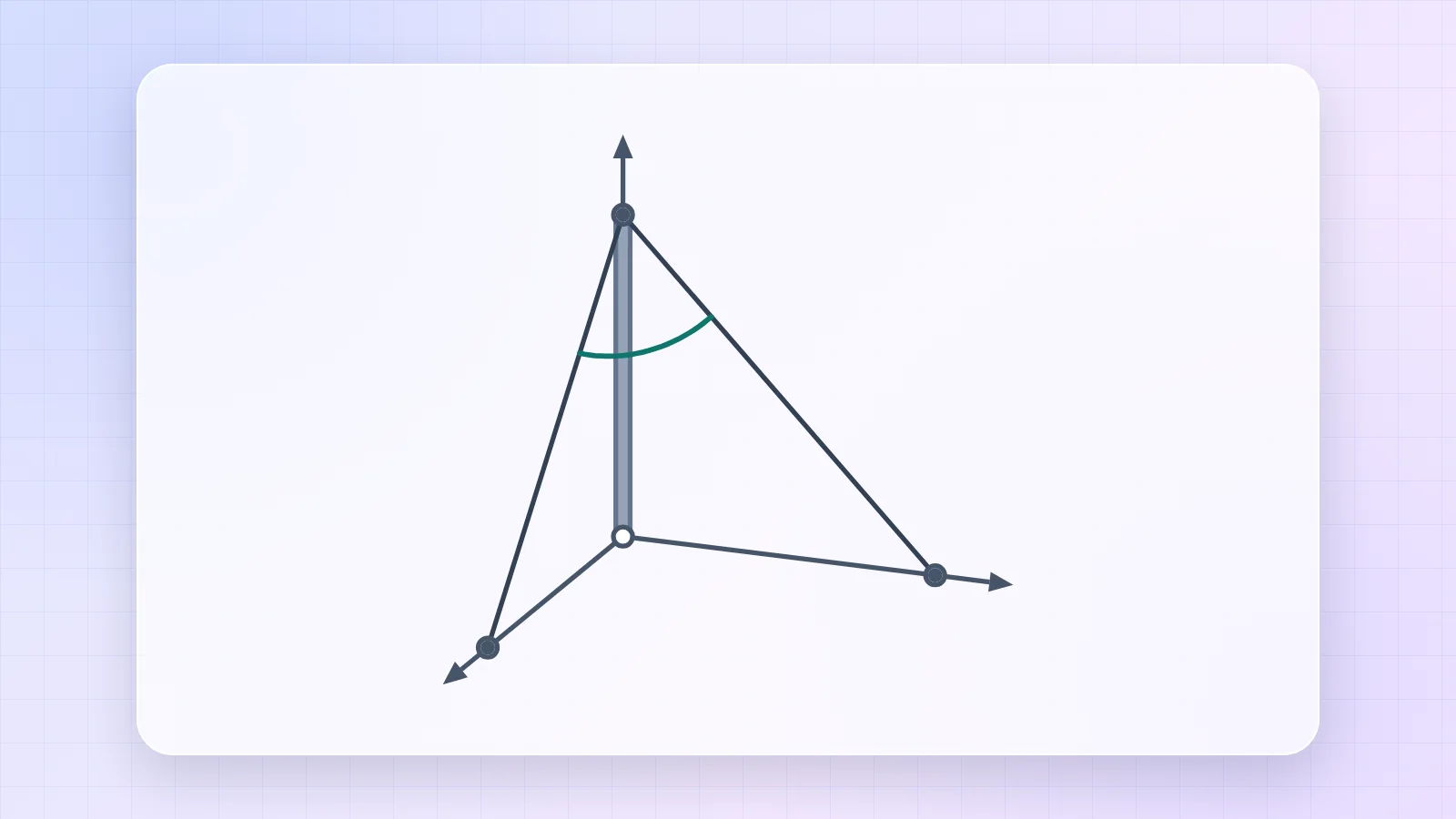
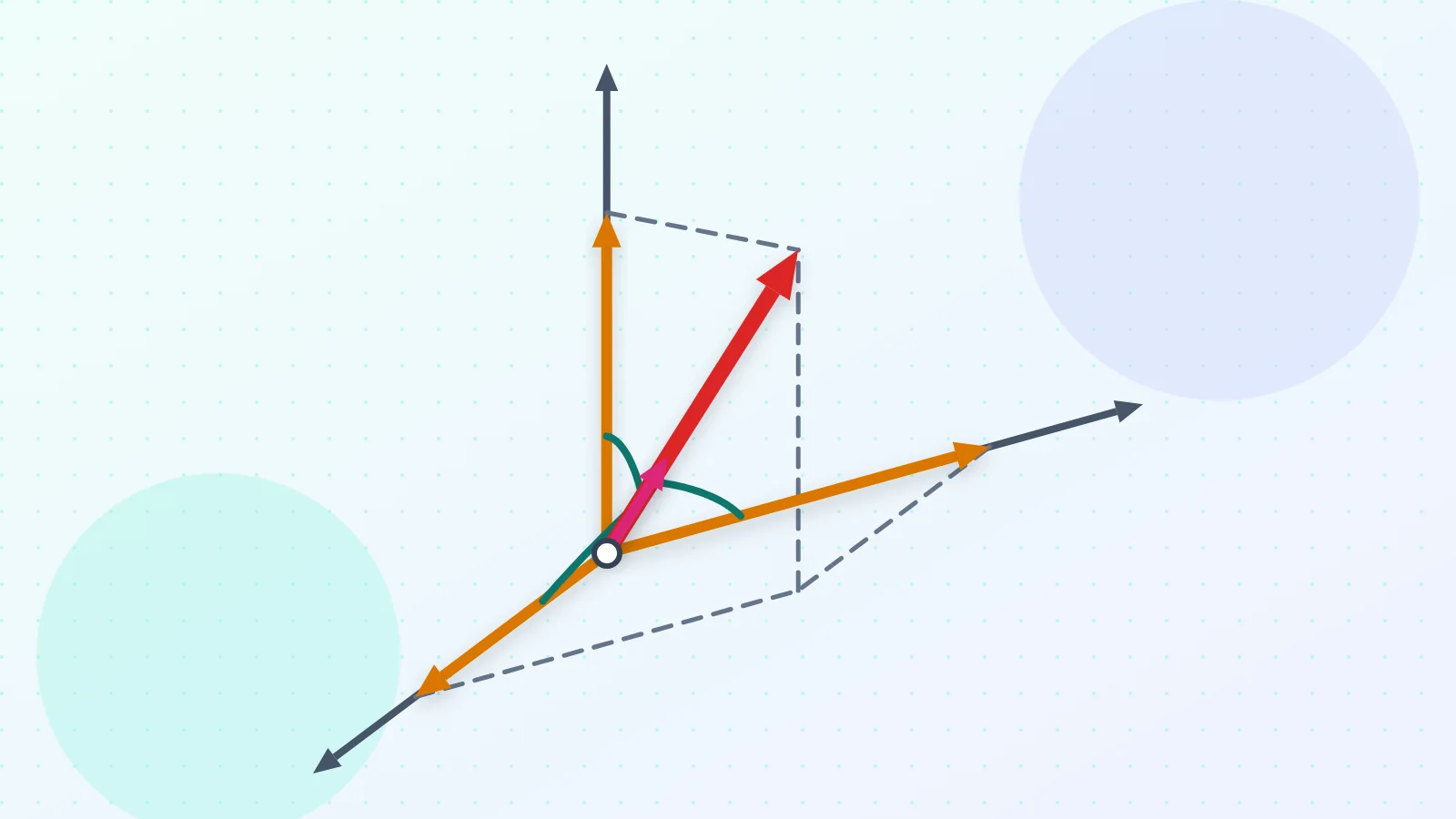
Equating Equations 1 and 2 gives the angle between any two vectors, or between two lines described by vectors along them:
The vectors along the lines usually come from point coordinates, as position vectors. Their tails must be at the same point, the vertex of the angle you want.
4. Components of a force along and across a line
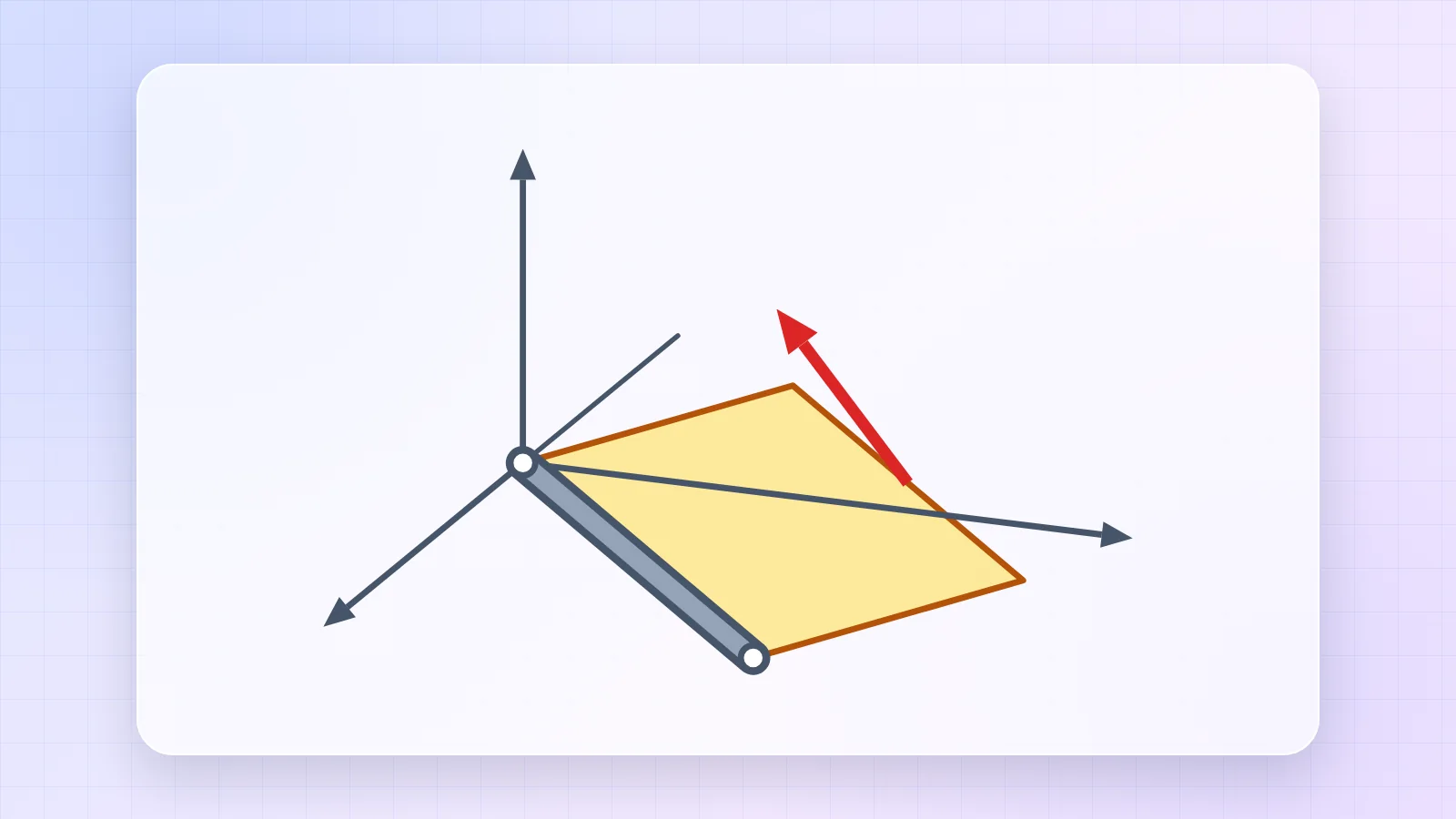
Let \(\mathbf{u}\) be the unit vector along a line \(a\). The component of \(\mathbf{F}\) parallel to the line is its projection, \(F_\parallel = F\cos\theta = \mathbf{F}\cdot\mathbf{u}\). The rest of the force is perpendicular to the line:
A negative \(F_\parallel\) means the parallel component points opposite to \(\mathbf{u}\). On the \(x\) axis, \(\mathbf{F}\cdot\mathbf{i} = F_x\): the rectangular components are projections on perpendicular axes.
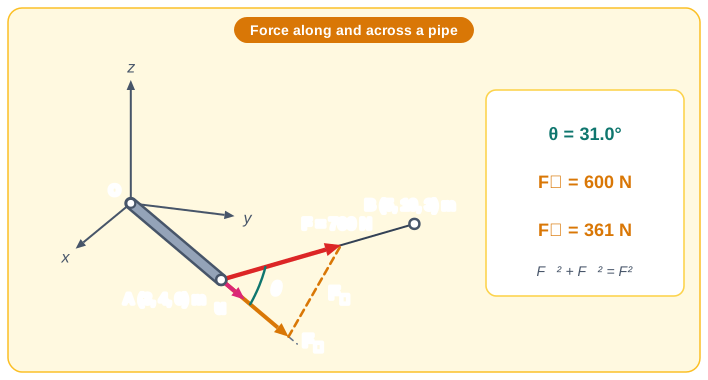
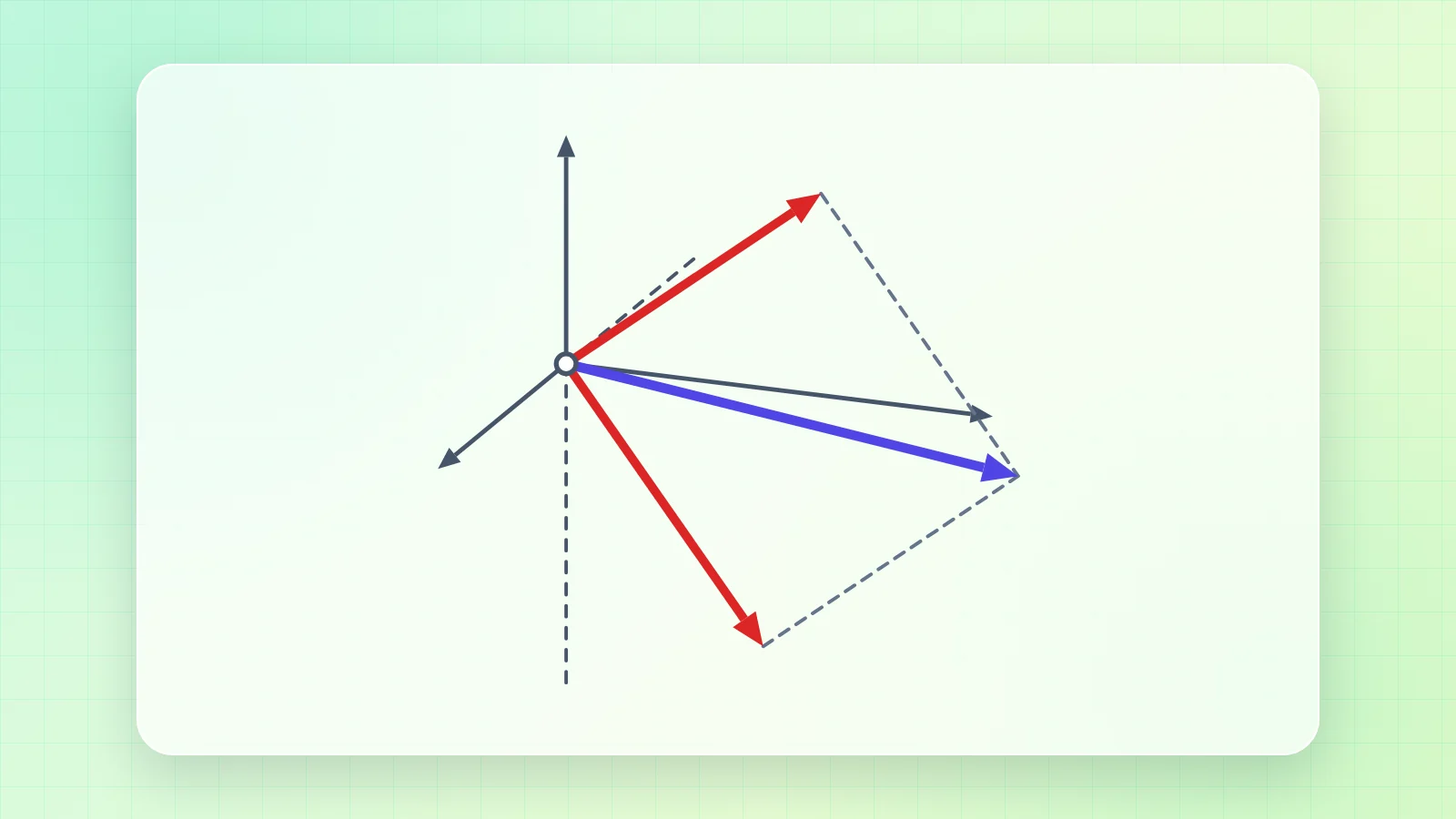
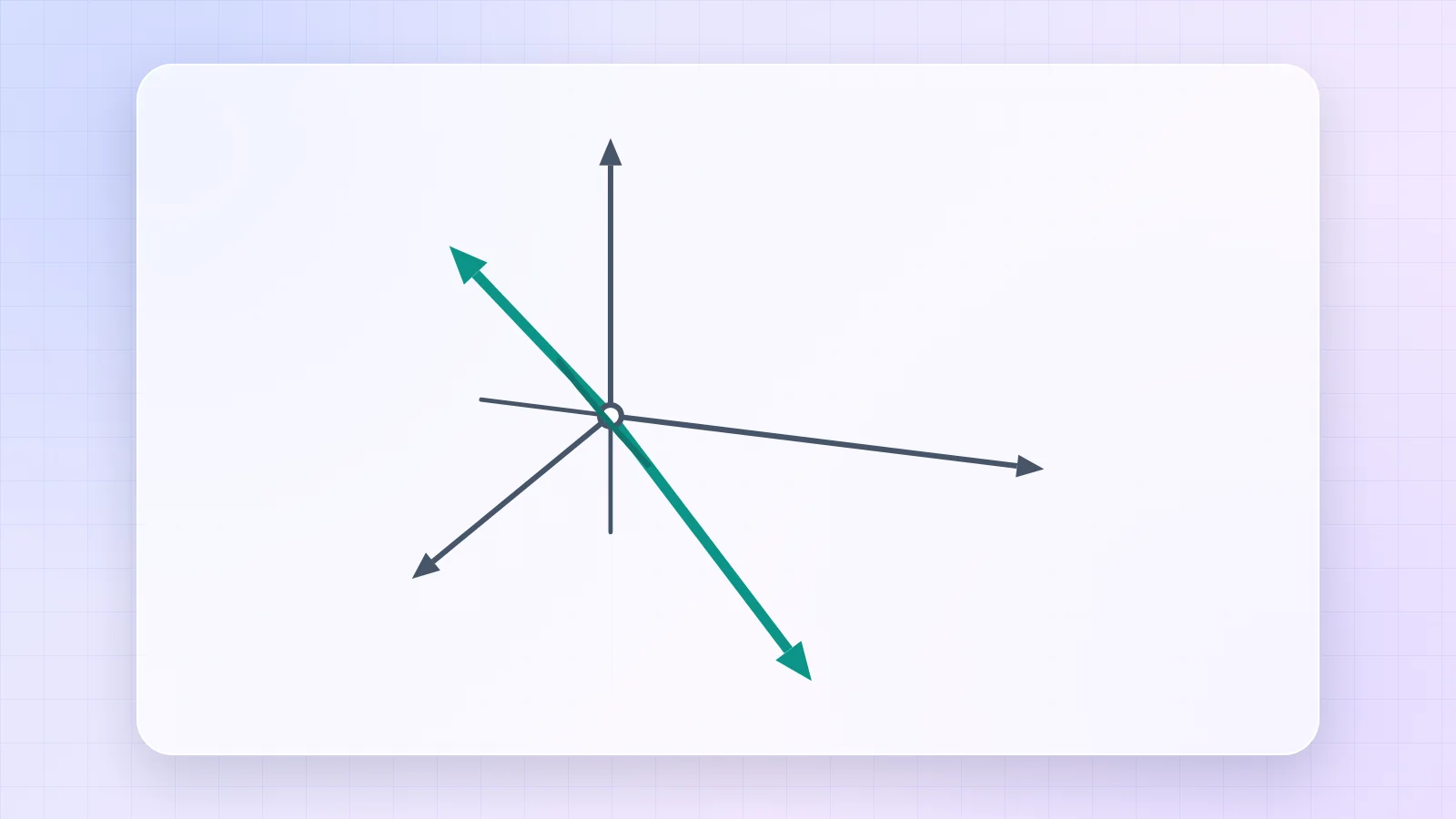
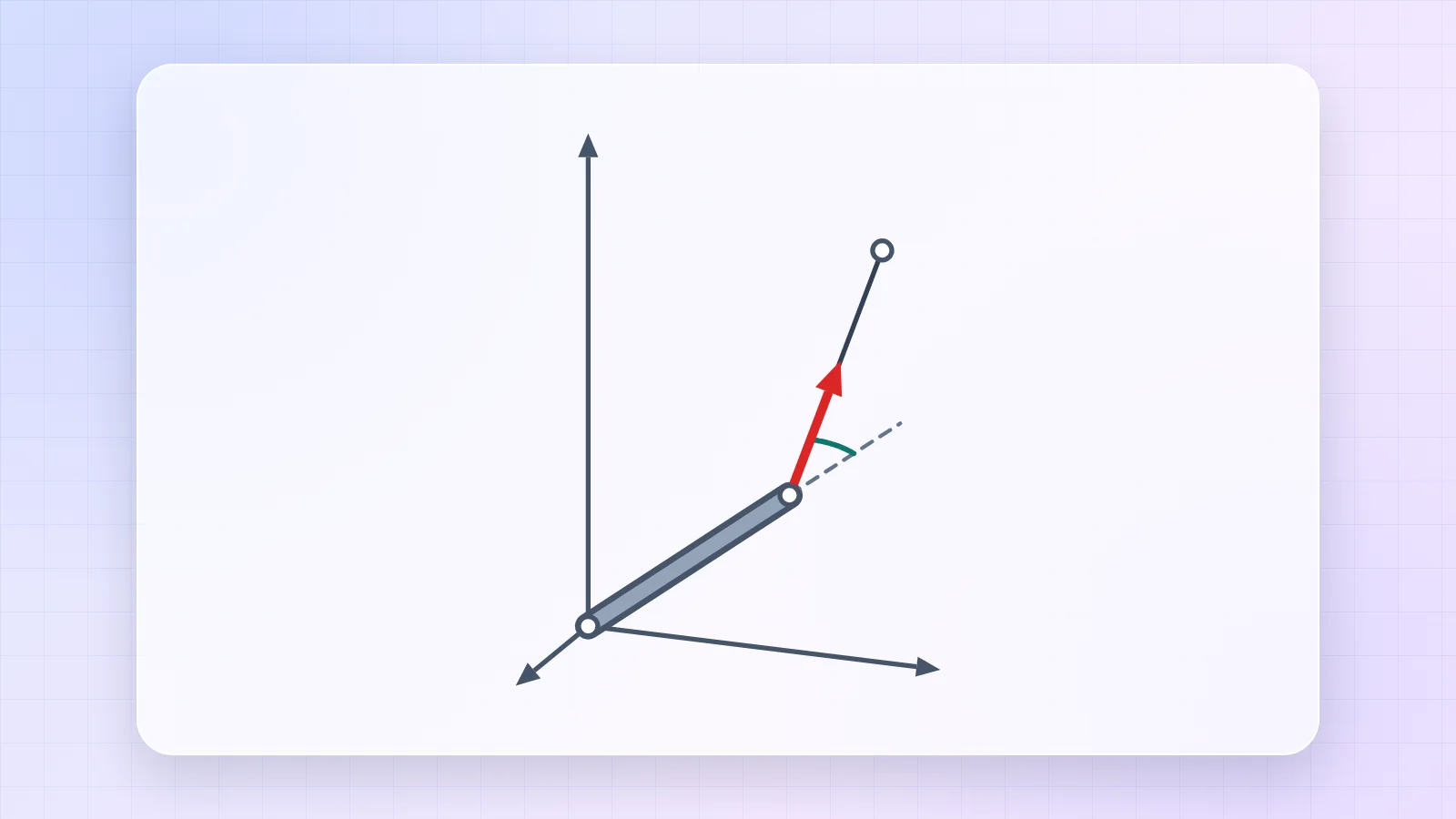
Cable on a pipe. A pipe runs from O (0, 0, 0) to A (3, 4, 0) m. A cable attached at A is pulled toward B (5, 10, 3) m with a force of 700 N (Figure 2). Find the angle between the cable and the pipe, and the components of the cable force along and across the pipe.
Vectors from A. Along the pipe, away from O: \(\mathbf{u} = (3\,\mathbf{i} + 4\,\mathbf{j})/5 = 0.6\,\mathbf{i} + 0.8\,\mathbf{j}\). Along the cable: \(\mathbf{r}_{AB} = \{2\,\mathbf{i} + 6\,\mathbf{j} + 3\,\mathbf{k}\}\,\text{m}\) with \(r_{AB} = 7\,\text{m}\), so
$$ \mathbf{F} = 700\,\frac{\mathbf{r}_{AB}}{7} = \{200\,\mathbf{i} + 600\,\mathbf{j} + 300\,\mathbf{k}\}\,\text{N} $$
Parallel component and angle. \(F_\parallel = \mathbf{F}\cdot\mathbf{u} = 200(0.6) + 600(0.8) + 300(0) = 600\,\text{N}\), and \(\theta = \cos^{-1}(600/700) = 31.0^\circ\).
Perpendicular component. \(F_\perp = \sqrt{700^2 - 600^2} = 361\,\text{N}\). As a vector, \(\mathbf{F}_\perp = \mathbf{F} - 600\,\mathbf{u} = \{-160\,\mathbf{i} + 120\,\mathbf{j} + 300\,\mathbf{k}\}\,\text{N}\).
Check. \(\mathbf{F}_\perp\cdot\mathbf{u} = -160(0.6) + 120(0.8) = 0\), so \(\mathbf{F}_\perp\) is indeed perpendicular to the pipe.
5. Checks
- \(\mathbf{u}\) must have length 1; \(F_\parallel\) can never exceed \(F\).
- \(F_\parallel^2 + F_\perp^2 = F^2\), and \(\mathbf{F}_\perp\cdot\mathbf{u} = 0\).
- The tails of both vectors must be at the vertex of the angle; a vector reversed by mistake gives \(180^\circ - \theta\).
Summary
- \(\mathbf{A}\cdot\mathbf{B} = AB\cos\theta = A_xB_x + A_yB_y + A_zB_z\); the result is a scalar.
- The angle between two lines: \(\theta = \cos^{-1}(\mathbf{u}_A\cdot\mathbf{u}_B)\).
- The component of a force along a line is \(F_\parallel = \mathbf{F}\cdot\mathbf{u}\); its vector form is \((\mathbf{F}\cdot\mathbf{u})\,\mathbf{u}\).
- The perpendicular component is \(\mathbf{F} - \mathbf{F}_\parallel\), with magnitude \(\sqrt{F^2 - F_\parallel^2}\).











Comments 0
Ask questions, explain a step or share a tip about this note.
Join the discussion
Log in to comment, reply and vote. It is free.
No comments yet
Ask a question, share a tip or say thanks. Be the first!