

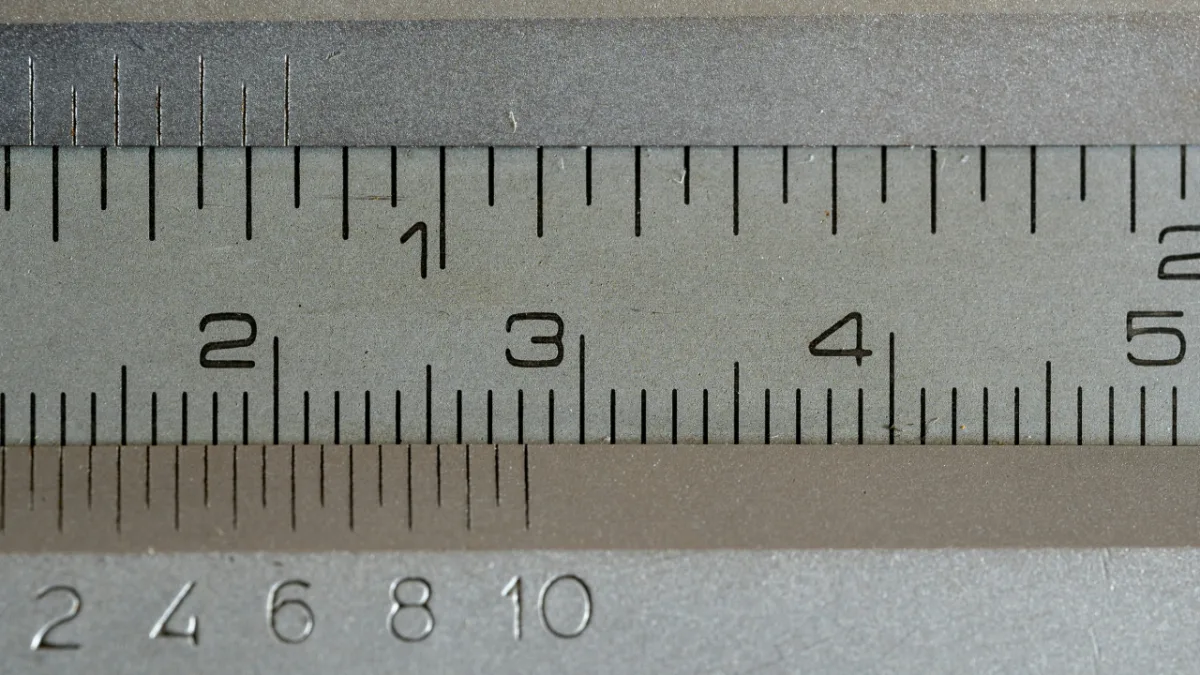

Unit conversion rewrites a quantity in a different unit: the number and the unit change together, while the physical quantity stays the same. This note explains one method that works for every unit, applies it to common engineering quantities from length to temperature, and ends with full conversion tables.
1. How unit conversion works
A quantity is a number multiplied by a unit: \(2.5\,\text{m}\) means \(2.5 \times (1\,\text{m})\). To convert it, the unit is replaced by an equal amount of another unit. A short length, a stress and an energy are all converted the same way.
Conversion factors are ratios equal to 1
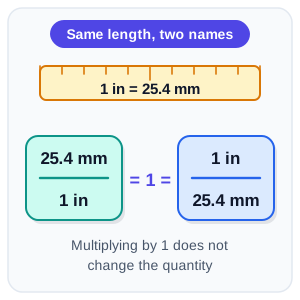
A definition such as 1 in = 25.4 mm says that two amounts are the same length. Written as a fraction, it becomes a conversion factor: a ratio equal to 1. Multiplying by it does not change the quantity, but it changes the unit.
Every definition gives two factors, one the inverse of the other (Figure 1). Choose the one that has the unit you want to remove on the opposite side of the fraction, so that it cancels.
The chain method step by step
- Write the quantity as a fraction with its units: 60 mi/h becomes 60 mi over 1 h.
- Add one factor for each unit you replace, with the old unit on the opposite side.
- Cancel the units and multiply the numbers. Only the new units should remain.
- Check the size. A smaller unit gives a larger number: 1 in is 25.4 mm, not 0.0254 mm.
- Round at the end, usually to three significant figures (four if the number starts with 1).
Exact and rounded factors. Many factors are exact by definition: 1 in = 25.4 mm, 1 lb = 0.45359237 kg, 1 kgf = 9.80665 N. Others are rounded when they are written down, such as 1 lbf = 4.448 N. Keep at least four significant figures in every factor and round only the final answer, so that the conversion adds no error of its own.
2. Length
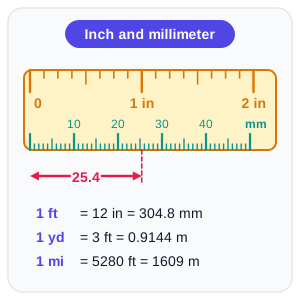
The SI unit of length is the meter (m). Prefixes give a unit for every scale: the micrometer (μm) for surface roughness, the millimeter (mm) for machine parts and the kilometer (km) for distances. Within SI a conversion only moves the decimal point, three places for each factor of 1000: 2.45 km = 2450 m = 2 450 000 mm.
The U.S. Customary units are the inch (in), foot (ft), yard (yd) and mile (mi). Since 1959 they have been defined from the meter, so their factors are exact: 1 in = 25.4 mm, 1 ft = 12 in = 0.3048 m, 1 yd = 3 ft = 0.9144 m and 1 mi = 5280 ft = 1609.344 m. Ships and aircraft use the nautical mile, 1 nmi = 1852 m.
Feet and inches to meters. Convert a height of 5 ft 8 in to meters. First write the height in one unit, then convert it:
\(5\,\text{ft} \times 12\,\text{in/ft} + 8\,\text{in} = 68\,\text{in}\), and \(68\,\text{in} \times 0.0254\,\text{m/in} = 1.727\,\text{m}\).
3. Mass
The SI unit of mass is the kilogram (kg), the only base unit with a prefix in its name. Small masses are given in grams (g) and large ones in tonnes (1 t = 1000 kg). U.S. Customary units give mass in pounds (lb, also written lbm), ounces (1 lb = 16 oz) and tons, and mechanics problems use the slug.
The pound is defined exactly as 1 lb = 0.45359237 kg. The slug is the mass that a force of 1 lbf accelerates at 1 ft/s², which gives 1 slug = 14.59 kg.
Pounds to kilograms. Convert a mass of 150 lb to kilograms: \(150\,\text{lb} \times 0.45359237\,\text{kg/lb} = 68.0\,\text{kg}\).
Mass units are easy to mix up, because the same names are used for different amounts and even for different quantities.
Tonne, ton and the two pounds. A metric tonne is 1000 kg, a U.S. short ton is 907.2 kg and a UK long ton is 1016 kg. The pound is used both for mass (lbm) and for force (lbf), and a mass of 1 lbm weighs 1 lbf only under standard gravity. Kilograms always measure mass, never force.
4. Force
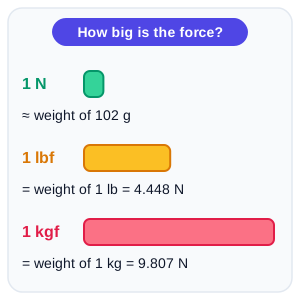
In SI, force is a derived unit. One newton (N) is the force that gives a 1 kg mass an acceleration of 1 m/s², so 1 N = 1 kg·m/s². Engineering loads are usually given in kilonewtons (kN) or meganewtons (MN).
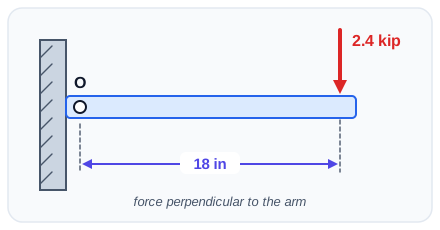
The pound-force (lbf) and the kilogram-force (kgf) are defined as the weight of 1 lb and of 1 kg under standard gravity, \(g_0 = 9.80665\,\text{m/s}^2\). U.S. structural loads are often given in kips (1 kip = 1000 lbf).
Since 1 kip = 1000 lbf = 4.448 kN, a load in kips converts directly to kilonewtons.
Kips to kilonewtons. A column carries a load of 2.5 kip: \(2.5\,\text{kip} \times 4.448222\,\text{kN/kip} = 11.12\,\text{kN}\).
5. Area

Area is a length squared, so its conversion factor is the length factor squared. Since 1 m = 100 cm, 1 m² = (100 cm)² = 10 000 cm², not 100 cm² (Figure 5). In the same way 1 ft² = 144 in² and 1 m² = 10⁶ mm².
Land areas are given in hectares (1 ha = 10 000 m²) and acres (1 acre = 4047 m²).
Square inches to square millimeters. A steel bar has a cross-sectional area of 3 in². Square the whole length factor in the chain:
\(3\,\text{in}^2 \times (25.4\,\text{mm/in})^{2} = 3 \times 645.16\,\text{mm}^2 = 1935\,\text{mm}^2\)
6. Volume
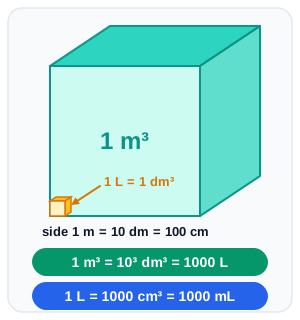
Volume is a length cubed, so the length factor is cubed: 1 m³ = (100 cm)³ = 10⁶ cm³ and 1 ft³ = (12 in)³ = 1728 in³. For liquids the liter is common: 1 L = 1 dm³ = 1000 cm³, so 1 m³ = 1000 L and 1 mL = 1 cm³ (Figure 6).
U.S. liquid volumes are given in gallons, defined as 231 in³ = 3.785 L. The imperial (UK) gallon is larger, 4.546 L, so check which gallon a source means.
Gallons to cubic meters. A tank holds 250 gal:
\(250\,\text{gal} \times \dfrac{3.785412\,\text{L}}{1\,\text{gal}} \times \dfrac{1\,\text{m}^3}{1000\,\text{L}} = 0.946\,\text{m}^3\)
7. Moment and torque
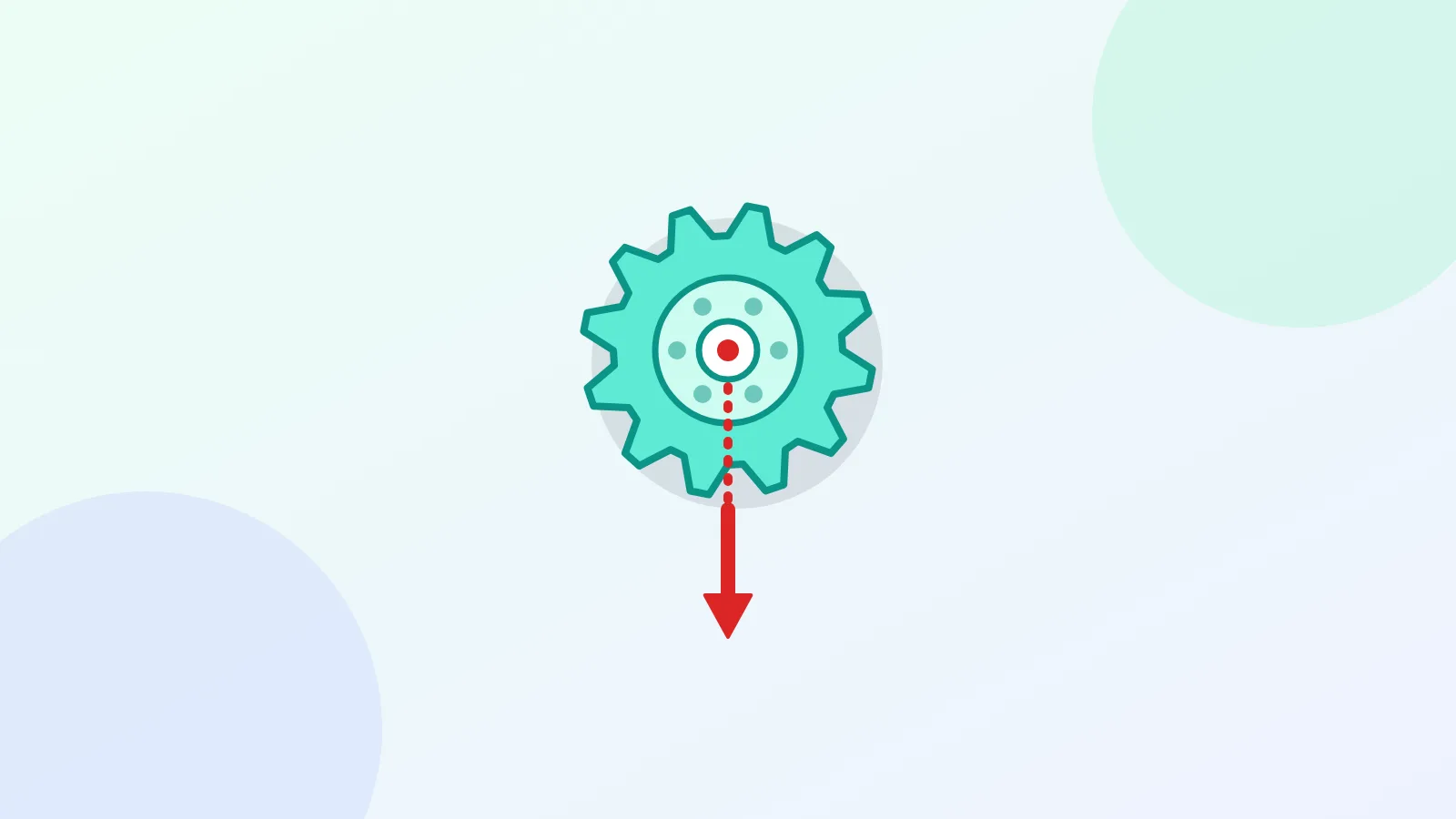
A moment, or torque, is a force multiplied by a distance, so its unit is a product of two units: N·m, kN·m or N·mm in SI, and lbf·ft (often written lb·ft), lbf·in or kip·ft in U.S. Customary units. Each unit of the product is converted with its own factor.
Within SI, 1 kN·m = (1000 N)(1000 mm) = 10⁶ N·mm. The newton meter has the same dimensions as the joule, but a moment is always written in N·m; the joule is kept for work and energy.
Torque on a bolt. A torque wrench is set to 1200 lbf·in:
\(1200\,\text{lbf}\cdot\text{in} \times \dfrac{4.448222\,\text{N}}{1\,\text{lbf}} \times \dfrac{0.0254\,\text{m}}{1\,\text{in}} = 135.6\,\text{N}\cdot\text{m}\)
8. Work and energy
Work is a force times the distance it moves through, so the SI unit of work and energy is the joule: 1 J = 1 N·m. Larger amounts are given in kJ and MJ. Several other energy units are still in daily use:
- Kilowatt hour (kW·h): electricity bills; 1 kW·h = 3.6 MJ.
- Calorie: heat and food; 1 cal = 4.184 J, and the food Calorie is 1 kcal = 4.184 kJ.
- British thermal unit (BTU): heating and cooling; 1 BTU = 1055 J.
- Foot pound-force (ft·lbf): U.S. mechanics; 1 ft·lbf = 1.356 J.
The other energy factors follow from their definitions in the same way; all of them are listed in the appendix.
Food energy. Convert a daily diet of 2000 kcal to megajoules and kilowatt hours:
\(2000\,\text{kcal} \times 4.184\,\text{kJ/kcal} = 8368\,\text{kJ} = 8.37\,\text{MJ}\), and \(8.368\,\text{MJ} \div 3.6\,\text{MJ}/(\text{kW}\cdot\text{h}) = 2.32\,\text{kW}\cdot\text{h}\).
9. Stress and pressure
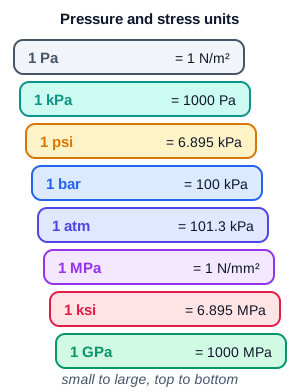
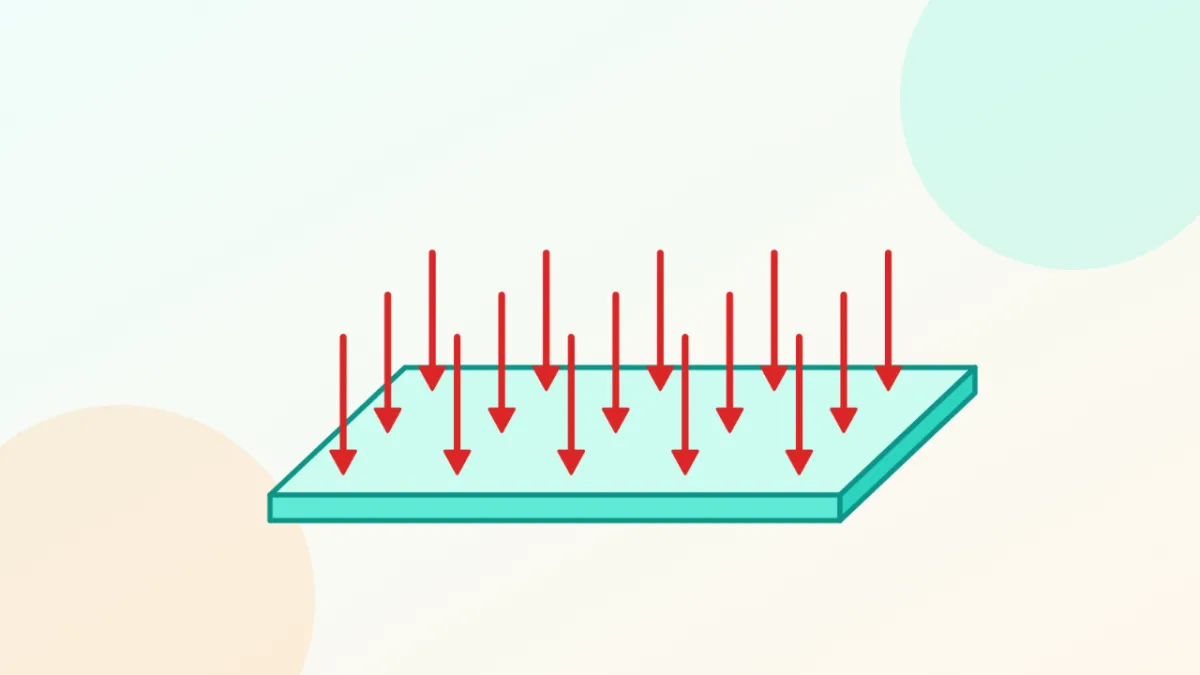
Stress and pressure are both a force per unit area. The SI unit is the pascal: 1 Pa = 1 N/m². The pascal is very small, so engineers use kilopascals (kPa) for soil and fluid pressures, megapascals (MPa) for stresses in materials and gigapascals (GPa) for elastic moduli.
A useful identity is 1 MPa = 1 N/mm²: a force in newtons divided by an area in square millimeters gives the stress directly in MPa. U.S. Customary stresses are given in psi (lbf/in²) and ksi (1000 psi). Pressures also appear in bar (100 kPa), standard atmospheres (1 atm = 101.325 kPa) and millimeters of mercury (Figure 7).
Since 1 ksi = 1000 psi, the same factor gives 1 ksi = 6.895 MPa.
Yield strength in MPa. A structural steel has a yield strength of 36 ksi: \(36\,\text{ksi} \times 6.894757\,\text{MPa/ksi} = 248\,\text{MPa}\).
A tire gauge reads the pressure above the atmosphere (gauge pressure). Absolute pressure is the gauge pressure plus the atmospheric pressure, about 101 kPa. A unit conversion does not change one into the other; in U.S. units the two are marked psig and psia.
10. Velocity and acceleration
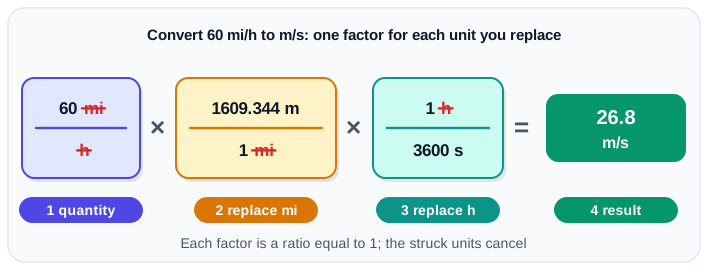
Velocity is a length divided by a time, so its conversion needs two factors, one for the length and one for the time (Figure 2). The most common case is km/h to m/s:
So divide km/h by 3.6 to get m/s, and multiply m/s by 3.6 to get km/h. Other exact factors are 1 mi/h = 0.44704 m/s and 1 ft/s = 0.3048 m/s; at sea, 1 knot = 1 nmi/h = 0.5144 m/s.
In an acceleration the time appears squared, so the time factor must be squared too. Accelerations are often given as multiples of standard gravity, \(g_0 = 9.80665\,\text{m/s}^2 = 32.17\,\text{ft/s}^2\). Rotational speed is usually given in revolutions per minute (rpm); one revolution is \(2\pi\) rad, so 1 rpm = 0.1047 rad/s.
Speeds and accelerations.
- A car at 100 km/h: \(100 \div 3.6 = 27.8\,\text{m/s}\).
- A motor at 1500 rpm: \(1500 \times 2\pi/60 = 157.1\,\text{rad/s}\).
- An acceleration of 3g: \(3 \times 9.80665\,\text{m/s}^2 = 29.4\,\text{m/s}^2\).
11. Density
Density is mass per unit volume, \(\rho = m/V\), with the SI unit kg/m³. Laboratory values are often given in g/cm³, and 1 g/cm³ = 1 kg/L = 1000 kg/m³. Water has a density of about 1000 kg/m³ and steel about 7850 kg/m³.
U.S. Customary densities are given in lb/ft³ or lb/in³, with the pound as a mass, or in slug/ft³. Do not confuse density with specific weight \(\gamma = \rho g\), which is a weight per unit volume in N/m³ or lbf/ft³: for water, \(\gamma = 9.81\,\text{kN/m}^3 = 62.4\,\text{lbf/ft}^3\).
To convert a density from SI to lb/ft³, divide by this factor.
Density of aluminum. Convert 2700 kg/m³ to lb/ft³ by dividing by the factor of Equation 8: \(2700 \div 16.01846 = 168.6\,\text{lb/ft}^3\).
12. Power
Power is the rate of doing work. Its SI unit is the watt, 1 W = 1 J/s; motors and engines are rated in kW and power plants in MW. The horsepower is still common: the mechanical horsepower is defined as 550 ft·lbf/s, while the metric horsepower (PS) is 735.5 W. Heating and cooling equipment is rated in BTU/h or in tons of refrigeration (1 ton = 12 000 BTU/h = 3.517 kW).
So 1 hp = 0.7457 kW, and 1 kW = 1.341 hp.
Engine power. An engine is rated at 150 hp: \(150\,\text{hp} \times 0.7457\,\text{kW/hp} = 111.9\,\text{kW}\).
13. Temperature
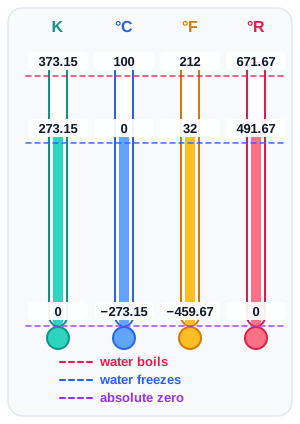
Temperature is the one common quantity whose units do not share the same zero. The Celsius (°C) and Fahrenheit (°F) scales start from practical reference points, while the kelvin (K) and Rankine (°R) scales start at absolute zero (Figure 8). A conversion therefore needs an offset as well as a factor:
Here \(T_{\mathrm{C}}\) is the temperature in °C, \(T_{\mathrm{F}}\) in °F, and so on. A kelvin and a degree Celsius have the same size, and so do a degree Fahrenheit and a degree Rankine; one kelvin is 1.8 °F.
| Point | K | °C | °F | °R |
|---|---|---|---|---|
| Absolute zero | 0 | −273.15 | −459.67 | 0 |
| Water freezes | 273.15 | 0 | 32 | 491.67 |
| Room temperature | 293.15 | 20 | 68 | 527.67 |
| Body temperature | 310.15 | 37 | 98.6 | 558.27 |
| Water boils (1 atm) | 373.15 | 100 | 212 | 671.67 |
Oven temperature. Convert 350 °F to °C and K: \(T_{\mathrm{C}} = (350 - 32)/1.8 = 176.7\,{}^{\circ}\text{C}\), and \(T_{\mathrm{K}} = 176.7 + 273.15 = 449.8\,\text{K}\).
The offsets belong to temperatures, not to temperature differences.
Temperature differences have no offset. A rise from 20 °C to 30 °C is a change of 10 °C = 10 K = 18 °F, not 50 °F. Use only the factor 1.8 for a difference, for example in the thermal expansion \(\Delta L = \alpha L\,\Delta T\).
Summary
- A conversion factor is a ratio equal to 1; multiply by it so that the unwanted unit cancels.
- Use one factor for each unit you replace, and keep at least four significant figures until the end.
- Square the length factor for areas and cube it for volumes.
- For compound units such as N·m, N/m² and m/s, convert each unit with its own factor.
- The kilogram and the pound (lbm) are masses; the newton, the lbf and the kgf are forces.
- Temperatures need an offset; temperature differences do not.
Appendix: Conversion tables
Each table lists the units of one quantity. The third column gives one unit in the SI unit: multiply by it to convert into SI. The fourth column gives one SI unit in that unit: multiply by it to convert out of SI. To convert between two non-SI units, go through SI. For example, 1 yd = 0.9144 m and 1 ft = 0.3048 m, so 1 yd = 0.9144/0.3048 ft = 3 ft.
Values in bold are exact by definition, and so are powers of ten. All other values are rounded to seven significant figures.
A.1 Length
| Unit | Symbol | Value in m | 1 m in this unit |
|---|---|---|---|
| nanometer | nm | \(10^{-9}\) | \(10^{9}\) |
| micrometer | μm | \(10^{-6}\) | \(10^{6}\) |
| millimeter | mm | 0.001 | 1000 |
| centimeter | cm | 0.01 | 100 |
| meter | m | 1 | 1 |
| kilometer | km | 1000 | 0.001 |
| mil (thou) | mil | \(\mathbf{2.54\times10^{-5}}\) | 39 370.08 |
| inch | in | 0.0254 | 39.37008 |
| foot | ft | 0.3048 | 3.280840 |
| yard | yd | 0.9144 | 1.093613 |
| mile | mi | 1609.344 | \(6.213712\times10^{-4}\) |
| nautical mile | nmi | 1852 | \(5.399568\times10^{-4}\) |
A.2 Mass
| Unit | Symbol | Value in kg | 1 kg in this unit |
|---|---|---|---|
| milligram | mg | \(10^{-6}\) | \(10^{6}\) |
| gram | g | 0.001 | 1000 |
| kilogram | kg | 1 | 1 |
| tonne (metric ton) | t | 1000 | 0.001 |
| ounce | oz | 0.028349523125 | 35.27396 |
| pound (mass) | lb, lbm | 0.45359237 | 2.204623 |
| slug | slug | 14.59390 | 0.06852177 |
| short ton (U.S.) | ton | 907.18474 | 0.001102311 |
| long ton (UK) | ton | 1016.0469088 | \(9.842065\times10^{-4}\) |
A.3 Force
| Unit | Symbol | Value in N | 1 N in this unit |
|---|---|---|---|
| dyne | dyn | \(10^{-5}\) | 100 000 |
| millinewton | mN | 0.001 | 1000 |
| newton | N | 1 | 1 |
| kilonewton | kN | 1000 | 0.001 |
| meganewton | MN | \(10^{6}\) | \(10^{-6}\) |
| ounce-force | ozf | 0.2780139 | 3.596943 |
| pound-force | lbf, lb | 4.448222 | 0.2248089 |
| kilogram-force | kgf | 9.80665 | 0.1019716 |
| kip (1000 lbf) | kip | 4448.222 | \(2.248089\times10^{-4}\) |
| short ton-force | tonf | 8896.443 | \(1.124045\times10^{-4}\) |
| tonne-force | tf | 9806.65 | \(1.019716\times10^{-4}\) |
A.4 Area
| Unit | Symbol | Value in m² | 1 m² in this unit |
|---|---|---|---|
| square millimeter | mm² | \(10^{-6}\) | \(10^{6}\) |
| square centimeter | cm² | \(10^{-4}\) | 10 000 |
| square meter | m² | 1 | 1 |
| hectare | ha | 10 000 | \(10^{-4}\) |
| square kilometer | km² | \(10^{6}\) | \(10^{-6}\) |
| square inch | in² | \(\mathbf{6.4516\times10^{-4}}\) | 1550.003 |
| square foot | ft² | 0.09290304 | 10.76391 |
| square yard | yd² | 0.83612736 | 1.195990 |
| acre | ac | 4046.8564224 | \(2.471054\times10^{-4}\) |
| square mile | mi² | \(2.589988\times10^{6}\) | \(3.861022\times10^{-7}\) |
A.5 Volume
| Unit | Symbol | Value in m³ | 1 m³ in this unit |
|---|---|---|---|
| cubic millimeter | mm³ | \(10^{-9}\) | \(10^{9}\) |
| cubic centimeter (milliliter) | cm³, mL | \(10^{-6}\) | \(10^{6}\) |
| liter | L | 0.001 | 1000 |
| cubic meter | m³ | 1 | 1 |
| cubic inch | in³ | \(\mathbf{1.6387064\times10^{-5}}\) | 61 023.74 |
| cubic foot | ft³ | 0.028316846592 | 35.31467 |
| cubic yard | yd³ | 0.764554857984 | 1.307951 |
| U.S. fluid ounce | fl oz | \(\mathbf{2.95735295625\times10^{-5}}\) | 33 814.02 |
| U.S. gallon | gal | 0.003785411784 | 264.1721 |
| imperial gallon | gal (UK) | 0.00454609 | 219.9692 |
| oil barrel (42 gal) | bbl | 0.158987294928 | 6.289811 |
A.6 Moment and torque
| Unit | Symbol | Value in N·m | 1 N·m in this unit |
|---|---|---|---|
| newton millimeter | N·mm | 0.001 | 1000 |
| newton meter | N·m | 1 | 1 |
| kilonewton meter | kN·m | 1000 | 0.001 |
| kilogram-force meter | kgf·m | 9.80665 | 0.1019716 |
| pound-force inch | lbf·in | 0.1129848 | 8.850746 |
| pound-force foot | lbf·ft | 1.355818 | 0.7375621 |
| kip inch | kip·in | 112.9848 | 0.008850746 |
| kip foot | kip·ft | 1355.818 | \(7.375621\times10^{-4}\) |
A.7 Work and energy
| Unit | Symbol | Value in J | 1 J in this unit |
|---|---|---|---|
| electronvolt | eV | \(\mathbf{1.602176634\times10^{-19}}\) | \(6.241509\times10^{18}\) |
| erg | erg | \(10^{-7}\) | \(10^{7}\) |
| joule | J | 1 | 1 |
| kilojoule | kJ | 1000 | 0.001 |
| megajoule | MJ | \(10^{6}\) | \(10^{-6}\) |
| watt hour | W·h | 3600 | \(2.777778\times10^{-4}\) |
| kilowatt hour | kW·h | \(\mathbf{3.6\times10^{6}}\) | \(2.777778\times10^{-7}\) |
| calorie (thermochemical) | cal | 4.184 | 0.2390057 |
| kilocalorie (food Calorie) | kcal | 4184 | \(2.390057\times10^{-4}\) |
| British thermal unit (IT) | BTU | 1055.05585262 | \(9.478171\times10^{-4}\) |
| foot pound-force | ft·lbf | 1.355818 | 0.7375621 |
A.8 Stress and pressure
| Unit | Symbol | Value in Pa | 1 Pa in this unit |
|---|---|---|---|
| pascal | Pa | 1 | 1 |
| kilopascal | kPa | 1000 | 0.001 |
| megapascal (= N/mm²) | MPa | \(10^{6}\) | \(10^{-6}\) |
| gigapascal | GPa | \(10^{9}\) | \(10^{-9}\) |
| bar | bar | 100 000 | \(10^{-5}\) |
| standard atmosphere | atm | 101 325 | \(9.869233\times10^{-6}\) |
| millimeter of mercury | mmHg | 133.322387415 | 0.007500616 |
| torr | Torr | 133.3224 | 0.007500617 |
| inch of mercury | inHg | 3386.389 | \(2.952998\times10^{-4}\) |
| kilogram-force per cm² | kgf/cm² | 98 066.5 | \(1.019716\times10^{-5}\) |
| pound per square foot | psf | 47.88026 | 0.02088543 |
| pound per square inch | psi | 6894.757 | \(1.450377\times10^{-4}\) |
| kip per square inch | ksi | \(6.894757\times10^{6}\) | \(1.450377\times10^{-7}\) |
A.9 Velocity
| Unit | Symbol | Value in m/s | 1 m/s in this unit |
|---|---|---|---|
| millimeter per second | mm/s | 0.001 | 1000 |
| meter per minute | m/min | 0.01666667 | 60 |
| kilometer per hour | km/h | 0.2777778 | 3.6 |
| meter per second | m/s | 1 | 1 |
| inch per second | in/s | 0.0254 | 39.37008 |
| foot per minute | ft/min | 0.00508 | 196.8504 |
| foot per second | ft/s | 0.3048 | 3.280840 |
| mile per hour | mi/h, mph | 0.44704 | 2.236936 |
| knot | kn | 0.5144444 | 1.943844 |
A.10 Acceleration
| Unit | Symbol | Value in m/s² | 1 m/s² in this unit |
|---|---|---|---|
| centimeter per second squared (gal) | cm/s², Gal | 0.01 | 100 |
| meter per second squared | m/s² | 1 | 1 |
| inch per second squared | in/s² | 0.0254 | 39.37008 |
| foot per second squared | ft/s² | 0.3048 | 3.280840 |
| standard gravity | g₀ | 9.80665 | 0.1019716 |
A.11 Density
| Unit | Symbol | Value in kg/m³ | 1 kg/m³ in this unit |
|---|---|---|---|
| gram per liter | g/L | 1 | 1 |
| kilogram per cubic meter | kg/m³ | 1 | 1 |
| gram per cubic centimeter | g/cm³ | 1000 | 0.001 |
| kilogram per liter | kg/L | 1000 | 0.001 |
| tonne per cubic meter | t/m³ | 1000 | 0.001 |
| pound per cubic foot | lb/ft³ | 16.01846 | 0.06242796 |
| pound per cubic inch | lb/in³ | 27 679.90 | \(3.612729\times10^{-5}\) |
| pound per U.S. gallon | lb/gal | 119.8264 | 0.008345404 |
| slug per cubic foot | slug/ft³ | 515.3788 | 0.001940320 |
A.12 Power
| Unit | Symbol | Value in W | 1 W in this unit |
|---|---|---|---|
| watt | W | 1 | 1 |
| kilowatt | kW | 1000 | 0.001 |
| megawatt | MW | \(10^{6}\) | \(10^{-6}\) |
| foot pound-force per second | ft·lbf/s | 1.355818 | 0.7375621 |
| horsepower (mechanical) | hp | 745.6999 | 0.001341022 |
| metric horsepower | PS | 735.49875 | 0.001359622 |
| BTU per hour | BTU/h | 0.2930711 | 3.412142 |
| kilocalorie per hour | kcal/h | 1.162222 | 0.8604207 |
| ton of refrigeration | TR | 3516.853 | \(2.843451\times10^{-4}\) |















Comments 0
Ask questions, explain a step or share a tip about this note.
Join the discussion
Log in to comment, reply and vote. It is free.
No comments yet
Ask a question, share a tip or say thanks. Be the first!