

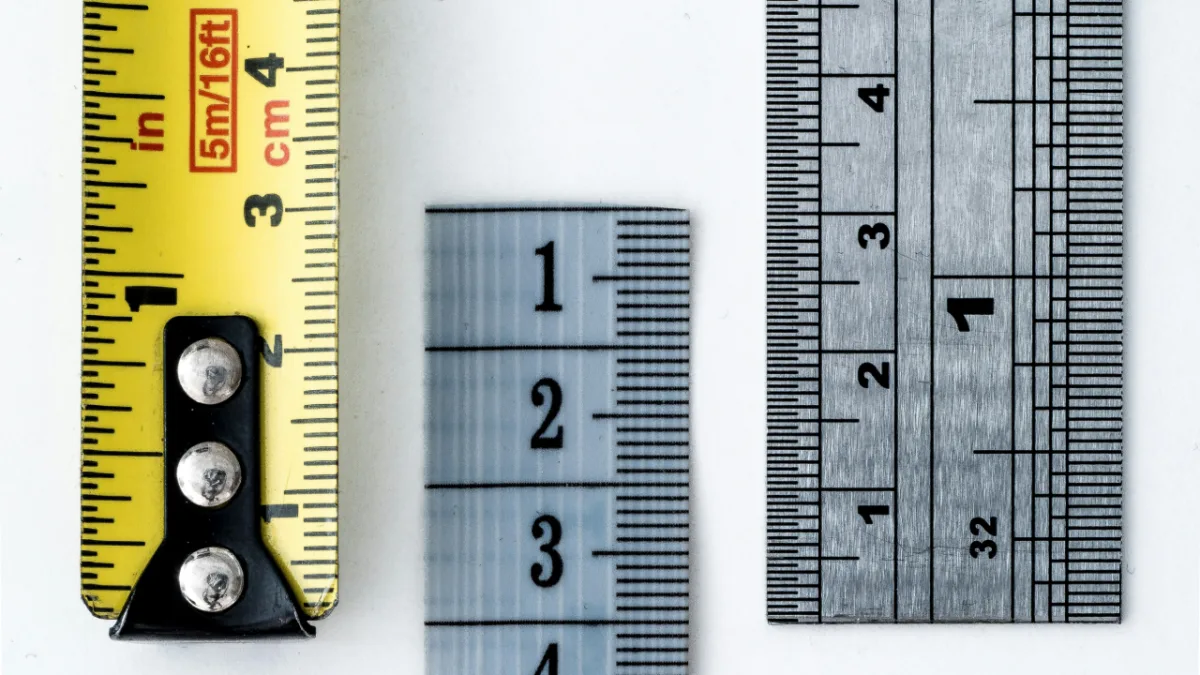

Every number in statics carries a unit, and a correct number with the wrong unit is a wrong answer. This note shows how the units of mechanics fit together, how to convert between SI and U.S. Customary units, and how to write SI quantities correctly.
1. Why the units are linked
Length, mass, time and force are tied together by Newton's second law, \(F = ma\). So only three of their units can be chosen freely. These are the base units; the fourth is a derived unit that follows from the law.
2. SI units
The International System (SI) takes meter, kilogram and second as base units. Force is derived:
| Quantity | Unit | Symbol |
|---|---|---|
| Length | meter | m |
| Mass | kilogram | kg |
| Time | second | s |
| Force | newton (derived) | N |
One newton is the force that gives a 1 kg mass an acceleration of 1 m/s². SI is the standard in science and in almost every country, and it is the main system on this site.
3. U.S. Customary units
The U.S. Customary system (FPS) takes foot (ft), pound (lb) and second (s) as base units. Here force is a base unit and mass is derived: one slug is the mass that a 1 lb force accelerates at 1 ft/s², so \(1\,\text{slug} = 1\,\text{lb}\cdot\text{s}^2/\text{ft}\). Many textbooks and problems still use these units, so you need to recognize and convert them.
4. Mass and weight
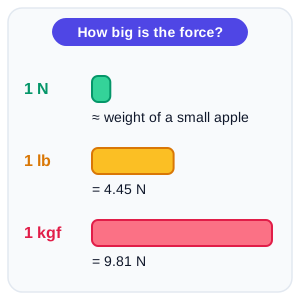
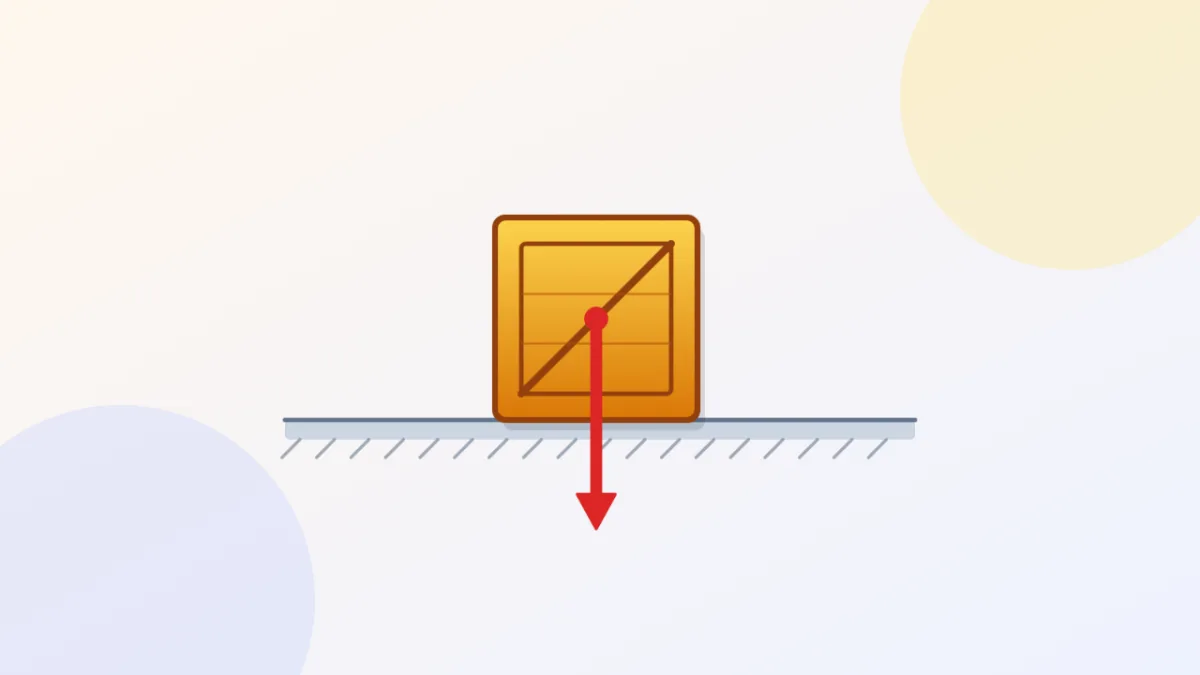
Mass and weight are measured in different units. Mass is the amount of matter and is given in kilograms (or slugs). Weight is a force and is given in newtons (or pounds):
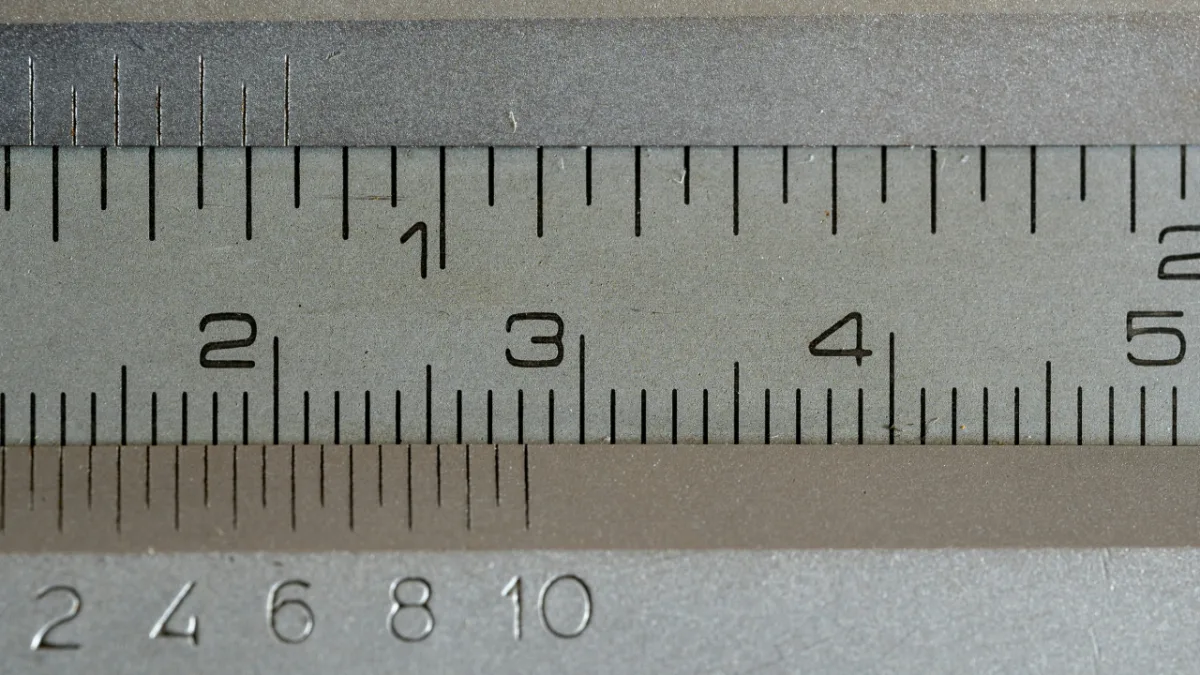
In everyday language "5 kg" often means a weight. In engineering the force unit kilogram-force (kgf) is sometimes used: 1 kgf = 9.81 N. Figure 1 compares the size of the force units.
Never write a force in kg. A 50 kg load has a weight of \(50 \times 9.81 = 491\,\text{N}\). Converting kilograms to newtons is a step that is easy to forget.
5. Converting units
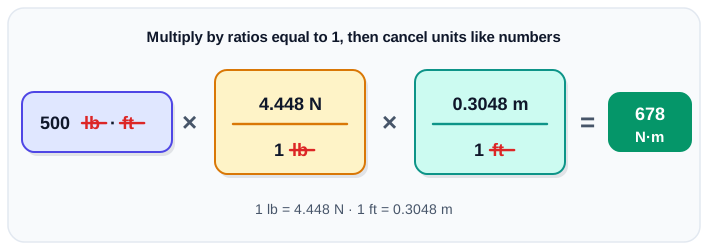
To convert, multiply by ratios that are equal to 1, such as \(4.448\,\text{N}/1\,\text{lb}\), and cancel the units as if they were numbers (Figure 2). The factors you need most are:
| U.S. Customary | SI |
|---|---|
| 1 ft | 0.3048 m |
| 1 in. | 25.4 mm |
| 1 lb | 4.448 N |
| 1 kip (1000 lb) | 4.448 kN |
| 1 slug | 14.59 kg |
| 1 lb·ft | 1.356 N·m |
The table above lists the factors used most often in statics. The same method works for every quantity: worked examples for area, volume, pressure, energy and temperature, with full conversion tables, are in the note below.
6. SI prefixes and how to write units
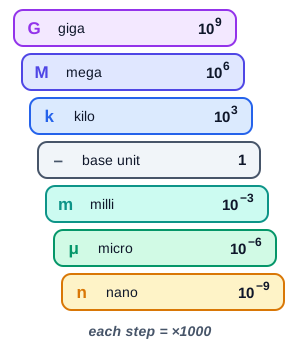
Prefixes keep numbers readable: 45 000 N is written 45 kN, and 0.006 m is 6 mm. Each step in Figure 3 is a factor of 1000. Symbols are case sensitive: m is meter or milli, M is mega, so 3 mN is 0.003 N while 3 MN is 3 000 000 N. The table shows the rules with common mistakes:
| Rule | Avoid | Write |
|---|---|---|
| One prefix, number between 0.1 and 1000 | 45 300 N | 45.3 kN |
| One prefix, number between 0.1 and 1000 | 0.0072 m | 7.2 mm |
| No prefix in the denominator (except kg) | 12 N/mm | 12 kN/m |
| Space between number and unit | 5kN | 5 kN |
| Dot between unit symbols | Nm | N·m |
| Kilo is a lowercase k | 2 KN | 2 kN |
In a calculation, replace each prefix by its power of ten, work with plain units, and choose one prefix for the result.
Prefixes in a calculation.
- A 40 kN force acts 25 mm from a point: \((40\,\text{kN})(25\,\text{mm}) = (40\times10^{3}\,\text{N})(25\times10^{-3}\,\text{m}) = 1000\,\text{N}\cdot\text{m} = 1\,\text{kN}\cdot\text{m}\)
- A 6 kN load is spread over 300 mm: \(6\,\text{kN}/0.3\,\text{m} = 20\,\text{kN/m}\), not 20 N/mm.
- A prefix is raised to the power with its unit: \(1\,\text{mm}^2 = (10^{-3}\,\text{m})^2 = 10^{-6}\,\text{m}^2\), not \(10^{-3}\,\text{m}^2\).
Summary
- Newton's second law links the units, so three are base units and one is derived.
- SI: m, kg, s are base units; the newton (N = kg·m/s²) is derived.
- U.S. Customary: ft, lb, s are base units; the slug is derived.
- Mass is in kg, weight in N: \(W = mg\).
- Convert by multiplying with ratios equal to 1, and write SI with one prefix.















Comments 0
Ask questions, explain a step or share a tip about this note.
Join the discussion
Log in to comment, reply and vote. It is free.
No comments yet
Ask a question, share a tip or say thanks. Be the first!