



Most mistakes in statics are not about physics. They come from skipping a step, losing a unit or rounding too early. A fixed procedure and a few quick checks prevent most of them.
1. A five-step procedure
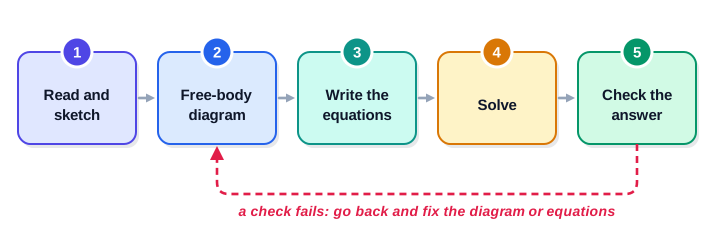
Solve every statics problem in the same order (Figure 1):
- Read and sketch. List what is given and what is asked, and make a clear drawing of the situation.
- Draw the free-body diagram. Isolate the body and show every force acting on it.
- Write the equations. Apply equilibrium and check that you have as many equations as unknowns.
- Solve. Work with symbols as long as you can, then substitute numbers.
- Check the answer. Test the units, the size and the direction of the result.
2. The free-body diagram comes first
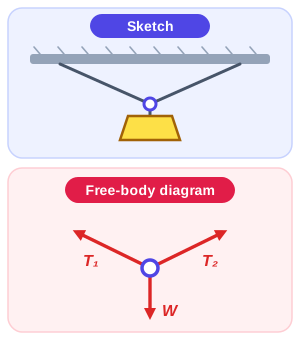
A free-body diagram shows one body cut free from everything around it, with all the forces that act on it: loads, weights and the forces from supports, cables or other bodies (Figure 2). It is the most important step, because the equations can only be as good as the diagram they come from.
Before writing any equation, ask two questions: is every contact replaced by a force, and is any force counted twice?
3. Symbols first, numbers last
Keep quantities as symbols, such as \(W\), \(T_1\) or \(\theta\), while you rearrange the equations. A symbolic result shows how the answer depends on each quantity, is easier to check, and can be reused for new numbers.
When you substitute numbers, keep full precision in the intermediate results and round only the final answer.
4. Check your answer
Three quick checks catch most errors:
- Units. Every term of an equation must have the same units. This is called dimensional homogeneity.
- An unused equation. If one equation was not needed to find the unknowns, substitute the results into it; it should still hold.
- Common sense. Is the size plausible and the direction physical? A cable cannot push, and a support force is rarely larger than all the loads together.
If a moment comes out in N/m, or a force in N·m, there is an algebra mistake before that line.
5. Significant figures and rounding
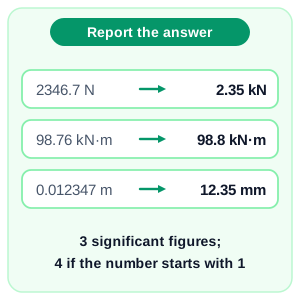
The data in engineering problems are rarely known better than about 0.2 percent, so more digits in the answer add no real accuracy. The rule used on this site is simple (Figure 3):
- Report final answers to three significant figures.
- Use four when the number starts with 1, such as 12.35 mm.
- Choose a prefix that keeps the number between 0.1 and 1000.
- Never round intermediate results; keep them in the calculator.
Summary
- Follow five steps: sketch, free-body diagram, equations, solve, check.
- The free-body diagram is the most important step.
- Solve with symbols first and substitute numbers at the end.
- Check units, an unused equation and whether the result makes sense.
- Report three significant figures, or four if the number starts with 1.










Comments 0
Ask questions, explain a step or share a tip about this note.
Join the discussion
Log in to comment, reply and vote. It is free.
No comments yet
Ask a question, share a tip or say thanks. Be the first!