



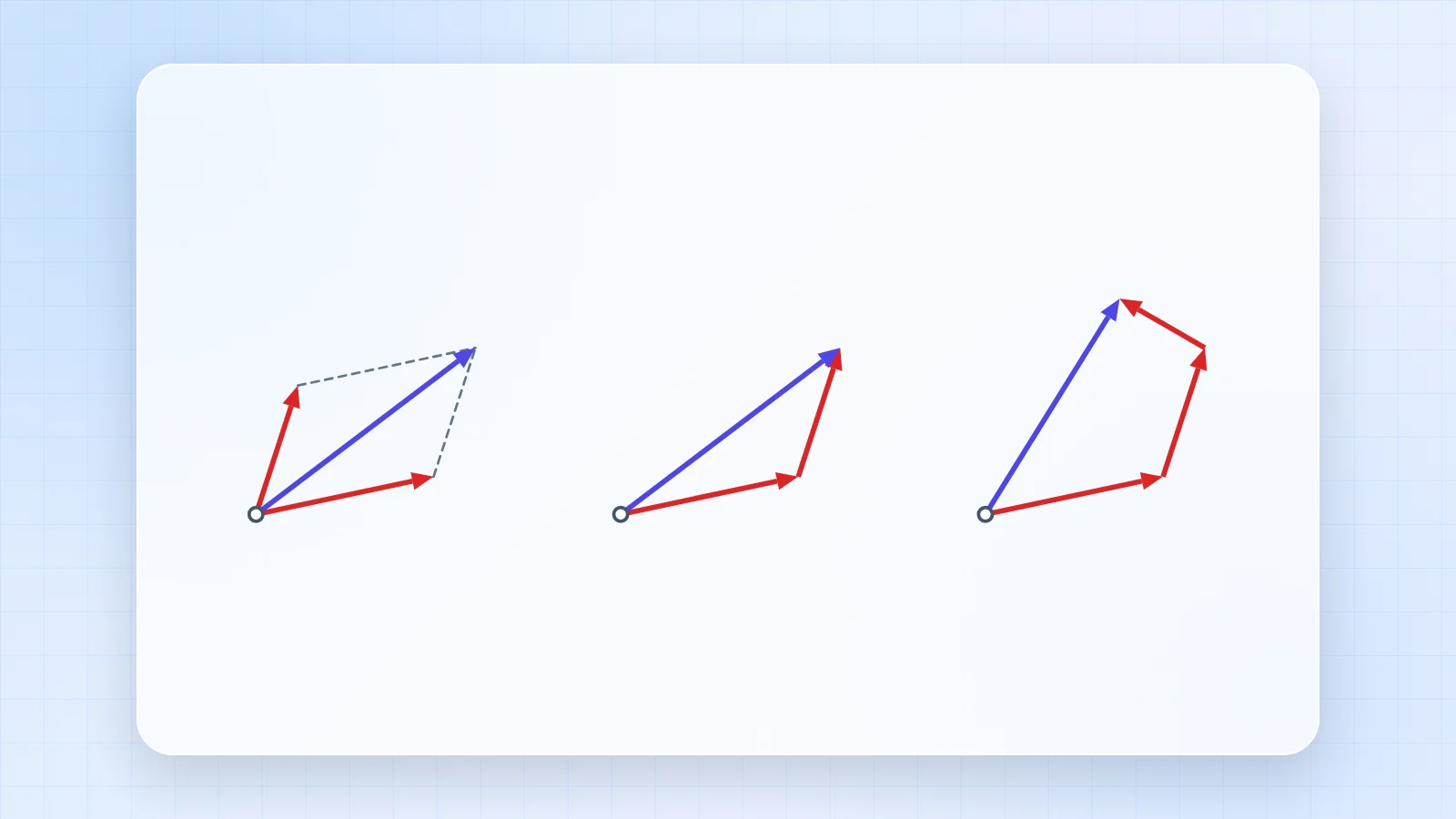
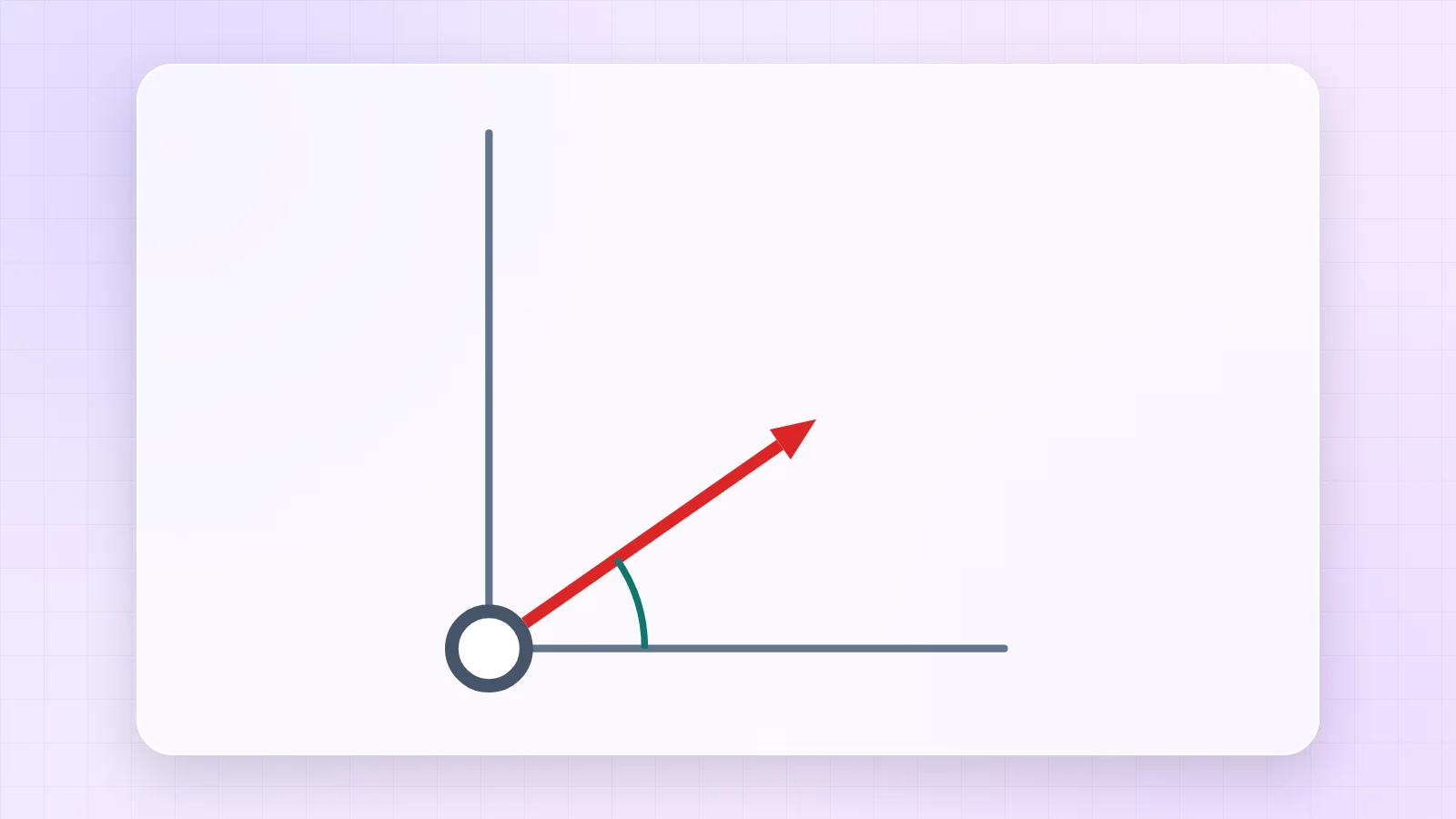
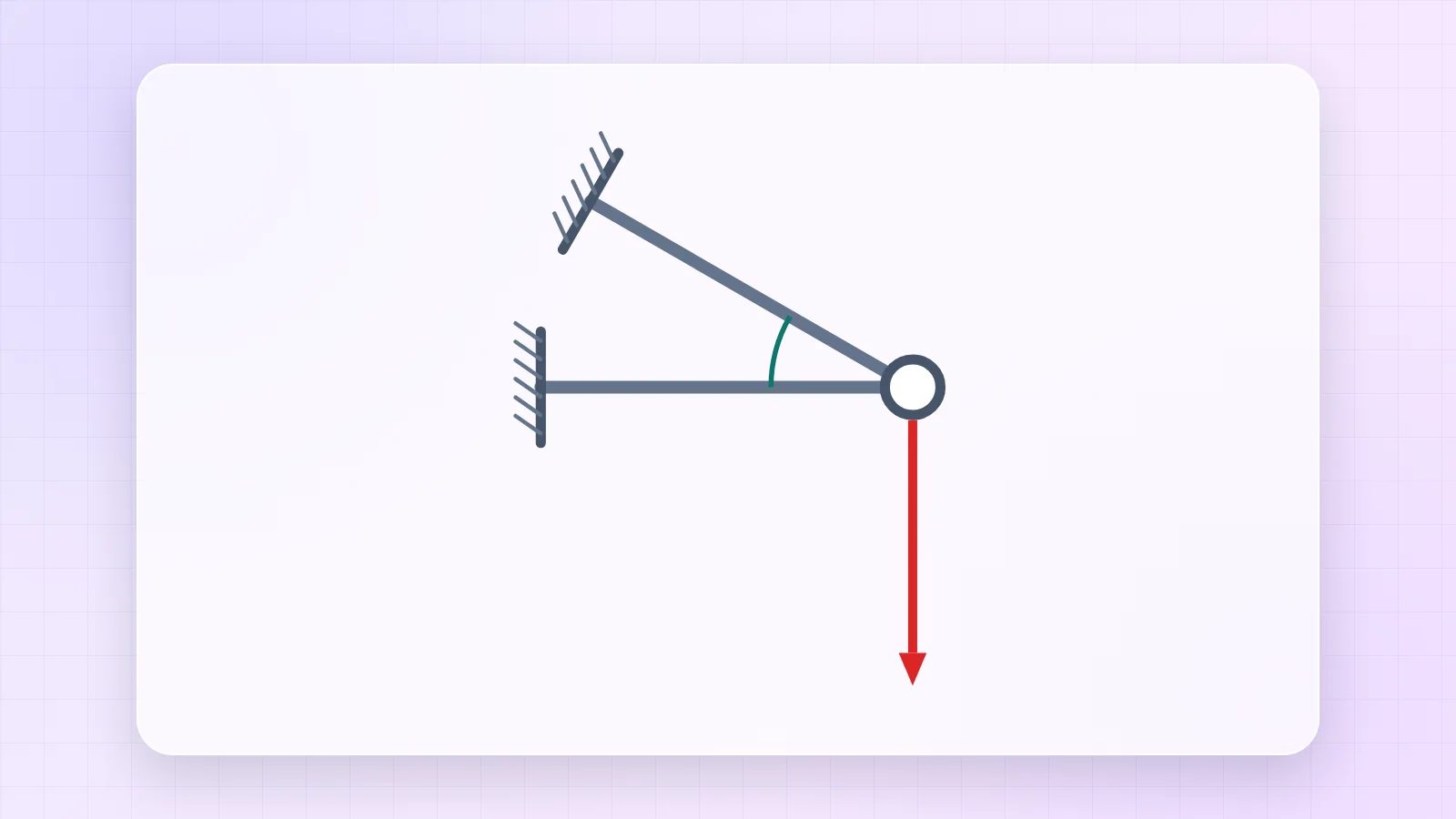
Resolving a force is addition in reverse: one force is replaced by two forces, its components, whose vector sum is the original force. Problems often ask for the components along two members or two cables, and these directions are rarely perpendicular.
1. Components along two given lines
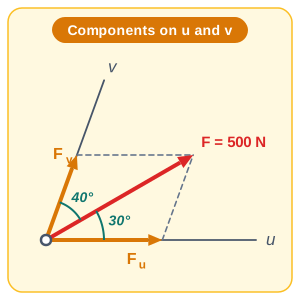
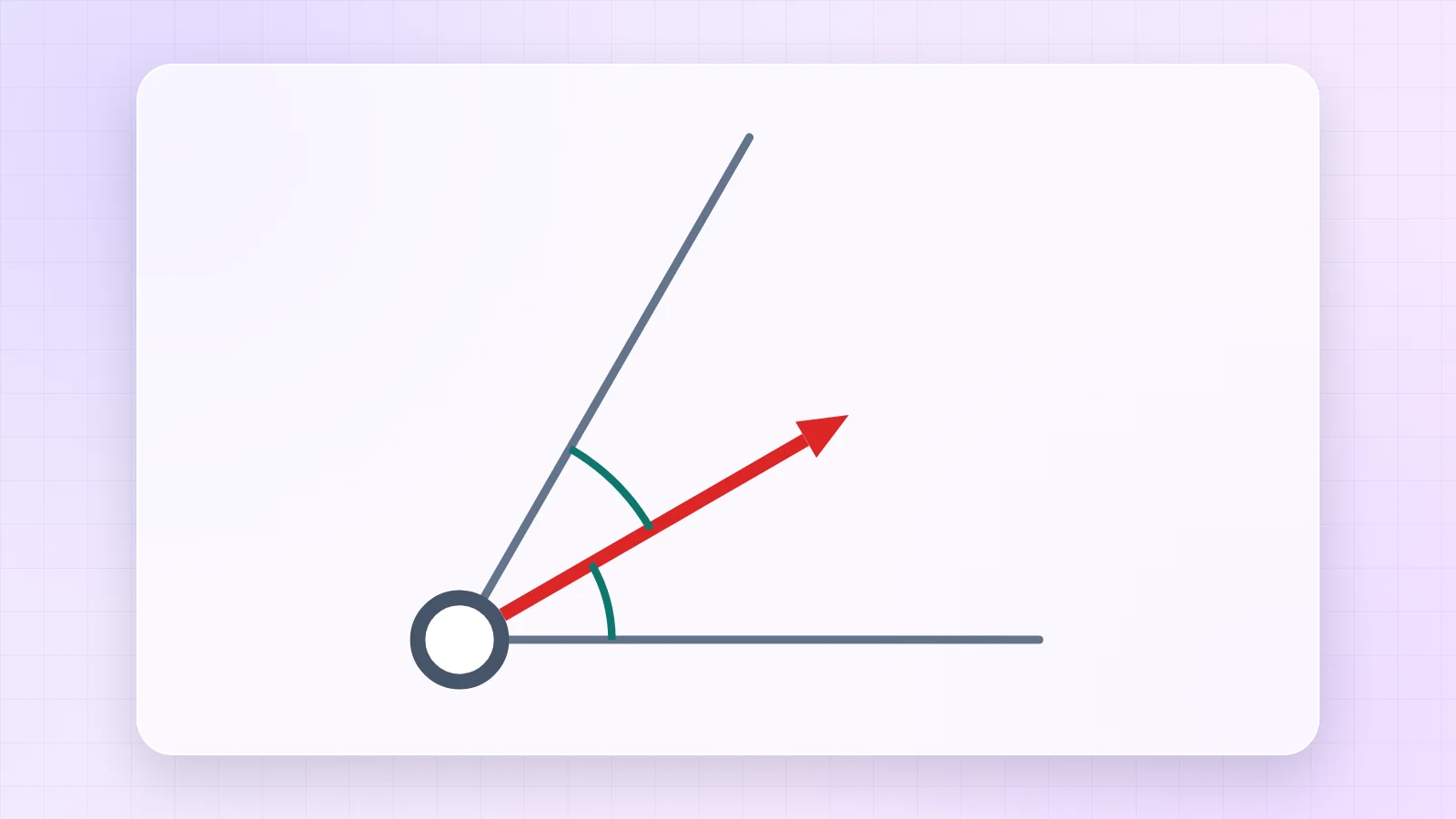
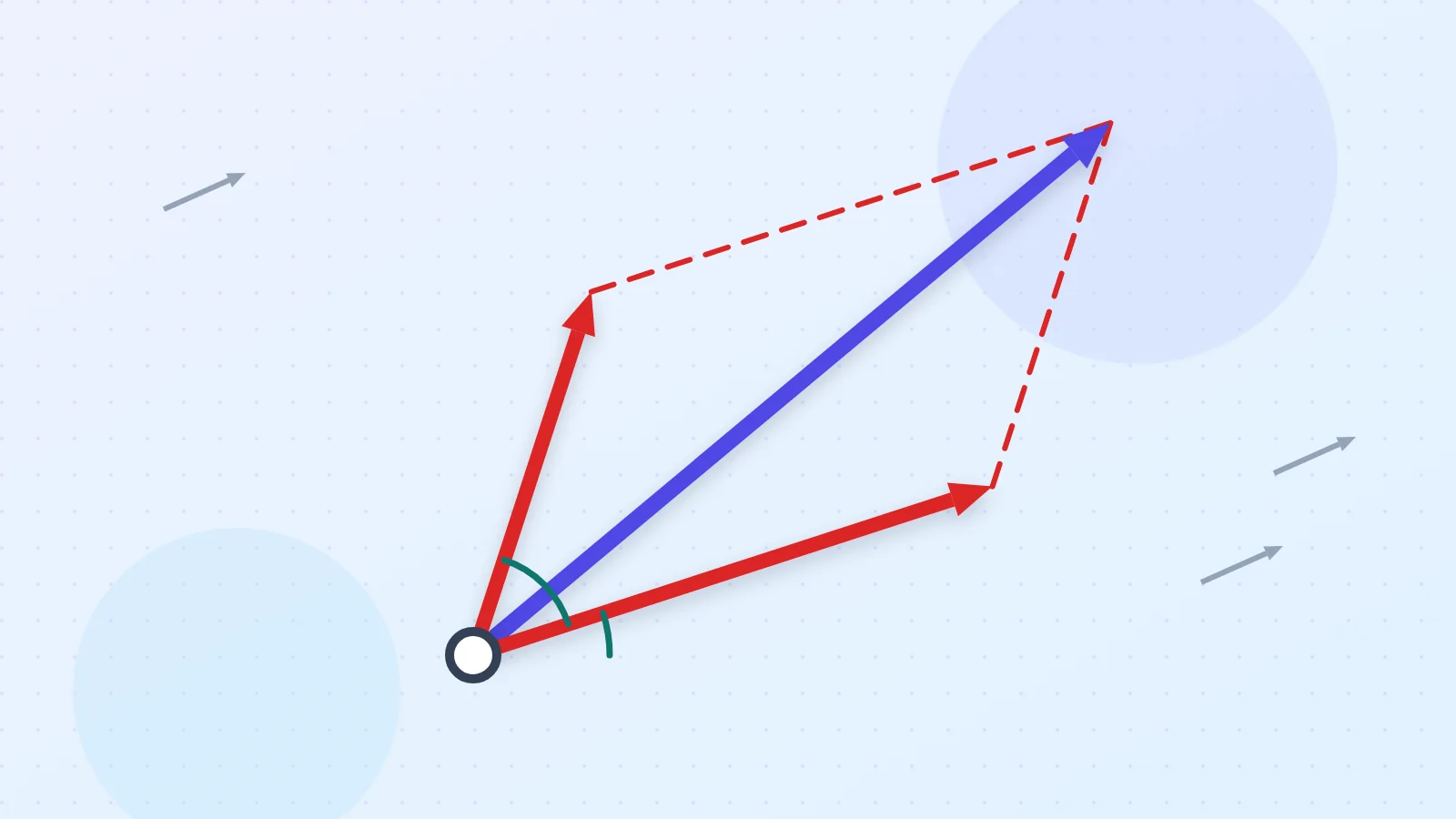
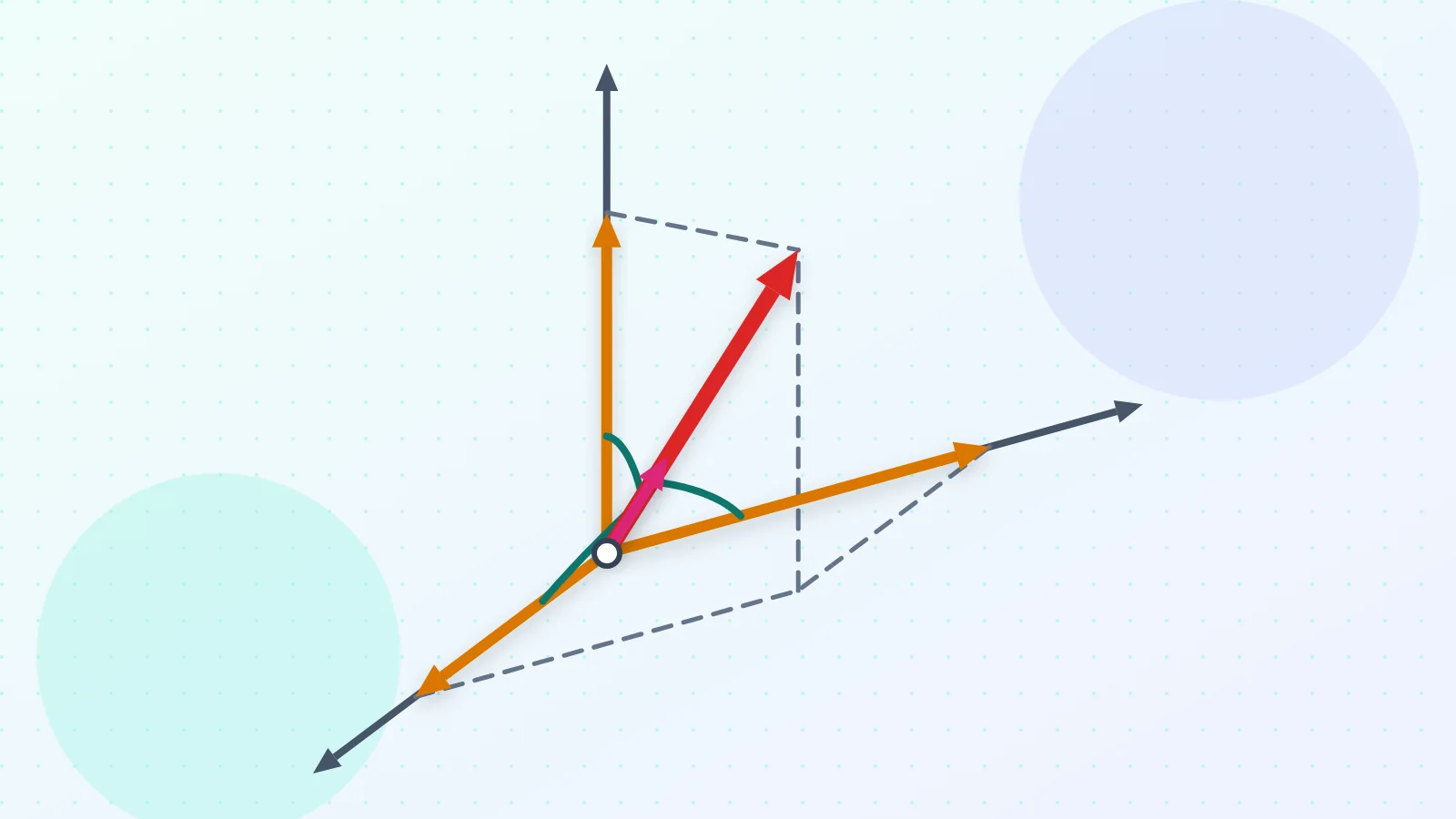
To resolve \(\mathbf{F}\) along two lines \(u\) and \(v\), draw lines parallel to \(u\) and \(v\) through the head of \(\mathbf{F}\). They complete a parallelogram whose sides are the components (Figure 1):
The construction works for any two directions that are not parallel. For a given pair of lines, the components are unique.
2. Solving with the law of sines
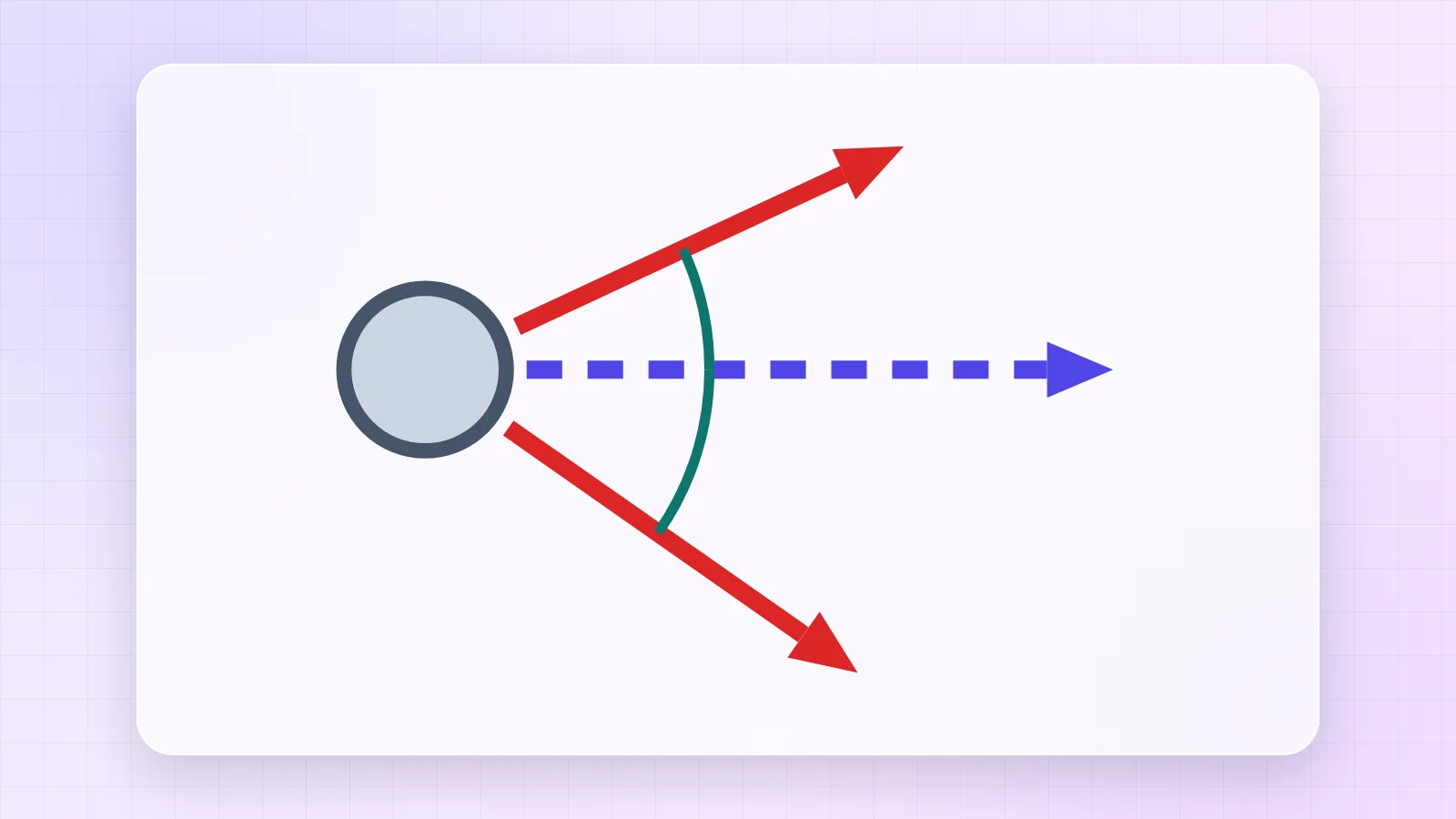
Let \(a\) be the angle between \(\mathbf{F}\) and the \(u\) axis and \(b\) the angle between \(\mathbf{F}\) and the \(v\) axis, with \(\mathbf{F}\) lying between them. In the force triangle, \(F_u\) is opposite \(b\), \(F_v\) is opposite \(a\), and \(F\) is opposite an angle whose sine equals \(\sin(a+b)\). The law of sines then gives both components at once:
If the axes are perpendicular, \(a + b = 90^\circ\) and Equation 2 reduces to \(F_u = F\cos a\) and \(F_v = F\sin a\).
Components on oblique axes. A force \(F = 500\,\text{N}\) makes \(30^\circ\) with the \(u\) axis and \(40^\circ\) with the \(v\) axis (Figure 1). Find \(F_u\) and \(F_v\).
Solution. Here \(a = 30^\circ\), \(b = 40^\circ\) and \(a + b = 70^\circ\):
$$ F_u = 500\,\frac{\sin 40^\circ}{\sin 70^\circ} = 342\,\text{N}, \qquad F_v = 500\,\frac{\sin 30^\circ}{\sin 70^\circ} = 266\,\text{N} $$
Check. \(F_u + F_v = 608\,\text{N}\) is larger than \(F\). That is normal: on oblique axes, the sum of the component magnitudes, and even a single component, can exceed the force itself.
3. Other given data
Not every problem gives both directions. Two other cases are common:
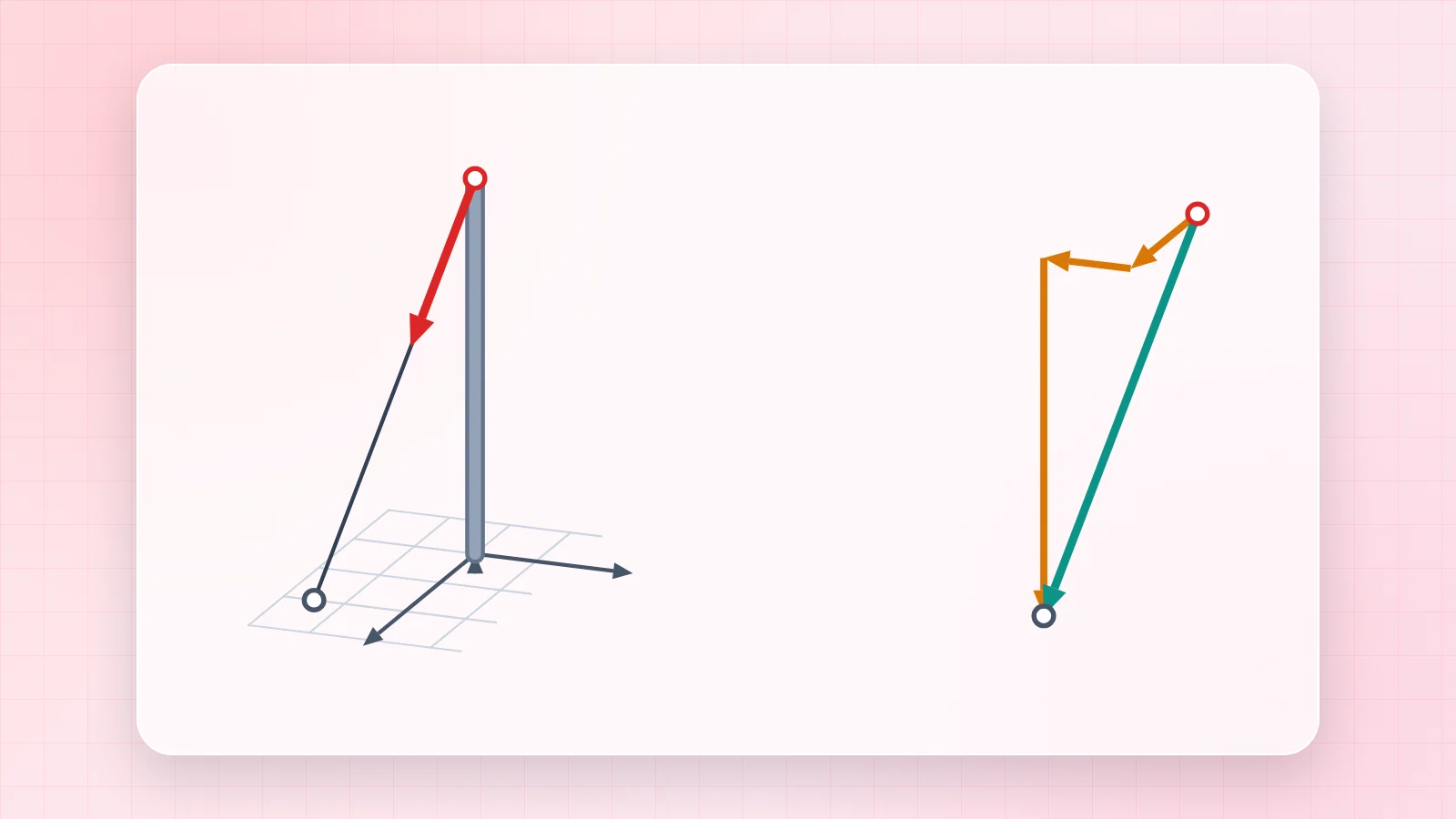
- One component is fully known. The other component closes the triangle: \(\mathbf{F}_v = \mathbf{F} - \mathbf{F}_u\). Find it with the law of cosines, then its direction with the law of sines.
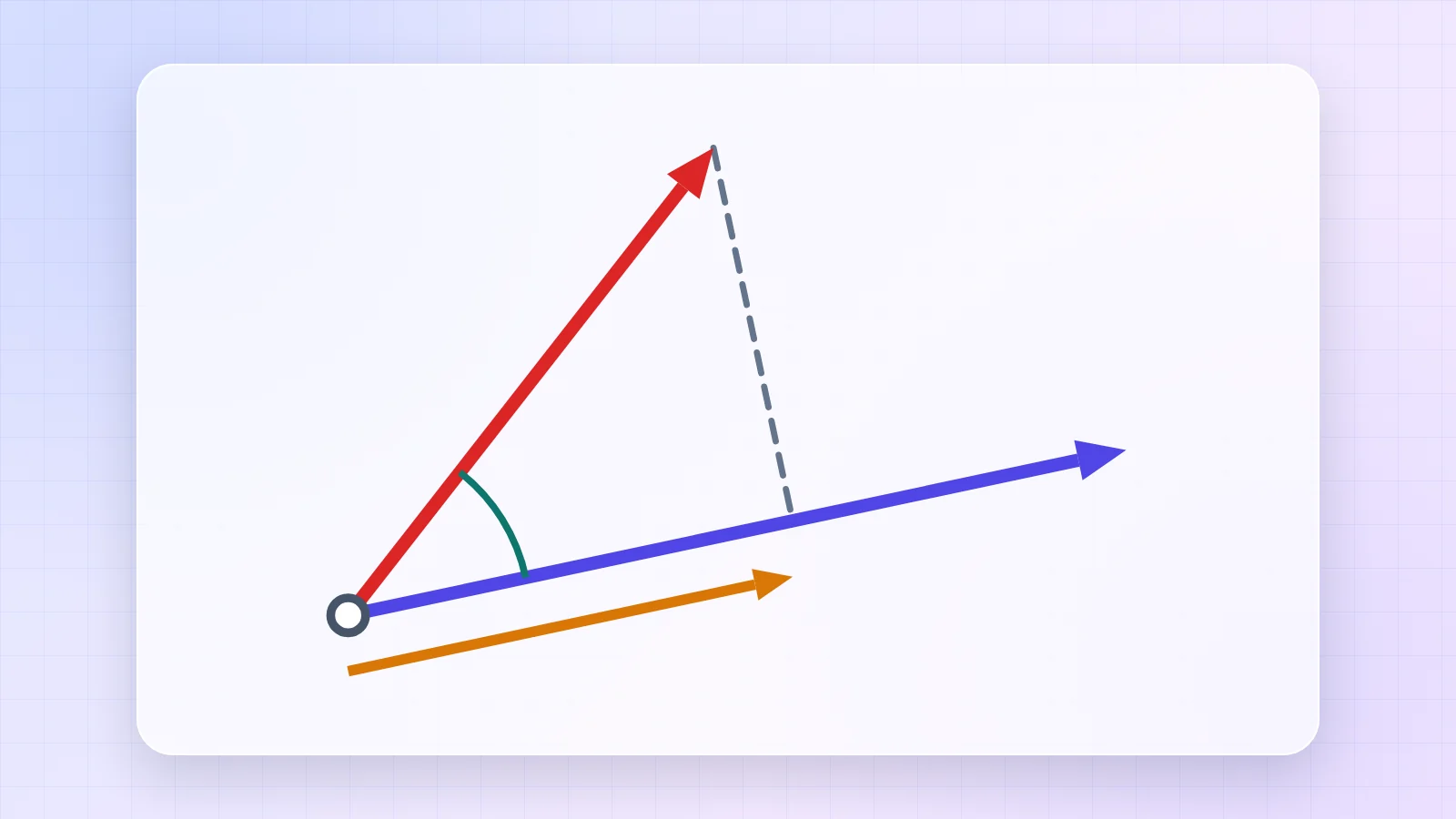
- Only the line of \(\mathbf{F}_u\) is known, and \(F_v\) should be as small as possible. The closing side of the triangle is shortest when it is perpendicular to the \(u\) line (Figure 2). Then \(F_{v,\min} = F\sin a\) and \(F_u = F\cos a\).
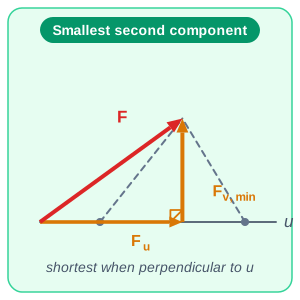
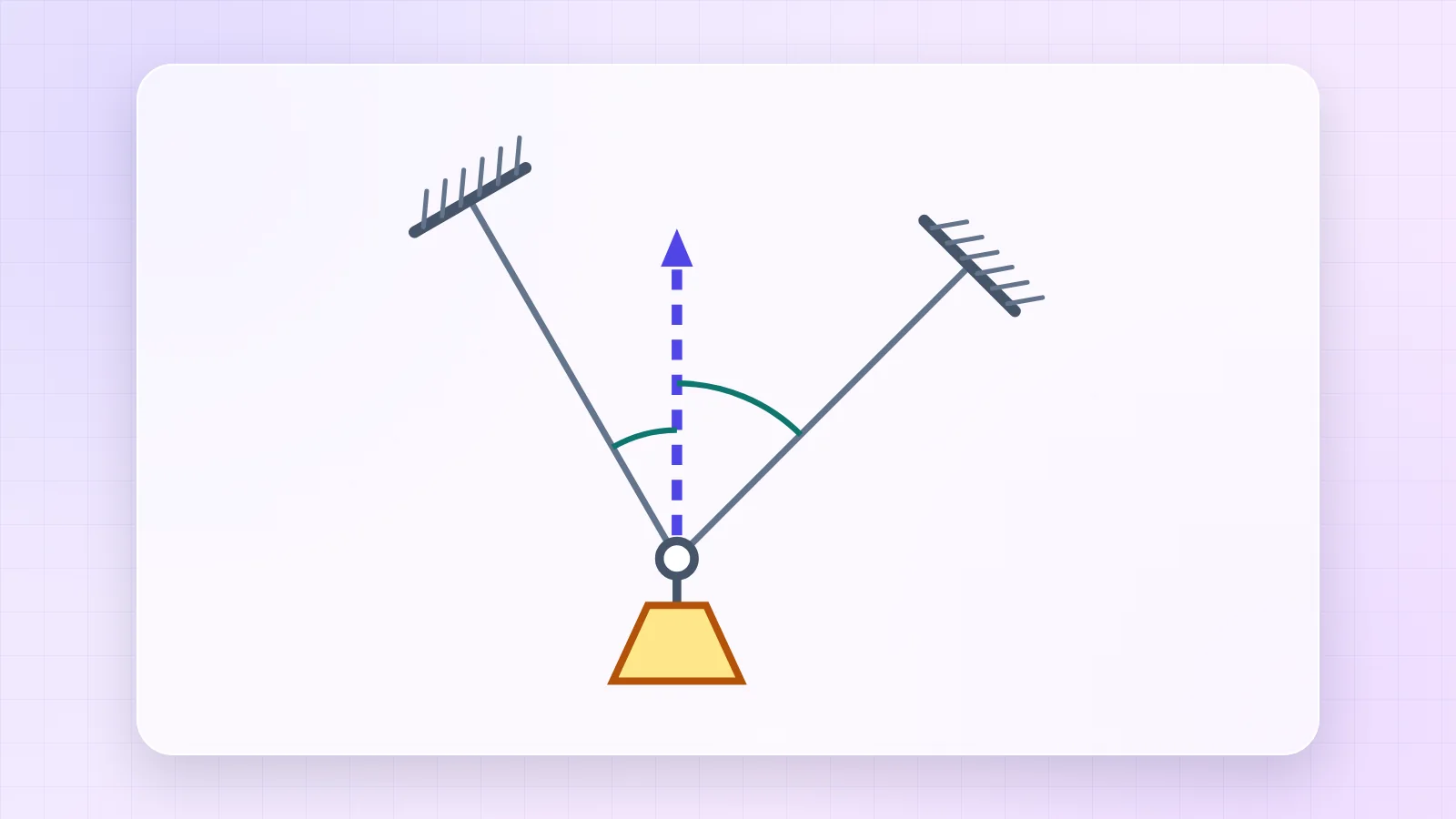
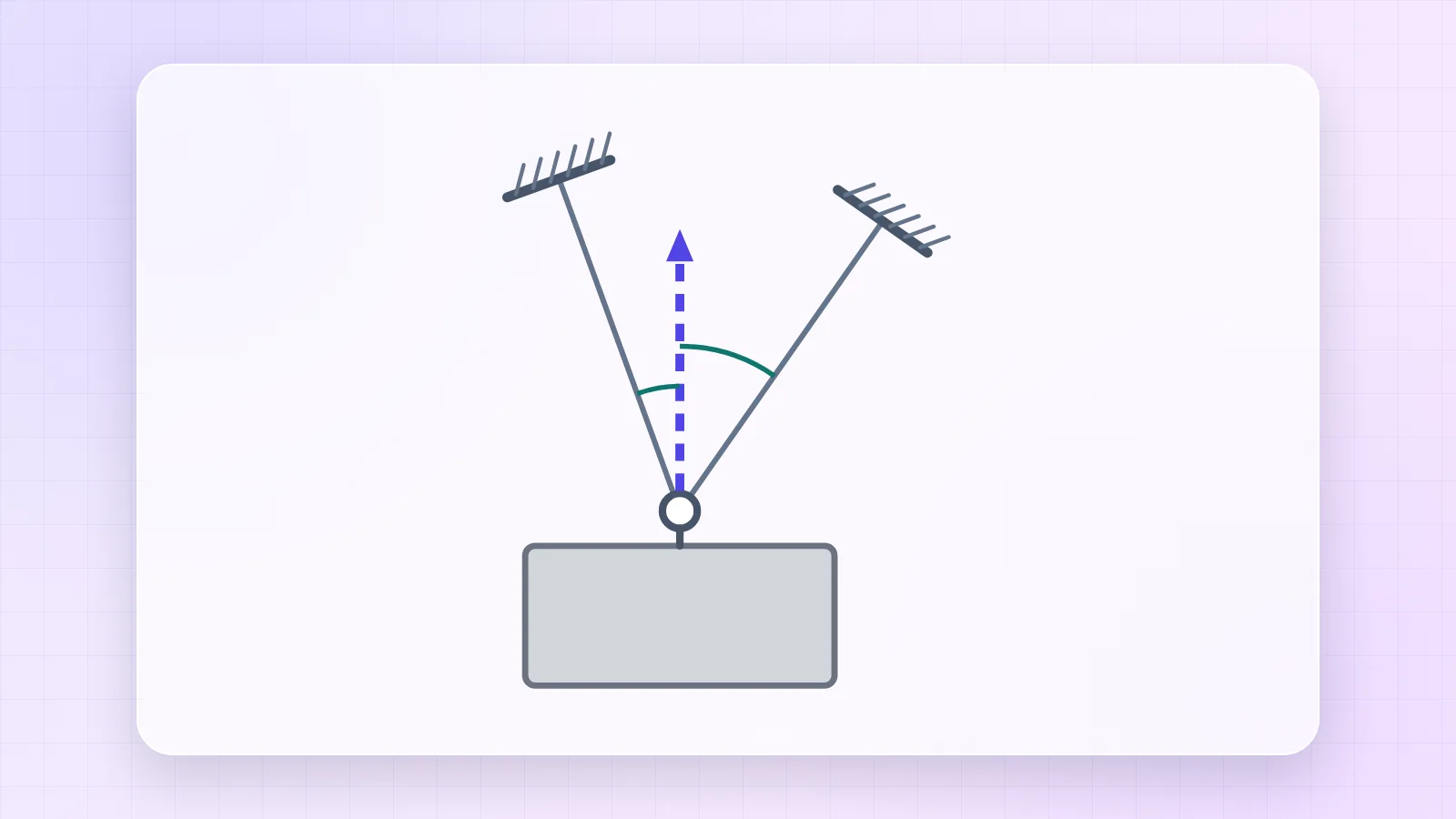
The second case appears when two ropes pull an object and one rope's direction can be chosen. The tension in that rope is smallest when it is perpendicular to the other rope.
4. Components are not projections
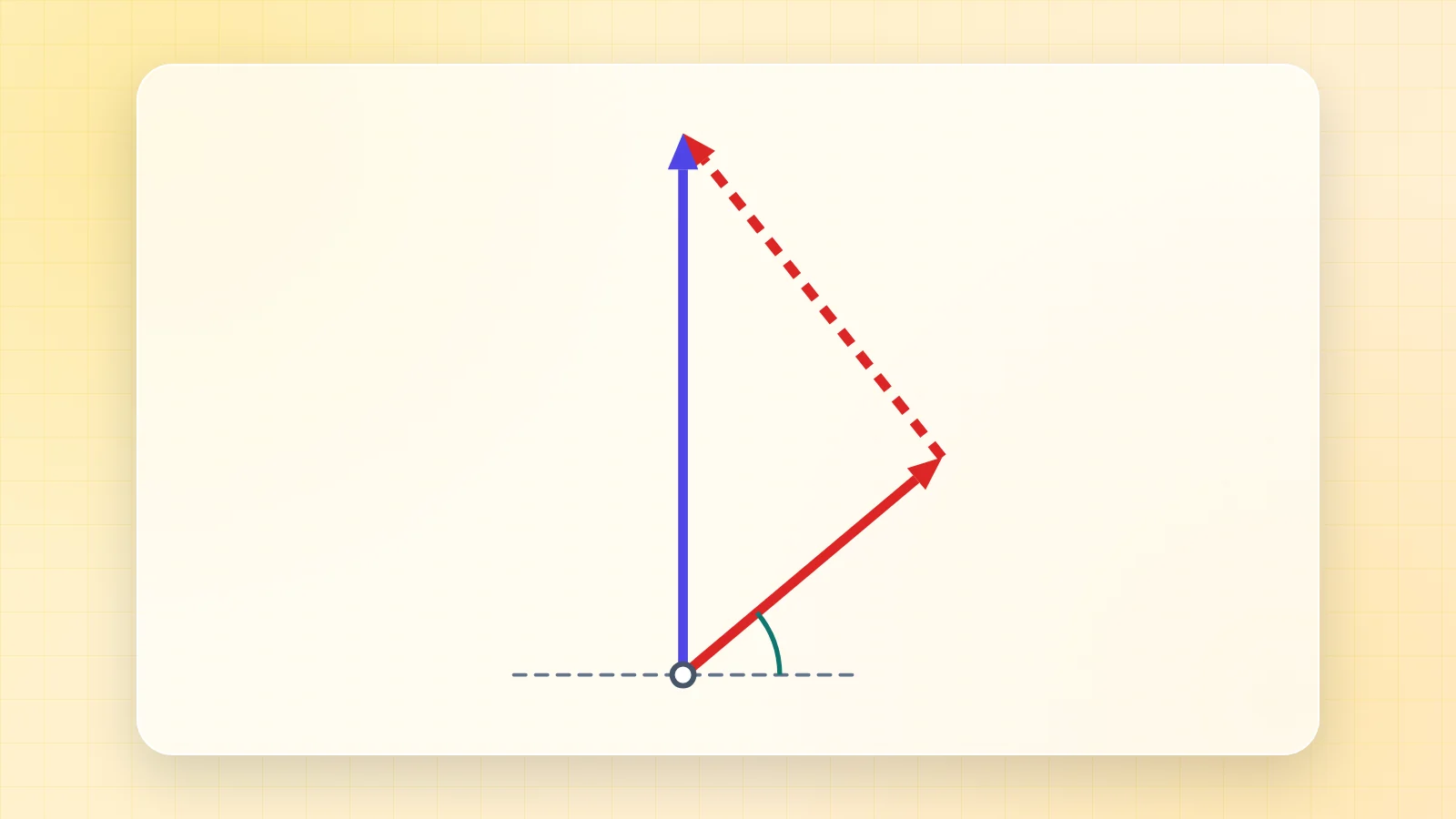
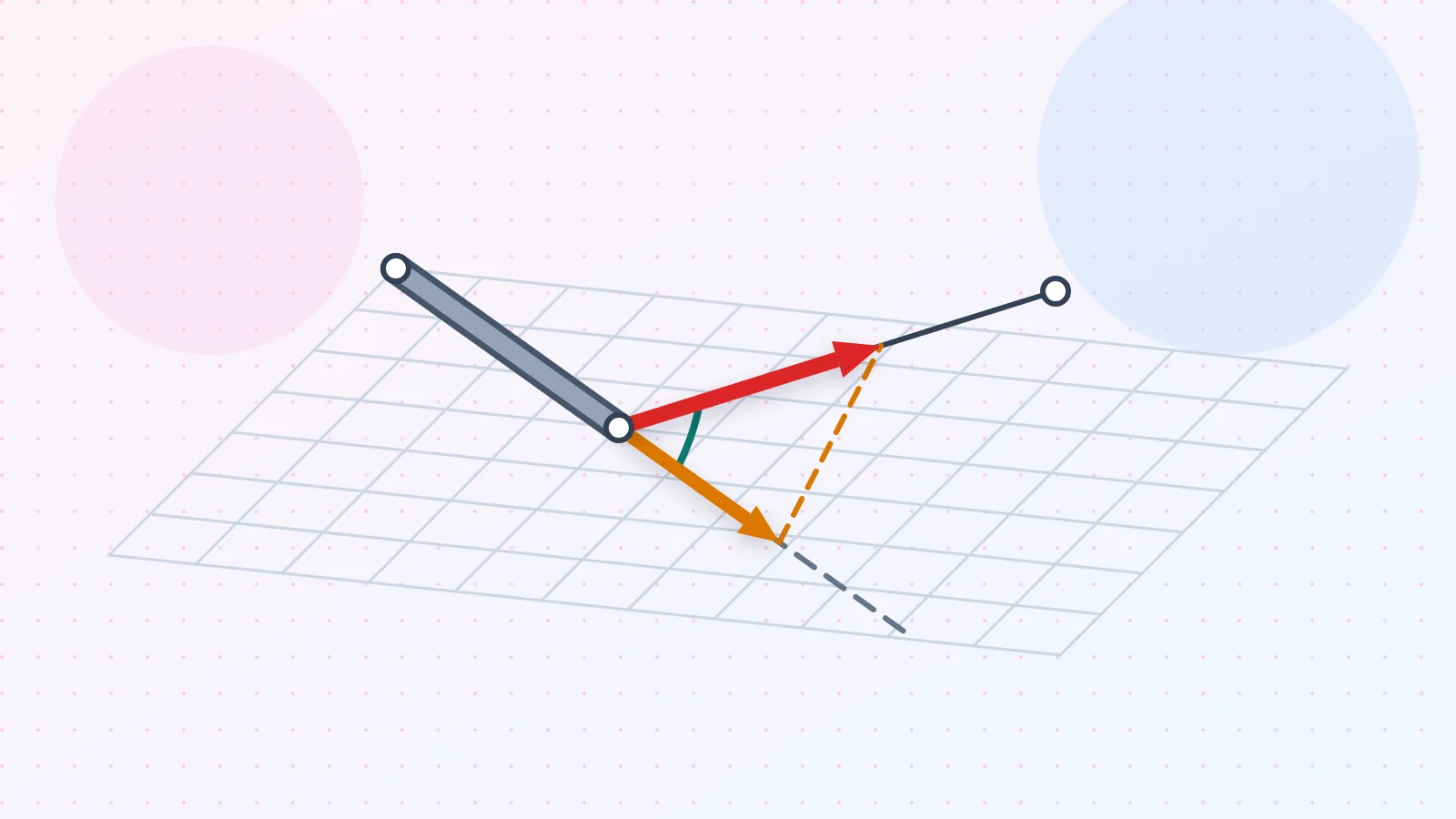
The perpendicular projection of \(\mathbf{F}\) onto an axis is \(F\cos\theta\), where \(\theta\) is the angle between them. On perpendicular axes, the projections and the components are the same. On oblique axes they differ (Figure 3):
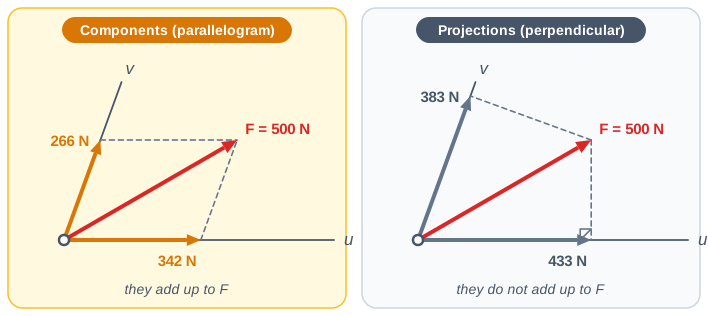
For the force in Example 1, the projections are \(500\cos 30^\circ = 433\,\text{N}\) on \(u\) and \(500\cos 40^\circ = 383\,\text{N}\) on \(v\). The components are 342 N and 266 N. Only the components add up to \(\mathbf{F}\) by the parallelogram law.
Do not use \(F\cos\theta\) on oblique axes. It gives the projection, not the component. Use the parallelogram and the law of sines instead.
Summary
- Resolution replaces a force by two components whose vector sum is the force: \(\mathbf{F} = \mathbf{F}_u + \mathbf{F}_v\).
- Draw the parallelogram through the head of \(\mathbf{F}\) and solve the triangle with the law of sines.
- If one component is known, the other closes the triangle; it is smallest when perpendicular to the first.
- On oblique axes, components and perpendicular projections are different; only components add up to the force.










Comments 0
Ask questions, explain a step or share a tip about this note.
Join the discussion
Log in to comment, reply and vote. It is free.
No comments yet
Ask a question, share a tip or say thanks. Be the first!