


Mechanics is the branch of physics that explains how bodies respond to forces: whether they stay at rest, start to move or change shape. Engineers rely on it to make sure that bridges stand, machines run and parts do not break.
1. What Mechanics Studies
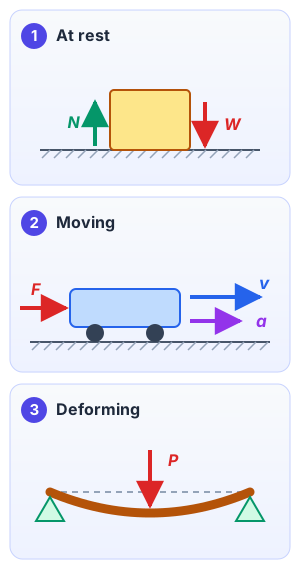
Every question in mechanics links the forces on a body to one of three outcomes:
- Rest: the forces balance and the body stays where it is, like a crate standing on the floor.
- Motion: the forces do not balance and the velocity of the body changes, like a cart pushed along a track.
- Deformation: the forces stretch, bend or twist the body, like a shelf that sags under books.
In real life the three happen together. Mechanics separates them with simple models, so each question is answered with the simplest model that is still accurate enough.
2. The Branches of Mechanics
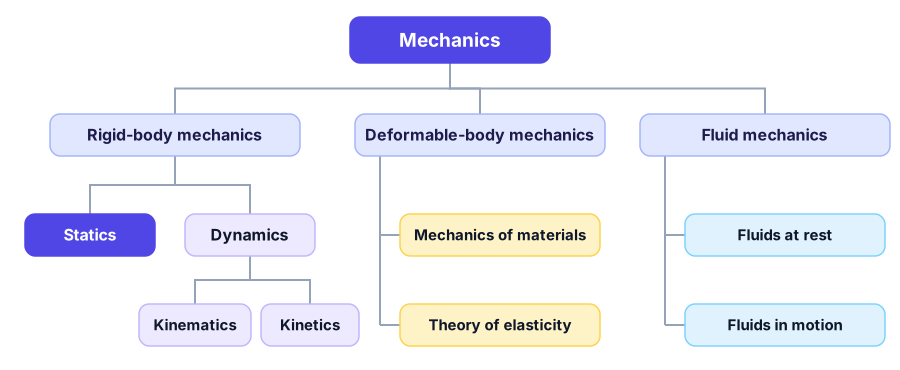
Mechanics is divided by the kind of body it studies: rigid bodies, deformable bodies and fluids.
2.1 Rigid-Body Mechanics
A rigid body is a model in which the distance between any two points never changes. Real bodies always deform a little, but when the deformation is tiny compared with the size of the body, the rigid model still gives the forces accurately. Rigid-body mechanics has two parts: statics and dynamics.
2.2 Deformable-Body Mechanics
When the change of shape itself matters, such as how much a beam sags or whether a bolt breaks, the body is treated as deformable. Mechanics of materials (also called strength of materials) deals with bars, beams and shafts; the theory of elasticity deals with solids of any shape.
2.3 Fluid Mechanics
Liquids and gases flow under even a very small shearing force. Fluid mechanics studies them at rest and in motion, and it is the basis of pipe flow, pumps and aerodynamics.
3. Statics and Dynamics
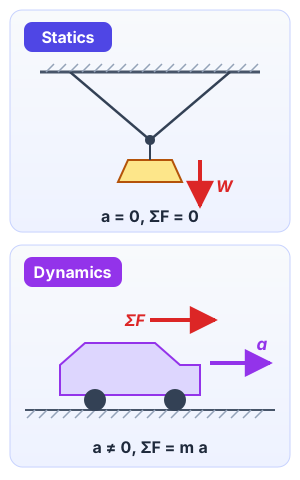
Statics studies bodies in equilibrium: bodies at rest or moving with constant velocity, so that their acceleration is zero. Dynamics studies bodies whose velocity changes. It has two parts: kinematics describes the motion (position, velocity, acceleration) without asking what causes it, and kinetics relates the forces to the motion they produce.
Both rest on Newton's second law, where \( \sum \mathbf{F} \) is the sum of all forces on the body, \( m \) its mass and \( \mathbf{a} \) its acceleration:
In statics \( \mathbf{a} = \mathbf{0} \), so the law becomes the equilibrium condition:
An elevator rising at a steady speed is in equilibrium, just like an elevator standing still. Its acceleration is zero, so the forces on it balance. Only a change of speed or direction calls for dynamics.
4. Why Statics Comes First
Statics is the first subject of engineering mechanics for three reasons:
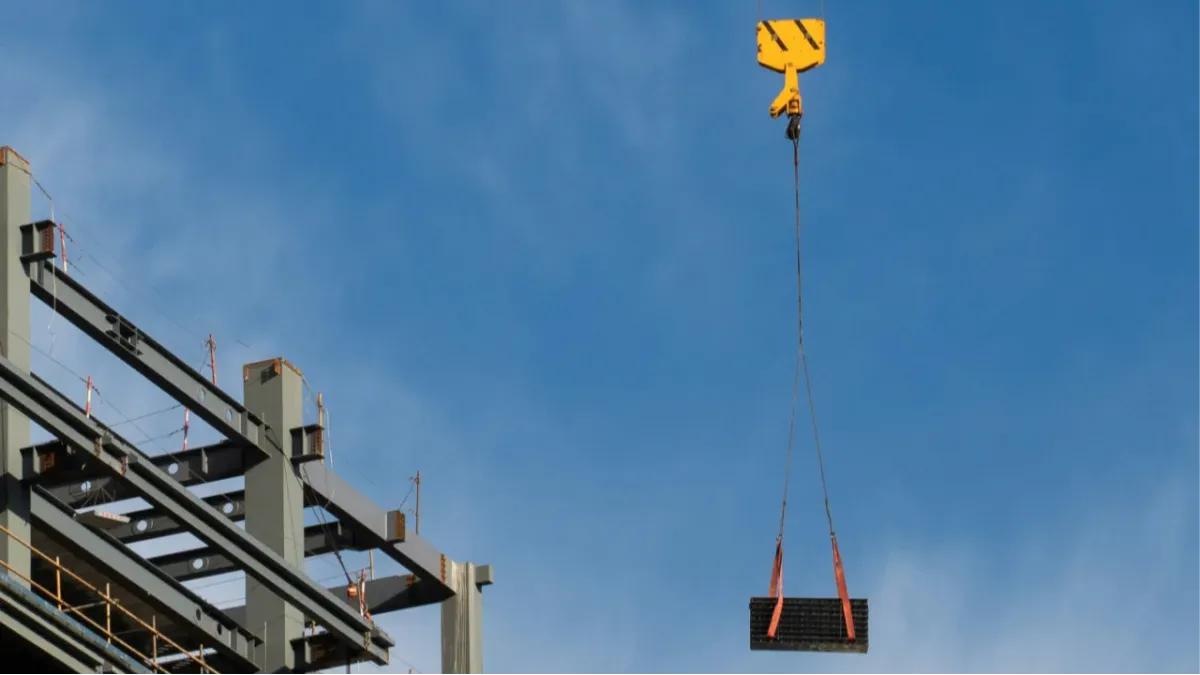
- Most structures are meant to stay still. Buildings, bridges, cranes and machine frames are designed first for the forces that keep them in equilibrium.
- Its tools are used everywhere. Force vectors, moments, the free-body diagram and the equilibrium equations return in dynamics, mechanics of materials and machine design.
- Strength comes after the loads. A beam cannot be sized until the forces inside it are known, and statics is what finds them.
5. A Short History of Mechanics
Mechanics is one of the oldest sciences, and each step below is still in use today:
- Archimedes (3rd century BC) stated the law of the lever and the principle of buoyancy.
- Simon Stevin (1586) studied equilibrium on inclined planes and showed how forces combine.
- Galileo Galilei (1638) studied falling bodies and the strength of beams.
- Isaac Newton (1687) published the three laws of motion and the law of gravitation, the foundation of classical mechanics.
- Leonhard Euler and Joseph-Louis Lagrange (18th century) extended the laws to rigid bodies and wrote mechanics in analytical form.
Newtonian mechanics fails only near the speed of light, where relativity is needed, and at the scale of atoms, where quantum mechanics is needed. Both are far from the speeds and sizes of engineering structures and machines.
Summary
- Mechanics explains how bodies respond to forces: they stay at rest, move or deform.
- Its three branches are rigid-body, deformable-body and fluid mechanics.
- Rigid-body mechanics splits into statics (\( \mathbf{a} = \mathbf{0} \)) and dynamics (kinematics and kinetics).
- Statics uses \( \sum \mathbf{F} = \mathbf{0} \), the special case of Newton's second law with zero acceleration.
- Statics comes first because structures are designed for equilibrium and its tools are needed in every other branch.










Comments 0
Ask questions, explain a step or share a tip about this note.
Join the discussion
Log in to comment, reply and vote.
No comments yet
Ask a question, share a tip or say thanks. Be the first!