




Statics works with a few basic quantities and three simple models of real objects. Knowing what each one means, and when to use it, is the first step in setting up any statics problem.
1. Basic quantities
Four quantities appear throughout mechanics. Statics uses all of them except time:
| Quantity | Meaning | Role in statics |
|---|---|---|
| Length | Position and size | Locates forces, supports and distances |
| Time | Order of events | Not needed, because nothing accelerates |
| Mass | Amount of matter | Gives the weight of a body |
| Force | Push or pull of one body on another | What statics calculates |
2. What defines a force
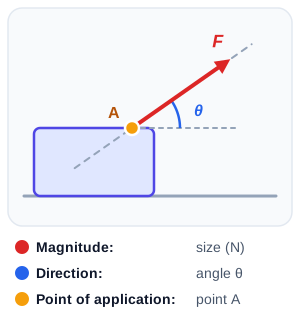
A force is fully described by three properties: its magnitude, its direction and its point of application (Figure 1). Because it has a direction, force is a vector quantity; its magnitude is measured in newtons (N). The line through the point of application along the force is its line of action.
Forces act either through contact, like the push of a hand or the pull of a cable, or at a distance, like gravity. The forces applied to a body are called loads; the forces that hold it in place, such as those from its supports, are called reactions.
3. Particle and rigid body
Real objects are complicated, so statics replaces them with simple models:
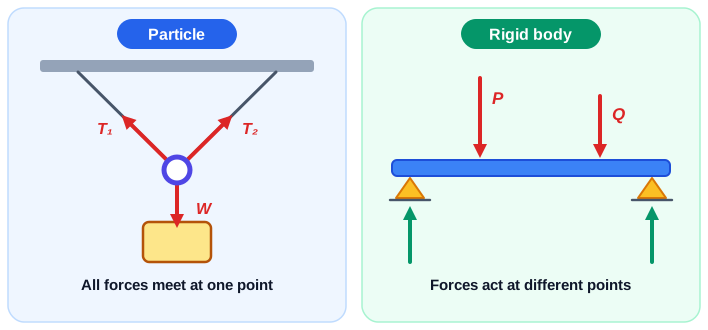
- Particle: a body whose size does not matter for the question. All forces act at one point, so only the balance of forces is needed. A ring where several cables meet is a typical particle.
- Rigid body: a body whose shape does not change under load. Its forces act at different points, so they can also turn it, and both forces and turning effects must balance. Beams, frames and machine parts are usually rigid bodies.
The same object can be either, depending on the question. An aircraft is a particle when you plot its route between two cities, but a rigid body when you find the forces on its landing gear (Figure 2).
4. Concentrated force
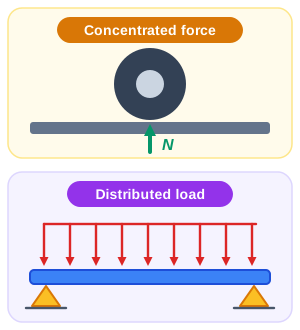
Real forces always act over an area. When that area is small compared with the body, the load can be replaced by a single force acting at one point: a concentrated force. The contact force between a train wheel and the rail is a good example (Figure 3).
When the load spreads over a large area, such as snow on a roof or water pressure on a dam, it is a distributed load and is handled differently.
5. Why the model matters
Choosing the model is the first decision in every statics problem, because it fixes the equations you need:
Here \(\sum \vec{M}\) is the sum of the turning effects, or moments, of the forces. For a particle all forces pass through one point, so their moments cancel automatically and the force equation is enough.
Summary
- Statics uses length, mass and force; time is not needed.
- A force is defined by its magnitude, direction and point of application.
- A particle is a body whose size does not matter; a rigid body is one whose shape does not change.
- A load acting on a small area can be modeled as a concentrated force.
- Particles need force balance only; rigid bodies need force and moment balance.










Comments 0
Ask questions, explain a step or share a tip about this note.
Join the discussion
Log in to comment, reply and vote.
No comments yet
Ask a question, share a tip or say thanks. Be the first!