
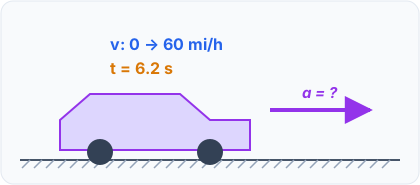
Problem: A car test reports that the car goes from rest to 60 mi/h in 6.2 s. Assuming constant acceleration, find (a) the acceleration in m/s² and (b) the acceleration as a multiple of standard gravity, \(g_0 = 9.80665\ \text{m/s}^2\).
Solve the problem, check your answers and follow the solution step by step.
ID: bgnph4rsb8
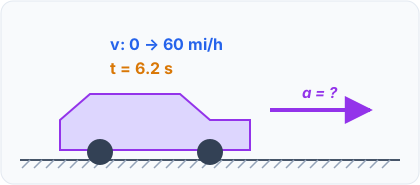
Problem: A car test reports that the car goes from rest to 60 mi/h in 6.2 s. Assuming constant acceleration, find (a) the acceleration in m/s² and (b) the acceleration as a multiple of standard gravity, \(g_0 = 9.80665\ \text{m/s}^2\).
Reference materials
What this problem relies on
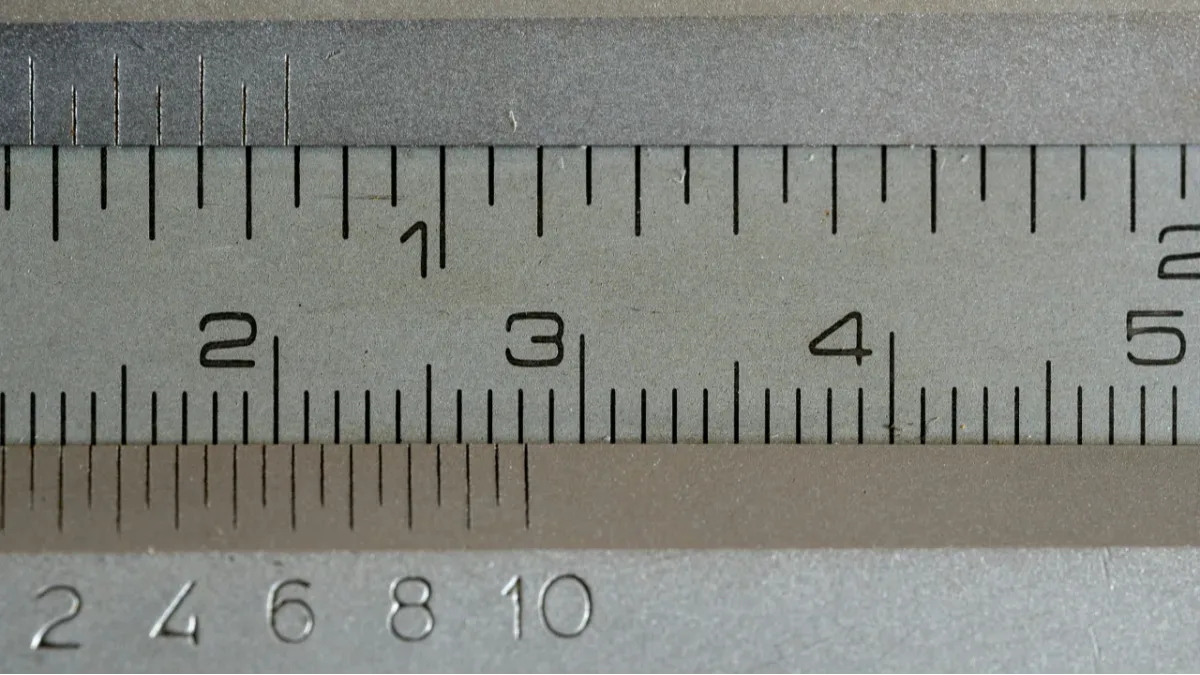
Convert any unit with ratios equal to 1: step-by-step examples from length to temperature, and full conversion tables for 12 engineering quantities.
Community members
Notes, problems and apps on the same topics
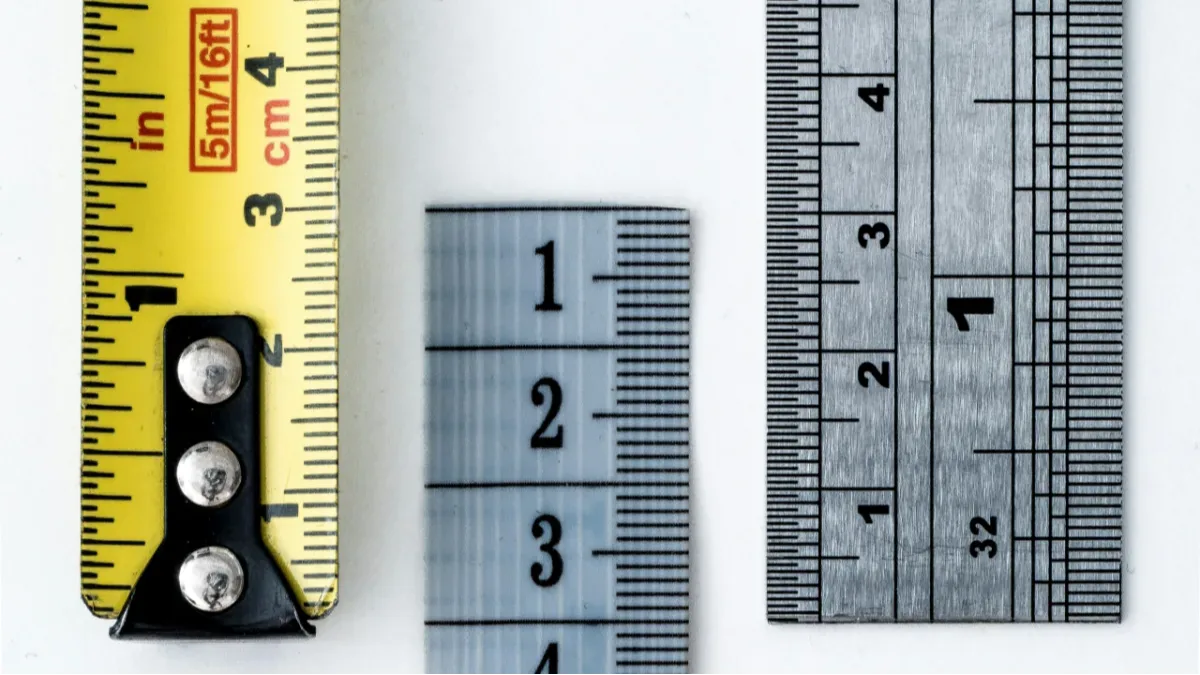
How force, mass and length units are linked by F = ma, how to convert between SI and U.S. units, and how to write SI quantities correctly.

Convert length, area, volume, force, stress, torque, speed, temperature, time, angle and moments of inertia between SI and U.S. units, with steps.
Editors can remove comments that break the rules.
Goes to the Hub 4 Mech Problem Team
About this problemCar Acceleration from 0–60 mi/h Time in m/s² and gLog in to send feedback, so the team can answer you.
Group it with other notes, problems and apps
Please log in to put content into sets.

Message text...
This action cannot be undone.
Choose how the printout looks

Read Online:
ID: bgnph4rsb8
H4M TeamChief Editor21 Nov 2026
A decentralized, interactive platform for engineering students.



Comments 0
Discuss the solution, ask for a hint or share another approach to this problem.
Join the discussion
Log in to comment, reply and vote.
No comments yet
Ask a question, share a tip or say thanks. Be the first!