


Unit Converter converts a value between SI, metric and U.S. Customary units for the quantities used in engineering mechanics: length, area, volume, force, stress and pressure, moment and torque, speed, rotational speed, temperature, temperature difference, time, angle and both moments of inertia. Pick a quantity from the picture grid (the arrow button at the end of the row shows the rest), type a number, and the result, the conversion steps and the value in every other unit appear at once.
1. What It Calculates
- The value in the unit you choose, updated while you type. You can also type into the result box; the conversion then runs the other way.
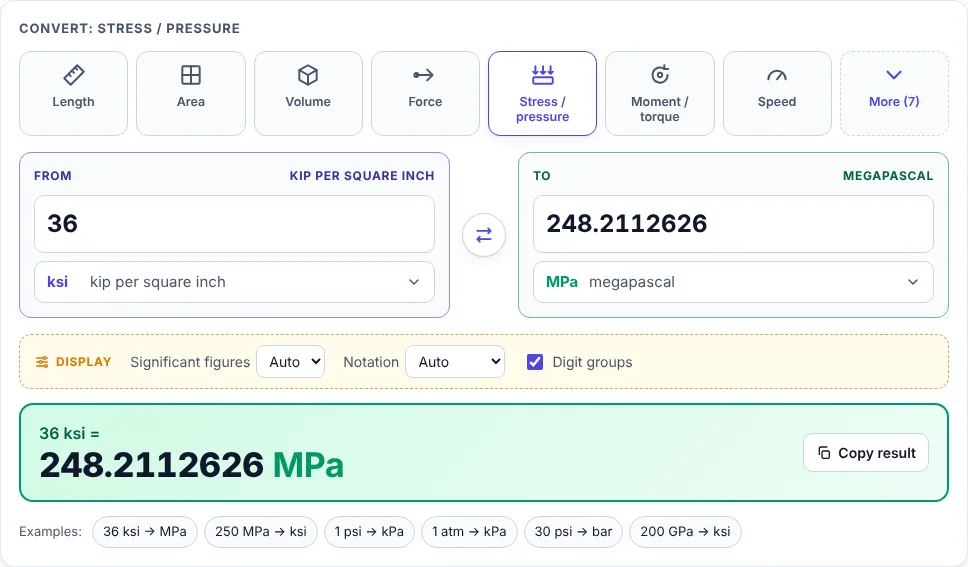
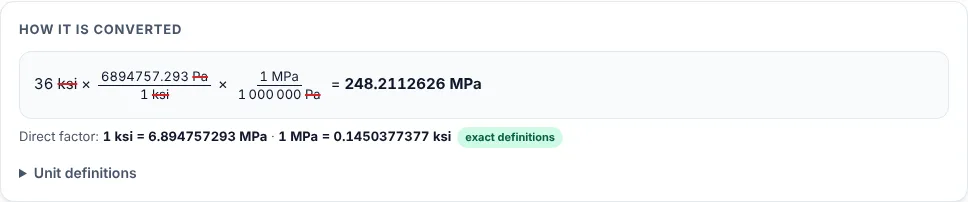
- The steps: the value is written in the SI unit of the quantity, then in the target unit, with each factor shown as a ratio equal to 1.
- The direct factor between the two units, for example 1 ksi = 6.894757 MPa.
- The same value in all units of the quantity, grouped as metric, U.S. Customary and other units. A click on a row makes it the target unit.
2. Formula
Every unit is stored by its size in the SI unit of its quantity, \(f\). A value \(x_1\) in unit 1 is converted through SI:
Temperature scales also have an offset, so they are converted with their own formulas, such as \(T_{\mathrm{K}} = T_{\mathrm{C}} + 273.15\) and \(T_{\mathrm{F}} = 1.8\,T_{\mathrm{C}} + 32\). A temperature difference has no offset: \(\Delta T = 1\ \text{K} = 1\ {}^{\circ}\text{C} = 1.8\ {}^{\circ}\text{F}\).
3. Worked Example
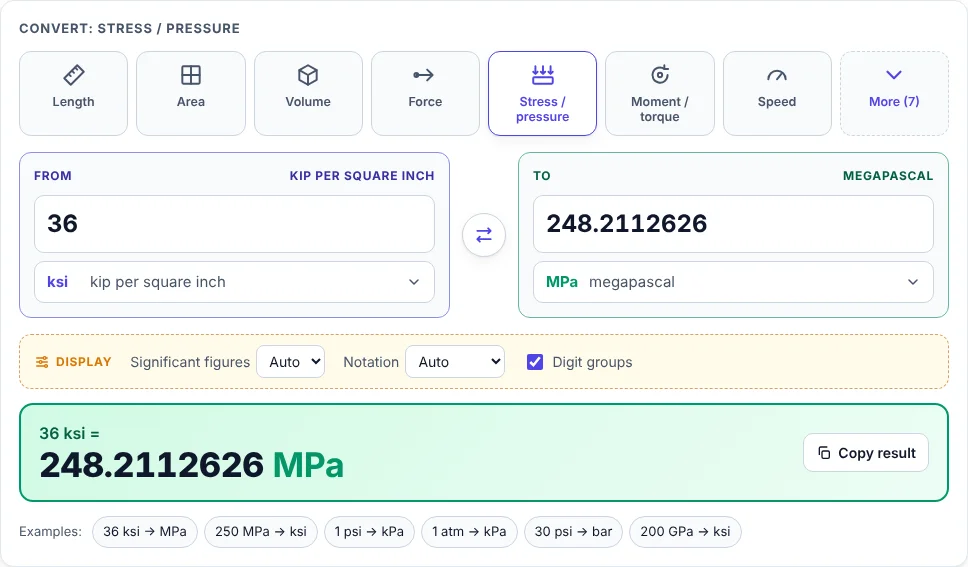
A U.S. data sheet gives the yield strength of a steel as 36 ksi. Choose Stress / pressure, type 36, choose ksi on the left and MPa on the right:
With Significant figures set to 3 the result reads 248 MPa. The list below gives the same stress as 248 N/mm², 36 000 psi and 2531 kgf/cm².
4. Assumptions and Limits
- All factors are exact by definition (1 in = 25.4 mm, 1 lb = 0.45359237 kg, standard gravity 9.80665 m/s²); factors with π are computed to full precision.
- Pound-force and kilogram-force are the weights of 1 lb and 1 kg under standard gravity. The kilogram and the pound mass are not force units and are not in the force list.
- Gauge and absolute pressures convert the same way; the converter never adds the atmospheric pressure.
- The area moment of inertia (m⁴) and the mass moment of inertia (kg·m²) are different quantities and cannot be converted into each other.
- Results are shown with up to 10 significant figures; round the final answer of a problem yourself, for example to three significant figures.
5. Units
145 units in 14 quantities, including mm, in, ft and ft + in; mm², ft², acre; L, U.S. and imperial gallon; N, kN, lbf, kip, kgf; Pa, kPa, MPa, psi, ksi, bar, atm, mmHg; N·m, lbf·ft, kip·ft; km/h, mi/h, knot, rpm; K, °C, °F, °R; s to years; degree, radian and degree-minute-second; mm⁴, in⁴; kg·m², slug·ft². Numbers can be typed as 12, 2.5, 3 1/2, 7/16 or 1.5e-3.
6. FAQ
Why does 20 °C not become 36 °F?
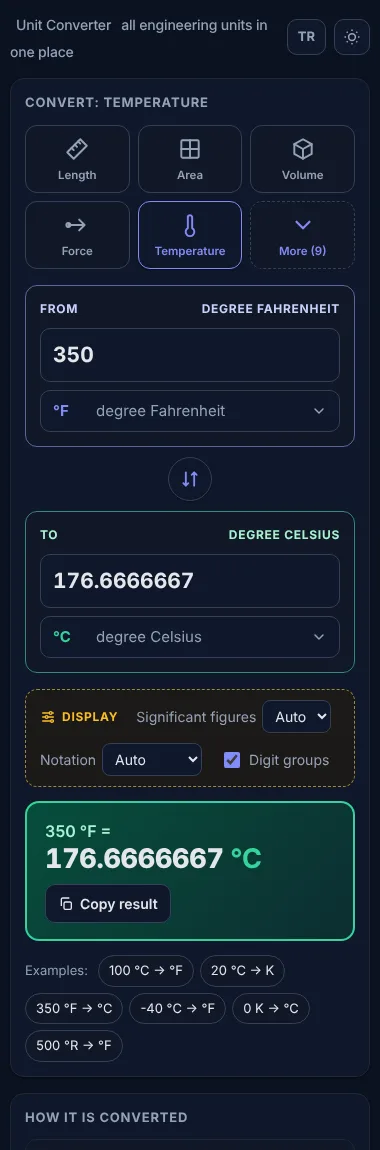
A temperature has an offset: 20 °C is 68 °F. Only a temperature change uses the plain factor, so a rise of 20 °C is a rise of 36 °F. Use the Temperature difference tab for changes.
Can I convert kilograms to newtons here?
No, because they are different quantities. A mass becomes a weight through \(W = mg\). The kilogram-force (kgf) in the force list is the weight of 1 kg under standard gravity, 9.80665 N.
Where do 5 ft 8 in go in?
In Length, choose feet + inches: two boxes appear, one for feet and one for inches. The list also shows any length to the nearest 1/16 in.
Does the converter remember my last values?
Yes. The last quantity, units, display options and theme are kept in your browser, so the converter opens where you left it. The language follows the site: the converter opens in English on the English page and in Turkish on the Turkish page; the EN/TR button switches it only while the page is open.




Comments 0
Ask how to use this app, report an issue or suggest an improvement.
Join the discussion
Log in to comment, reply and vote.
No comments yet
Ask a question, share a tip or say thanks. Be the first!